




Shape Memory Polymer Process Development
Superior two-dimensional filters can be fabricated easily via electrospinning.
This work introduces a simple technique of separately fabricating electrospun short fibers. This technique employs a paper mesh, which is placed between the needle tip and counter electrode of the electrospinning unit. Usability of this technique was examined by fabricating fine fibers consisting of different kinds of polymers.
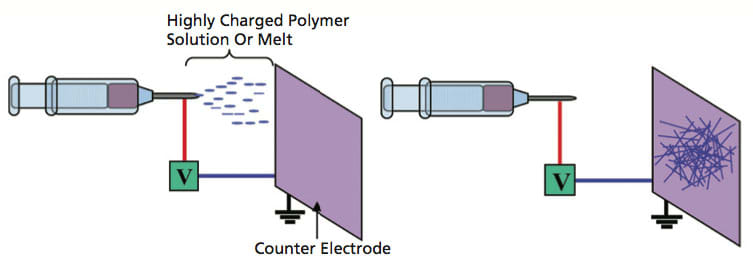
It was observed in the electrospinning that partially blocking the traveling path of the highly charged polymer between the needle tip and counter electrode with a cardboard frame resulted in the formation of fibers between the cardboard frame and the counter electrode vertically to the counter electrode. This phenomenon was employed for separately fabricating electrospun short fibers.
Two kinds of polymer solutions were prepared to be electro-spun: 2.5 g of polynorobornen (PN) was dissolved into 50 g of THF in the water bath at 70 °C. Once it was fully dissolved, it was cooled down to room temperature; 11.5g of polyvinyl acetate (PVAc) was dissolved into 100g of DMF in the water bath at 70 °C. Once it was fully dissolved, it was cooled down to room temperature.
Using the setup without a paper mesh, the electrospinning of PN and PVAc was carried out, where the voltage was ~10 kV and the gap between the needle tip and counter electrode was ~10 cm. The PN fibers were formed horizontally to the counter electrode surface and stuck together. These fibers could not be extracted separately. PVAc fibers were also formed on the counter electrode surface horizontally.
The highly charged polymer solution in the syringe was spewed out toward the counter electrode under the high voltage, where the voltage was ~10 kV and the gap between the needle tip and counter electrode was ~10 cm. It passed through the paper mesh, resulting in the formation of fine fibers separately between the paper mesh and counter electrode. Compared with PN fibers, the fiber diameter was quite large. Fiber diameter heavily depends on the condition of electrospinning such as voltage, gap between the needle tip and counter electrode, and the ratio of PN and solvent. Since it was difficult to precisely control the experimental condition, it was difficult to fabricate the same-diameter fibers. It was confirmed that the paper mesh method could be used for fabricating the PN fibers separately.
The formation process of the separately formed short fibers was considered. Fiber ingredient is spewed out from the needle tip, and it travels toward the paper mesh. It is trapped with the mesh and immediately it is stretched toward the counter electrode, resulting in the short fiber formation. Using a high-speed camera, the fiber formation process was analyzed. Once the voltage was applied between the syringe needle tip and counter electrode, the fiber ingredient was continuously supplied to the paper mesh. The polymer supply continued from beginning to end in this experiment. But fiber formation between the needle tip and counter electrode was not induced for a while, even after the start of the polymer supply at t=0 ms. Fiber formation suddenly started at t=40 ms. The fiber continued to grow and was completed at t=160 ms. During the fiber-growing process, the fiber initially kept on waving but gradually subsided to stillness.
The fiber formation was not a continuous process. First, the fiber ingredient accumulated on the paper mesh. Secondly, the fiber jet was suddenly spewed out from the paper mesh to the counter electrode, resulting in a fiber. Since there were a number of holes on the paper mesh, fiber formation was induced not only at one hole, but at multiple holes. Even though the supply of fiber ingredient continued at single position of paper mesh, the accumulated fiber ingredient flew to the multiple holes of the paper mesh, eventually resulting in the fiber formation from those multiple holes. A number of short fibers were formed between the multiple holes of paper mesh and the counter electrode.
This fiber fabrication technique was applicable for the fabrication of polymer-metal composite fibers, but it is important to use a highly volatile solvent for the preparation of the polymer ingredient to be electrospun. Otherwise, the fibers are not effectively formed separately.
This work was done by Hirohisa Tamagawa of Gifu University, Japan, for the Asian Office of Aerospace Research and Development. For more information, download the Technical Support Package (free white paper) at www.defensetechbriefs.com/tsp under the Manufacturing & Prototyping category. AFRL-0153
This Brief includes a Technical Support Package (TSP).

Shape Memory Polymer Process Development
(reference AFRL-0153) is currently available for download from the TSP library.
Don't have an account?
More From SAE Media Group
Tech Briefs
Precision CNT Cutting Mechanism
Tech Briefs
Automated Tow/Tape Placement System
Medical Design Briefs
Nontoxic, Flexible Energy Converters Could Power Wearable Devices

Tech Briefs
Fiber-Metal Laminate Manufacturing Technique
Tech Briefs
Miniscule Robots of Metal and Plastic
Medical Design Briefs
Elastomer Material Flexibility Optimizes Performance
Tech Briefs
A Novel Way to Convert Heat to Electricity

Tech Briefs
Process for Preparing Aerogels from Polyamides
Tech Briefs
Boosting Nanofiber Production
Medical Design Briefs
High-Power Electrostatic Actuators to Realize Artificial Muscles
Medical Design Briefs
Medical Plastics: Understanding Ultrasonic Welding, Part 1
Aerospace & Defense Tech Briefs
Development of a Novel Electrospinning System with Automated Positioning and Control Software
Tech Briefs
Method Sprays Extremely Thin Wires on 3D Objects
Automotive Engineering
Linking Embroidery and Carbon Fiber to save Weight and Cost
Tech Briefs
3D-Printed Device Produces Nanofiber Meshes
Tech Briefs
Self-Healing, Highly Adhesive Elastomers
Tech Briefs
Technology Remedies 3D Printing’s “Weak Spot”
Medical Design Briefs
Automated Production of Advanced Materials
Aerospace & Defense Tech Briefs
Streamlining Post-Processing in Additive Manufacturing
Automotive Engineering
Lighter, Recyclable Body Seal from Cooper Standard Wins SAA Award
Medical Design Briefs
Metal and Plastic Microrobots Interlock
Aerospace & Defense Tech Briefs
Unlocking the Potential of 3D-Printed Polymers in Aerospace and Defense
Medical Design Briefs
New Material Family Could Build Realistic Prosthetics
Overview
The document presents research on a novel technique for fabricating electro-spun short fibers, focusing on the challenges and solutions associated with the electrospinning process. Electrospinning is a highly efficient method for creating two-dimensional mats of fine fibers, which can be utilized in various applications, including advanced filters. However, a significant challenge in this technology is the tendency of electro-spun fibers to become entangled and stick together during formation, making it difficult to extract individual fibers.
To address this issue, the research introduces a simple technique that employs a paper mesh placed between the needle tip and the counter electrode of the electrospinning apparatus. This setup allows for the separate fabrication of electro-spun short fibers. The study examines the usability of this technique by fabricating fine fibers from different types of polymers, specifically polynorobornen (PN) and polyvinyl acetate (PVAc).
The document details the experimental setup and the formation process of the fibers. It describes how the polymer solution is ejected from the syringe needle and travels toward the counter electrode, where fibers are typically collected. By incorporating the paper mesh, the fibers are formed vertically, allowing for easier separation. The research also includes observations from high-speed camera analyses that capture the fiber formation process over time, illustrating how the fibers initially exhibit a waving motion before stabilizing.
The findings indicate that this technique not only facilitates the separate fabrication of fibers but is also applicable for creating polymer-metal composite fibers. The research emphasizes the importance of using highly volatile solvents in the preparation of the polymer solutions to ensure effective fiber formation.
In conclusion, the document highlights a significant advancement in the field of electrospinning, providing a straightforward method for producing individually formed fibers. This technique has the potential to broaden the range of applications for electro-spun fibers, making it a valuable contribution to materials science and engineering. The research underscores the ongoing challenges in fiber extraction and the innovative approaches being developed to overcome them.
Top Stories
NewsSensors/Data Acquisition
 Microvision Aquires Luminar, Plans Relationship Restoration, Multi-industry Push
INSIDERRF & Microwave Electronics
 A Next Generation Helmet System for Navy Pilots
INSIDERWeapons Systems
 New Raytheon and Lockheed Martin Agreements Expand Missile Defense Production
NewsAutomotive
 Ford Announces 48-Volt Architecture for Future Electric Truck
INSIDERAerospace
 Active Strake System Cuts Cruise Drag, Boosts Flight Efficiency
ArticlesTransportation

Webcasts
Aerospace
 Cooling a New Generation of Aerospace and Defense Embedded...
Energy
 Battery Abuse Testing: Pushing to Failure
Power
 A FREE Two-Day Event Dedicated to Connected Mobility
Automotive
 Quiet, Please: NVH Improvement Opportunities in the Early Design Cycle
Electronics & Computers
 Advantages of Smart Power Distribution Unit Design for Automotive &...
Unmanned Systems
 Sesame Solar's Nanogrid Tech Promises Major Gains in Drone Endurance