




Fluid Helmet Liner for Protection Against Blast-Induced Traumatic Brain Injury
This liner can be used to mitigate shock waves that cause traumatic brain injuries such as blast-induced trauma.
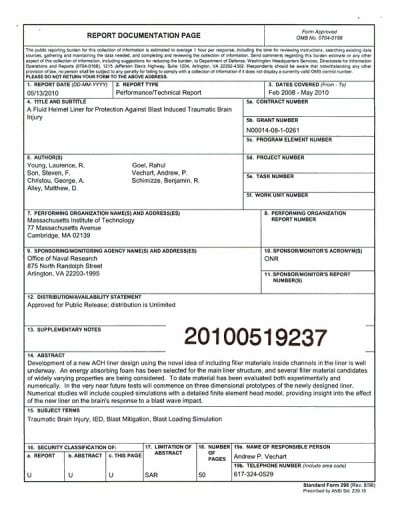
An Advanced Combat Helmet liner design uses the novel idea of including filler materials inside channels in the liner. An energy-absorbing foam was selected for the main liner structure, and several filler material candidates of widely varying properties are being considered. To date, material has been evaluated both experimentally and numerically. Numerical studies will include coupled simulations with a detailed finite element head model, providing insight into the effect of the new liner on the brain’s response to a blast wave impact.
To design and test the liner, experimental and computational techniques were used. To isolate effects of material properties on the transmitted blast wave characteristics, experiments first were carried out on “flat plate” samples. Essentially, this amounts to a rectangular sandwich consisting of layers of foam and filler material. Filler materials being considered include aerogel, glycerin, water, glass beads, and Volcanic Tuff.
The physical modeling aspect of the study was accomplished by varying surrogate materials, geometric configuration, and blast loading conditions in order to determine the measurable behavior variations. Quantitative results were obtained through pressure, acceleration, strain, and displacement measurements. These results suggested large initial amplification of pressures at anterior locations near the shell/gel interface. Material property effects and geometric features effects were seen by larger responses with the material of lower stiffness and more severe responses with the facial-feature shell models over the solid shell models.
Extreme accelerations were experienced with oscillatory behavior over the duration of the blast. In addition, significant relative displacement was observed between the shell and the gel material suggesting large strain values. Further quantitative results were obtained through shadowgraph imaging of the blast scenarios. The shadowgraph imaging confirmed the approximation that global movement of the target was minimal during the blast on a different time scale. The complete results then provided a means of comparison to actual measured behavior from surrogate models to injury mechanisms in computational and clinical trials. Furthermore, the data obtained can be used in computational validation.
The blast mitigation aspect of the study was accomplished by applying blast loading conditions to the various materials. Composite structures were constructed using various filler materials that varied density, porosity, viscosity, and particle size. Quantitative results were then obtained by measuring transmitted wave profiles behind the respective samples and comparing to free-field loading conditions. Attenuation effectiveness was then determined by the reduction of blast profile characteristics (peak overpressure, pulse duration, and impulse). The results of these experiments showed that lower-density, porous materials caused blast profile resembling scaled air blasts. Specifically, shorter wave front rise times and negative overpressure values were observed. The higher-density materials exhibited the greatest attenuation by lowering the overall peak pressure, lengthening the duration, and slowing the rise to peak amplitude.
This resulted in lower overall impulse values. Furthermore, significant frequency distribution was observed, surpassing the effectiveness of the solid foam control sample and the lower-density materials.
This work was done by Laurence R. Young, Steven F. Son, George A. Christou, Matthew D. Alley, Rahul Goel, Andrew P. Vechart, and Benjamin R. Schimizze of the Massachusetts Institute of Technology for the Office of Naval Research. For more information, download the Technical Support Package (free white paper) at www.defensetechbriefs.com/tsp under the Physical Sciences category. ONR-0018
This Brief includes a Technical Support Package (TSP).
Fluid Helmet Liner for Protection Against Blast-Induced Traumatic Brain Injury
(reference ONR-0018) is currently available for download from the TSP library.
Don't have an account?
More From SAE Media Group
Tech Briefs
Cryogenic Flux Capacitor
Aerospace & Defense Tech Briefs
Multifunctional Vehicle Structural Health Monitoring with Piezoelectric Wafer Active Sensors
Photonics & Imaging Technology
Leveraging CAD for Precision in Wide Field Star Imaging and Spectroscopy
Aerospace & Defense Tech Briefs
Localization of Head-Mounted Vibrotactile Transducers

Motion Design INSIDER
Friction That Cools
Tech Briefs
A Color-Based Sensor Emulates Skin’s Sensitivity
Photonics & Imaging Technology
Large Format Windows: From Material to Mission
Photonics & Imaging Technology
The Latest Advancements in Optics
Tech Briefs
Octopus-Inspired Tech Can Operate Underwater
Tech Briefs
Victim Simulator for Victim Detection Radar


Aerospace & Defense Tech Briefs
Forehead-Mounted Sensor Measures Oxygen Saturation for Hypoxia Early Detection and Warning


Aerospace & Defense Tech Briefs
Scientists Fuse Simulations and Machine Learning to Accelerate Novel Additively Manufactured Materials
Motion Design INSIDER
First Toroidal Micro-Robot to Swim Autonomously in Viscous Liquids
Aerospace & Defense Tech Briefs
A New Look at Ignition: Refining Our Understanding of Combustion Dynamics in Gun Chambers

Aerospace & Defense Tech Briefs
Circuit Models for Robust, Adaptive Neural Control
Tech Briefs
Microscale Thermal-Transpiration Gas Pump
Tech Briefs
PGUOM Can Block Noise Without Blocking Air
Overview
The document is a performance/technical report detailing a project focused on developing a fluid helmet liner aimed at protecting against blast-induced traumatic brain injury. Conducted by Laurence R. Young and his team at the Massachusetts Institute of Technology, the project spans from February 2008 to May 2010.
The report begins with an abstract summarizing the project's objectives, which include the exploration of energy-absorbing materials and the evaluation of various filler candidates to enhance the protective capabilities of helmets. The introduction sets the context for the research, highlighting the significance of addressing traumatic brain injuries, particularly in military and high-risk environments.
The document is structured into several key sections. The literature survey reviews existing research on helmet design and materials, emphasizing the need for improved protective solutions. The experimental section details the methods used to test different filler materials, including both old and new experimental setups. Results from these experiments indicate that high-density materials significantly reduce peak transmitted overpressure and pressure gradients, while also extending the duration of the positive phase of the transmitted wave. This leads to lower overall impulse values and improved frequency distribution, suggesting that these materials could enhance helmet performance.
A numerical modeling section follows, where the validation of shock wave propagation and material modeling are discussed. The model description includes geometry, boundary conditions, mesh, and material assignments, providing a comprehensive overview of the computational approach taken to simulate the helmet's performance under blast conditions.
The results and discussion sections present findings from both experimental and numerical analyses, highlighting the effectiveness of the proposed helmet liner design. Conclusions drawn from the research emphasize the potential for these innovations to significantly reduce the risk of traumatic brain injuries in blast scenarios.
The report also outlines future directions for the project, including plans for testing three-dimensional prototypes to further validate the findings. The document concludes with a list of references, appendices, and tables that support the research conducted.
Overall, this report serves as a detailed account of the efforts to improve helmet safety through innovative material use and advanced modeling techniques, aiming to provide better protection for individuals exposed to explosive blasts.
Top Stories
INSIDERManufacturing & Prototyping
 How Airbus is Using w-DED to 3D Print Larger Titanium Airplane Parts
NewsAutomotive
 Microvision Aquires Luminar, Plans Relationship Restoration, Multi-industry Push
INSIDERAerospace
 A Next Generation Helmet System for Navy Pilots
INSIDERDesign
 New Raytheon and Lockheed Martin Agreements Expand Missile Defense Production
ArticlesAR/AI
 CES 2026: Bosch is Ready to Bring AI to Your (Likely ICE-powered) Vehicle
Road ReadyDesign

Webcasts
Semiconductors & ICs
 Advantages of Smart Power Distribution Unit Design for Automotive...
Unmanned Systems
 Quiet, Please: NVH Improvement Opportunities in the Early Design...
Electronics & Computers
 Cooling a New Generation of Aerospace and Defense Embedded...
Power
 Battery Abuse Testing: Pushing to Failure
AR/AI
 A FREE Two-Day Event Dedicated to Connected Mobility
