




Power Enhancement of a Rubidium Vapor Laser with a Master Oscillator Power Amplifier
Power enhancement of an alkali laser is achieved using an amplifier.
The concept of alkali lasers was first suggested by Schalow and Townes in the late 1950s. In the 1970s, photo-dissociation of several of the alkali salts produced lasers with wavelengths ranging from the visible to the far infrared. Thirty years later, diode-pumped alkali lasers (DPAL) started rapidly gaining attention as highly efficient lasers as well as brightness converters. These systems partly owe their high efficiencies to the very small energy differences between the pump and lasing levels. Due to recent technological advances in the field of solid-state lasers, direct-diode pumping has provided the efficient, yet compact method for excitation. To date, to increase the power of alkali laser systems, higher intensity pumping of the gain medium has been used. However, there is a critical limit that can be achieved on these smaller scale systems due to decomposition of the gain medium due to excess thermal loading. One way to mitigate this problem is to use an amplifier or an amplifier chain. As demonstrated with solid-state lasers, this is a possible way to increase system power loading while alleviating the thermal management issues of the laser by spreading the heat out over several pieces of gain medium.
A master oscillator power amplifier (MOPA) with variable amplifier gain lengths was built to demonstrate power enhancement of an alkali vapor laser. A maximum intensity of ~25W/cm2 of 795-nm oscillator light was used. The maximum extraction efficiency (power extracted/power in) for the amplifier experiments was 14%. This is lower than the 54% optical-to-optical efficiency that was achieved when all the radiation was directed into the oscillator. This result is not unexpected because the intensity of the master oscillator was purposely left low as to not cause saturation of the amplifier.
Power enhancement of a DPAL system utilizing an amplifier has been demonstrated. Relatively high gains with small gain lengths have been achieved. A small signal gain of 0.91/cm for two different gain lengths was observed. For a 2-cm-long amplifier gain length, an amplification of 7.9 dB was observed. More importantly, the gain is not so high as to have parasitics, such as amplified spontaneous emission, become detrimental to laser performance.
This work was done by David A. Hostutler and Wade L. Klennert of the Air Force Research Laboratory. For more information, download the Technical Support Package (free white paper) at www.defensetechbriefs.com/tsp under the Photonics category. AFRL-0148
This Brief includes a Technical Support Package (TSP).
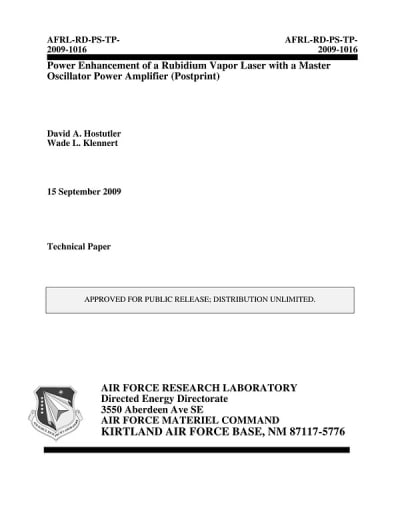
Power Enhancement of a Rubidium Vapor Laser with a Master Oscillator Power Amplifier
(reference AFRL-0148) is currently available for download from the TSP library.
Don't have an account?
More From SAE Media Group
Tech Briefs
Free-Space Fiber Optic Laser Rod
Photonics & Imaging Technology
Tiny Terahertz Laser for Imaging and Chemical Detection
Aerospace & Defense Tech Briefs
Integration of Adaptive Optics Into High-Energy Laser Modeling And Simulation
Aerospace & Defense Tech Briefs
Terahertz Fiber-Optic Lasers for Detection of Explosives
Photonics Tech Briefs
Fiber-Coupled Microsphere Laser at Wavelength of 1.55 µm
Aerospace & Defense Tech Briefs
Development of Photoacoustic Sensing Platforms
Photonics Tech Briefs
Pulsed Laser System to Simulate Effects of Cosmic Rays in Semiconductor Devices
Photonics Tech Briefs
Terahertz Quantum Cascade Laser With Efficient Coupling and Beam Profile
Aerospace & Defense Tech Briefs
On the Pulsed Laser Ablation of Metals and Semiconductors
Photonics & Imaging Technology
Creating High-Precision Glass for NIR Lasers

Photonics & Imaging Technology
Ultrafast Beam-Steering Breakthrough at Sandia Labs


Aerospace & Defense Tech Briefs
Room-Temperature Sub-Diffraction-Limited Plasmon Laser

Photonics & Imaging Technology
A Laser That Could Reshape the Landscape of Integrated Photonics
Photonics & Imaging Technology
A First-Of-Its-Kind Integrated Optical Isolator
Photonics & Imaging Technology
Sussex Researchers Combine Lasers, Computers & THz Waves to Build Camera That Sees ‘Unseen’ Details
Tech Briefs
Visible-Light Lasers That Fit on a Fingertip
Tech Briefs
Low-Energy Nanolaser Shines in all Directions
Aerospace & Defense Tech Briefs
Compact Megawatt Infrared Free-Electron Laser Amplifier
Tech Briefs
High-Power, Portable Terahertz Laser
Aerospace & Defense Tech Briefs
High-Power Broadband Multispectral Source on a Hybrid Silicon Chip
Photonics & Imaging Technology
Using Magnets to Toggle Nanolasers Leads to Better Photonics
Tech Briefs
Nanoscale LED Also Functions as a Laser
Tech Briefs
Sensitive Optical Receivers for Space
Photonics & Imaging Technology
Ultra-Narrowband Optical Filters Pushing Boundaries from the UV to the LWIR
Photonics & Imaging Technology INSIDER
Upconverting Nanolasers from Subwavelength Plasmons
Overview
The document titled "Power Enhancement of a Rubidium Vapor Laser with a Master Oscillator Power Amplifier" by David A. Hostutler and Wade L. Klennert presents research on improving the power output of rubidium (Rb) vapor lasers using a Master Oscillator Power Amplifier (MOPA) configuration. Conducted by the Air Force Research Laboratory, the study aims to enhance the efficiency and performance of diode-pumped alkali lasers (DPALs), which are known for their high radiance and potential applications in directed energy systems.
The paper begins by discussing the background of DPAL technology, highlighting previous advancements in the field, including the use of multimode diode arrays and the development of Rb and cesium (Cs) lasers. It notes that while higher intensity pumping can increase power, it also poses challenges such as thermal loading and gain medium decomposition. To address these issues, the authors propose the use of an amplifier or amplifier chain to distribute thermal load and enhance overall system power.
The experimental setup involved a Ti:Sapphire laser that provided the necessary pump light for the Rb vapor laser. The authors describe the configuration of the oscillator and amplifier, detailing the use of a curved high reflector and a flat output coupler to create an effective lasing environment. The gain medium consisted of a vapor cell containing Rb metal and ethane, with the number density of Rb controlled by temperature.
Results from the experiments demonstrated a small signal gain of 0.91 cm⁻¹ for two different amplifier gain lengths, with a notable amplification of 7.9 dB observed for a 2 cm long gain length. The experiments also measured the intensity of the output light, showing that the MOPA configuration successfully enhanced the power output of the Rb vapor laser.
The conclusions drawn from the study emphasize the effectiveness of the MOPA approach in achieving significant power enhancement without introducing detrimental effects such as amplified spontaneous emission. The authors acknowledge the support received during the research and highlight the potential implications of their findings for future developments in laser technology.
Overall, this document contributes valuable insights into the optimization of alkali vapor lasers, paving the way for advancements in high-energy laser systems and their applications in various fields.
Top Stories
INSIDERDesign
 How Airbus is Using w-DED to 3D Print Larger Titanium Airplane Parts
NewsSensors/Data Acquisition
 Microvision Aquires Luminar, Plans Relationship Restoration, Multi-industry Push
INSIDERManned Systems
 A Next Generation Helmet System for Navy Pilots
NewsAR/AI
 Accelerating Down the Road to Autonomy
INSIDERDefense
 New Raytheon and Lockheed Martin Agreements Expand Missile Defense Production
ArticlesAR/AI
 CES 2026: Bosch is Ready to Bring AI to Your (Likely ICE-powered) Vehicle
Webcasts
Semiconductors & ICs
 Advantages of Smart Power Distribution Unit Design for Automotive...
Unmanned Systems
 Quiet, Please: NVH Improvement Opportunities in the Early Design...
Electronics & Computers
 Cooling a New Generation of Aerospace and Defense Embedded...
Automotive
 Battery Abuse Testing: Pushing to Failure
Transportation
 A FREE Two-Day Event Dedicated to Connected Mobility
