




Reducing Thicknesses of PbZrₓTi₁₋ₓO₃ Films in Capacitors
A document describes experiments performed to determine effects of reducing the thicknesses of films of lead zirconate titanate (PbZrxTi1-xO3, wherein 0<x<1) used as ferroelectric dielectric layers in some capacitors. The fabrication of specimen capacitors for the experiments involved numerous steps, including spin-coating of PbZrxTi1-xO3-precursor sol-gel solutions onto bottom Pt electrode layers on silicon substrates, heat treatments to covert the sol-gel coats to PbZrxTi1-xO3, and deposition of top Pt electrode layers on the PbZrxTi1-xO3 layers. Various spin rates and solution compositions were used to obtain various PbZrxTi1-xO3- film thicknesses and compositions. Current responses of specimens to applied voltage waveforms were measured to characterize the specimens in terms of capacitance, hysteresis, and polarization. It was concluded that thicknesses of PbZrxTi1-xO3 films could be reduced to between 1,800 and 2,200 A while retaining ferroelectric performance adequate for a proposed development in which nanoelectromechanical switches containing PbZrxTi1-xO3 films would be integrated with complementary metal oxide/semiconductor transistors. One of the sol-gel solutions, characterized by x = 0.45 and a molarity of 0.367, was found to be the most promising for further work to improve performance at thicknesses < 1,800 A.
This work was done by Vikram Rao and Ronald G. Polcawich of the Army Research Laboratory. ARL-0035
This Brief includes a Technical Support Package (TSP).
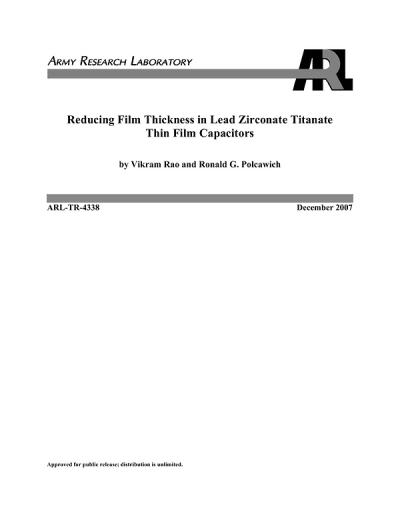
Reducing Thicknesses of PbZrxTi1-xO3 Films in Capacit
(reference ARL-0035) is currently available for download from the TSP library.
Don't have an account?
More From SAE Media Group

Electronics & Sensors INSIDER
MIT Engineers Grow “High-Rise” 3D Chips
Tech Briefs
Large-Area Vacuum Ultraviolet Sensors
Electronics & Sensors INSIDER
This Advance May Enable 2D Transistors for Tinier Microchip Components
Electronics & Sensors INSIDER
New Material Will Make Locally Flexible Diodes Possible
Electronics & Sensors INSIDER
Tiny But Mighty: Next-Gen Transistors Hold Great Promise
Tech Briefs
Better Microelectronics from Coal
Tech Briefs
Microfabricated Ice Sensors

Electronics & Sensors INSIDER
A New Magnetic Transistor for More Energy-Efficient Electronics
Motion Design INSIDER
New Transfer Process Moves 2D Materials from Growth Substrate to Device Substrate
Electronics & Sensors INSIDER
Researchers Create First Functional Semiconductor Made from Graphene
Electronics & Sensors INSIDER
Scientists Create Superconducting Semiconductor Material
Electronics & Sensors INSIDER
Novel Approach to Advanced Electronics and Data Storage with Ferroelectricity

Battery & Electrification Technology
Enhancing the Performance of All-Solid-State Batteries
Power Electronics INSIDER
Improved GaN-Based Semiconductor Devices for Power Electronics

Electronics & Sensors INSIDER
Atomic Scale Semiconductor Chips — Pushing the Limits

Electronics & Sensors INSIDER
New Cooling Technique Could Make Computer Chips More Powerful
Electronics & Sensors INSIDER
Growing a 2D Functional Transistor on a Silicon Wafer
Electronics & Sensors INSIDER
The World’s First Wood Transistor

Aerospace & Defense Tech Briefs
Detector Module for Testing Silicon Carbide Semiconductor Devices

Photonics Tech Briefs
Multiple-Event, Single-Photon Counting Imaging Sensor
Overview
The document titled "Reducing Film Thickness in Lead Zirconate Titanate Thin Film Capacitors," authored by Vikram Rao and Ronald G. Polcawich, presents research conducted by the U.S. Army Research Laboratory, focusing on the optimization of lead zirconate titanate (PZT) thin film capacitors. Published in December 2007, the report details the motivation behind the study, the experimental methods employed, and the results obtained.
The introduction highlights the significance of PZT due to its ferroelectric properties, which make it a valuable material for capacitors used in various electronic applications, including sensors and actuators. The authors emphasize the need for reducing film thickness to improve the performance and efficiency of these capacitors, as thinner films can lead to enhanced electrical characteristics and reduced material usage.
The experimental section outlines the sample preparation techniques, the tests conducted, and the equipment used. It includes detailed procedures for dielectric and ferroelectric testing, as well as the sol-gel method for creating PZT solutions. The report also discusses the calculations performed to analyze the data obtained from the experiments.
Results and discussions are presented, focusing on the impact of film thickness on the dielectric and ferroelectric properties of the capacitors. The findings indicate that optimizing the thickness can significantly enhance the performance metrics of the capacitors, such as capacitance and energy density. The report includes specific tests, such as thickness tests and spin rate tests, which provide insights into the relationship between film thickness and the resulting electrical properties.
In conclusion, the document summarizes the key findings and their implications for future research and applications in the field of thin film capacitors. The authors suggest that further exploration of film thickness reduction techniques could lead to advancements in capacitor technology, ultimately benefiting various electronic systems.
Overall, this report serves as a comprehensive resource for researchers and engineers interested in the development of high-performance PZT thin film capacitors, offering valuable insights into the methodologies and results of the study. The research contributes to the ongoing efforts to enhance the functionality and efficiency of electronic devices through improved material properties.
Top Stories
INSIDERManufacturing & Prototyping
 How Airbus is Using w-DED to 3D Print Larger Titanium Airplane Parts
INSIDERManned Systems
 FAA to Replace Aging Network of Ground-Based Radars
NewsTransportation
 CES 2026: Bosch is Ready to Bring AI to Your (Likely ICE-powered) Vehicle
NewsSoftware
 Accelerating Down the Road to Autonomy
EditorialDesign
 DarkSky One Wants to Make the World a Darker Place
INSIDERMaterials
 Can This Self-Healing Composite Make Airplane and Spacecraft Components Last...
Webcasts
Defense
 How Sift's Unified Observability Platform Accelerates Drone Innovation
Automotive
 E/E Architecture Redefined: Building Smarter, Safer, and Scalable...
Power
 Hydrogen Engines Are Heating Up for Heavy Duty
Electronics & Computers
 Advantages of Smart Power Distribution Unit Design for Automotive...
Unmanned Systems
 Quiet, Please: NVH Improvement Opportunities in the Early Design...
