




A Cleaner, Scalable Process to Recycle Lithium-Ion Batteries
In a major step forward for sustainable energy technology, researchers have developed a new, scalable method to recycle lithium-ion batteries in a way that is both efficient and environmentally friendly.
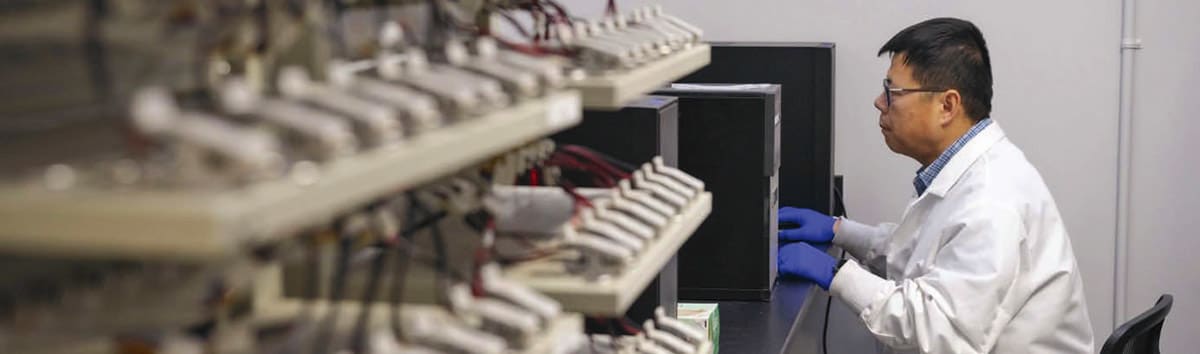
In a major step forward for sustainable energy technology, researchers at Worcester Polytechnic Institute (WPI), led by Professor Yan Wang, William B. Smith Professor of Mechanical and Materials Engineering, have developed a new, scalable method to recycle lithium-ion batteries in a way that is both efficient and environmentally friendly.
The team’s research, titled Upcycling Mixed Spent Ni-Lean Cathodes into Ni-Rich Polycrystalline Cathodes, was recently published in Energy Storage Materials, a multidisciplinary peer-reviewed journal focused on the topics of materials and energy. The paper details an innovative hydrometallurgical upcycling approach that offers both environmental and performance advantages over traditional recycling methods.
The process specifically targets spent mixed nickel-lean (Ni-lean) cathode materials, which are commonly found in used lithium-ion batteries. Traditional recycling methods struggle to recover these materials effectively and often rely on energy-intensive processes that produce lower-value outputs. In contrast, Wang’s approach recovers more than 92 percent of critical metals — nickel, cobalt, and manganese — and turns them into high-performance cathode powders.
Testing shows that batteries made with these recycled materials perform on par with those made from virgin materials, retaining 88 percent of their capacity after 500 charge cycles and over 85 percent capacity after 900 cycles in commercial-scale pouch cells. The new process also uses 8.6 percent less energy than conventional hydrometallurgical methods and significantly reduces carbon emissions — by 13.9 percent when compared with traditional recycling, slightly more than with direct upcycling.
“This work not only addresses the environmental challenges of battery waste but also helps reduce our dependence on mining for critical materials,” said Wang. “We’ve shown that it’s possible to create high-performance batteries from recycled materials at scale, which is essential for building a more sustainable and resilient battery supply chain.”
This innovation directly tackles two major challenges: the growing volume of battery waste and the global demand for critical materials used in electric vehicles and other clean energy technologies. With industry and policymakers focused on sustainable solutions, this advancement could play a key role in building a more circular and climate-conscious battery economy.
For more information, contact Professor Yan Wang at 508-831-5000x5453.
More From SAE Media Group
Battery & Electrification Technology
Solving the Battery Recycling Challenge
Battery & Electrification Technology
Developing Advanced Recycling Technology to Restore Spent Battery Cathode Materials
Tech Briefs
Dry Manufacturing Process for EV Batteries
Battery & Electrification Technology
Recyclable ‘Water Batteries’ That Won’t Catch Fire
Tech Briefs
Making EV Batteries More Sustainable

Battery & Electrification Technology
New Cathode Material for Sodium-Ion Batteries
Battery & Electrification Technology
Upcycling Commercial Fleets into Circular EVs
Battery & Electrification Technology
Built-In Smart Sensors Can Prevent Lithium-Ion Battery Fires Before They Start
Battery & Electrification Technology
A Path to Safer, High-Energy Electric Vehicle Batteries
Green Design & Manufacturing INSIDER
Enhanced Lithium Ion Battery Abuse Testing Laboratory

Battery & Electrification Technology
Cobalt-Free Electrodes Achieved with Nickel Ions
Battery & Electrification Technology
Cobalt-Free Batteries Could Power EVs of the Future
Battery & Electrification Technology
Eco-Friendly Upcycling: Turning Spent Batteries into High-Voltage Energy Storage Systems
Battery & Electrification Technology
New Technique for Environmentally Friendly Battery Recycling
Battery & Electrification Technology
Batteries and Recycling: The Next Frontier
Power Electronics INSIDER
World’s Strongest Battery Paves Way for Light, Energy-Efficient Vehicles
Tech Briefs
A Green Li-ion Battery-Recycling Method


Battery & Electrification Technology
Control Valves: Essential Components for EV Battery Manufacturing and Recycling
Battery & Electrification Technology
A Triple-Layer Battery Resistant to Fire and Explosion


Battery & Electrification Technology
Advancing High-Energy-Density Devices
Battery Technology
Metal-Free, Recyclable Polypeptide Battery Degrades on Demand
Tech Briefs
Turning Coal Waste into a Resource for Clean EVs
Top Stories
NewsSensors/Data Acquisition
 Microvision Aquires Luminar, Plans Relationship Restoration, Multi-industry Push
INSIDERRF & Microwave Electronics
 A Next Generation Helmet System for Navy Pilots
INSIDERWeapons Systems
 New Raytheon and Lockheed Martin Agreements Expand Missile Defense Production
NewsAutomotive
 Ford Announces 48-Volt Architecture for Future Electric Truck
INSIDERAerospace
 Active Strake System Cuts Cruise Drag, Boosts Flight Efficiency
ArticlesTransportation

Webcasts
Aerospace
 Cooling a New Generation of Aerospace and Defense Embedded...
Energy
 Battery Abuse Testing: Pushing to Failure
Power
 A FREE Two-Day Event Dedicated to Connected Mobility
Automotive
 Quiet, Please: NVH Improvement Opportunities in the Early Design Cycle
Electronics & Computers
 Advantages of Smart Power Distribution Unit Design for Automotive &...
Unmanned Systems
 Sesame Solar's Nanogrid Tech Promises Major Gains in Drone Endurance