




Polypeptide-Based Molecular Electronics
Self-assembled supramolecules can form molecular devices such as diodes and sensors.
Polypeptide supramolecules that will self assemble from solution and will form molecular wires that exploit quantum mechanical transport mechanisms can enable the formation of molecular devices such as transistors, diodes, and sensors. The peptides were designed and then arranged on substrates using self-assembly, Dip-PEN nanolithography, and e-beam assisted lithography. The peptides were characterized using atomic force microscopy (AFM) and the electrical properties of the self-assembled interconnects are characterized as well. These peptides can be nanoengineered/nanoassembled individual building blocks at the molecular level to form conducting channels towards realization of molecular MOSFETs/CMOS device technology.
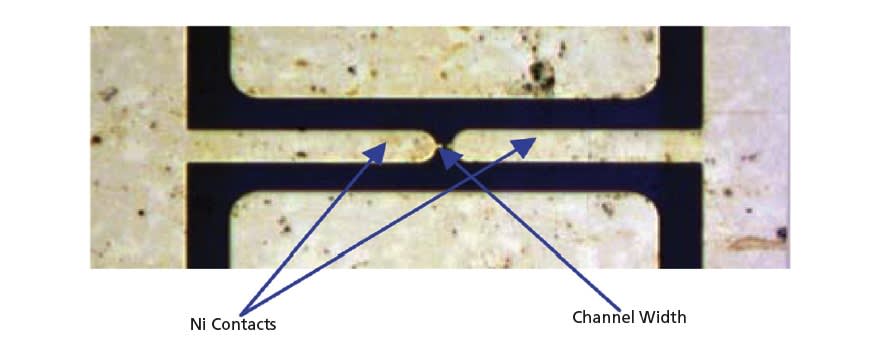
The polypeptide is composed of an amino acid chain comprised of Alanine, Glycine, Phenylalanine (Phe), and Cysteine (Cys). The attachment to poly peptide via polyhistidine side groups was carried out, as it gives a very good ohmic contact with metals such as nickel, which was selected as the electrode surface to allow covalent attachment of the polypeptide functional end moieties.
A series of polypeptides at different concentrations was prepared. The peptides have 256 repeats, which correspond to channel length of about 3-5 microns). Atomic force microscopy surface topography measurements of self-assembled polypeptide nanostructures was carried out using BioScope II to document the surface roughness, determine polypeptide domain structure, and evaluate lamellae assembly.
Electrical measurements of synthesized polypeptides were carried out using scanning tunneling microscopy. Peptides were synthesized in between two terminal electrodes made of nickel. The polypeptide-based molecular quantum crystal wires are a candidate building block of synthesized peptides between the two-terminal device and direction of current flow. One end of the electrode was grounded and an STM conducting probe was placed on the other end of the electrode.
The molecular interconnects will be able to form part of the building blocks for portable devices. The peptides can be designed to have specific affinity to the substrate and can contain moieties that can be organized to serve as conducting channels. Self-assembled peptides have shown conducting characteristics. Both soft e-beam lithography and DIP-PEN method are also suitable for patterning for polypeptides.
This work was done by Yeng Ming Lam, Mhaisalkar Subodh, and Lain-Jong Li of Nanyang Technological University, Singapore; Vinayak P. Dravid and Dr. Gajendra S. Shekhawat of Northwestern University; and Dr. C. Raman Suri of the Institute of Microbial Technology, India. AFRL-0119
This Brief includes a Technical Support Package (TSP).
Polypeptide-Based Molecular Electronics
(reference AFRL-0119) is currently available for download from the TSP library.
Don't have an account?
More From SAE Media Group

Aerospace & Defense Tech Briefs
Dense Functionalized-Nanowire Biosensor Arrays
Tech Briefs
Smart Molecules Act as Computer Transistors
Photonics & Imaging Technology
Individual Quantum Dots Imaged in 3-D for the First Time




Embedded Technology INSIDER
Newly Discovered Property Could Help Keep Computer Chips Cool
Tech Briefs
Stable Polymeric Ink with High Conductivity
Photonics & Imaging Technology
Measuring Surface Roughness with an Atomic Force Microscope



Tech Briefs
Single-Atom Transistors
Aerospace & Defense Tech Briefs
Fabrication and Electrical Characterization of Correlated Oxide Field Effect Switching Devices for High Speed Electronics
Aerospace & Defense Tech Briefs
Reconfigurable Electronics and Non-Volatile Memory Research
Embedded Technology INSIDER
Could Black Phosphorus be the Next Silicon?
Tech Briefs
T-Shaped Emitter Metal Structures for HBTs
Battery Technology
Sustainable Aluminum-Anode Batteries
Tech Briefs
Platform for All-Optical Computing
Medical Design Briefs
Artificial Muscle Device Produces Force 34 Times Its Weight
Tech Briefs
Molecular Highway for Electrons in OLEDs
Tech Briefs
Products of Tomorrow
Tech Briefs
Enhanced Material Stable Enough for Solar Cells


Overview
The document titled "Polypeptides Based Molecular Electronics" discusses the innovative use of polypeptide supramolecules in the development of molecular electronics. It highlights the potential of these molecules to self-assemble from solution, forming molecular wires that exploit quantum mechanical transport mechanisms. This capability enables the creation of various molecular devices, including transistors, diodes, and sensors.
The report outlines the background and motivation for this research, referencing the challenges faced in the semiconductor industry as feature sizes shrink below 50nm. Key issues include increased electrical resistivity due to quantum effects, surface scattering that inhibits conduction, and limitations imposed by the basic laws of physics. The document emphasizes the need for new materials and methods to overcome these challenges and achieve higher integration levels in electronic devices.
The research focuses on the design and characterization of peptides that can be engineered to have specific affinities for substrates and can be organized to serve as conducting channels. The self-assembled peptides demonstrate promising conducting characteristics, making them suitable for use in molecular interconnects. The document also discusses the techniques employed for patterning these polypeptides, including soft e-beam lithography and Dip-Pen Nanolithography (DPN). DPN is described as a bottom-up technique that allows for precise control over the deposition of ink molecules onto substrates, with various factors such as dwell time, humidity, and temperature influencing the patterning process.
The outcomes of the project indicate that these molecular interconnects can serve as building blocks for portable electronic devices, with significant potential for field applications. The peptides can be tailored for specific functionalities, enhancing their utility in molecular electronics.
In summary, the document presents a comprehensive overview of the research on polypeptide-based molecular electronics, detailing the methods, challenges, and potential applications of this technology. It underscores the importance of molecular-scale engineering in addressing the limitations of traditional semiconductor technologies and advancing the field of molecular electronics. The findings suggest a promising future for the integration of polypeptides in electronic devices, paving the way for innovative solutions in the realm of nanoscale electronics.
Top Stories
INSIDERManufacturing & Prototyping
 How Airbus is Using w-DED to 3D Print Larger Titanium Airplane Parts
INSIDERManned Systems
 FAA to Replace Aging Network of Ground-Based Radars
NewsTransportation
 CES 2026: Bosch is Ready to Bring AI to Your (Likely ICE-powered) Vehicle
NewsSoftware
 Accelerating Down the Road to Autonomy
EditorialDesign
 DarkSky One Wants to Make the World a Darker Place
INSIDERMaterials
 Can This Self-Healing Composite Make Airplane and Spacecraft Components Last...
Webcasts
Defense
 How Sift's Unified Observability Platform Accelerates Drone Innovation
Automotive
 E/E Architecture Redefined: Building Smarter, Safer, and Scalable...
Power
 Hydrogen Engines Are Heating Up for Heavy Duty
Electronics & Computers
 Advantages of Smart Power Distribution Unit Design for Automotive...
Unmanned Systems
 Quiet, Please: NVH Improvement Opportunities in the Early Design...
