




WCX 2025: Study Shows Safety Top Priority of Potential Vehicle-To-Everything Consumers
As automakers look to V2X to potentially create new revenue streams, respondents in a survey make it clear that the ability to have car pay for, say, a meal or a coffee is low on their list of priorities.

A study released Tuesday afternoon at an SAE World Congress (WCX) Learning Lab indicated that when it comes to vehicle-to-everything (V2X) technology, consumers place far greater priority on safety than on transactions and entertainment. The research was sponsored by SAE International, automotive research hub Mcity at the University of Michigan and Poco Labs. It was completed in December. The findings could influence the future of V2X deployment in three key areas.
Safety features
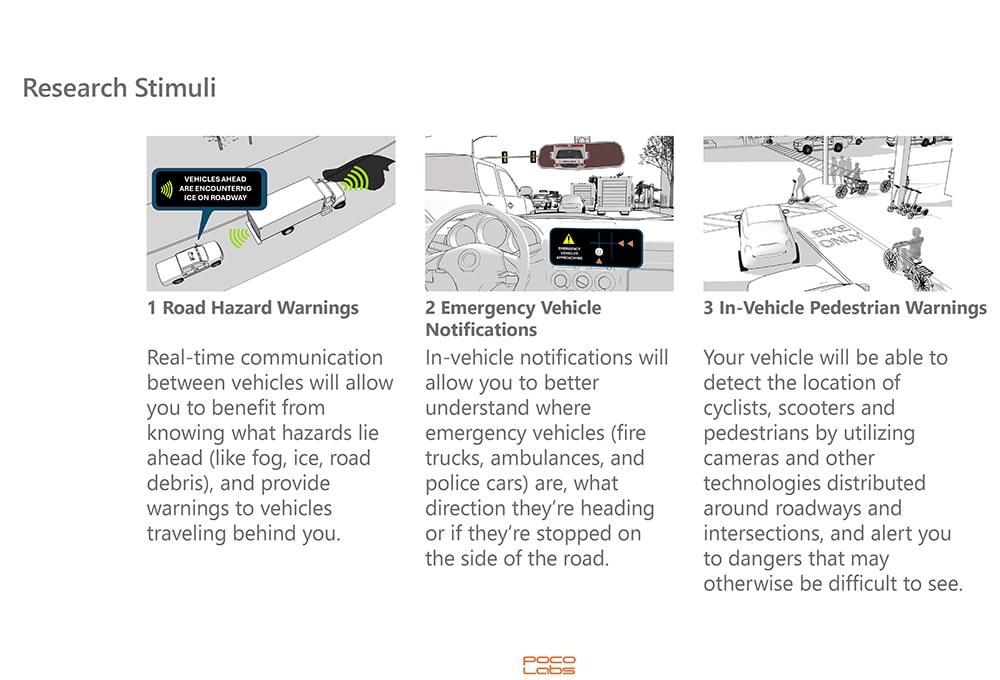
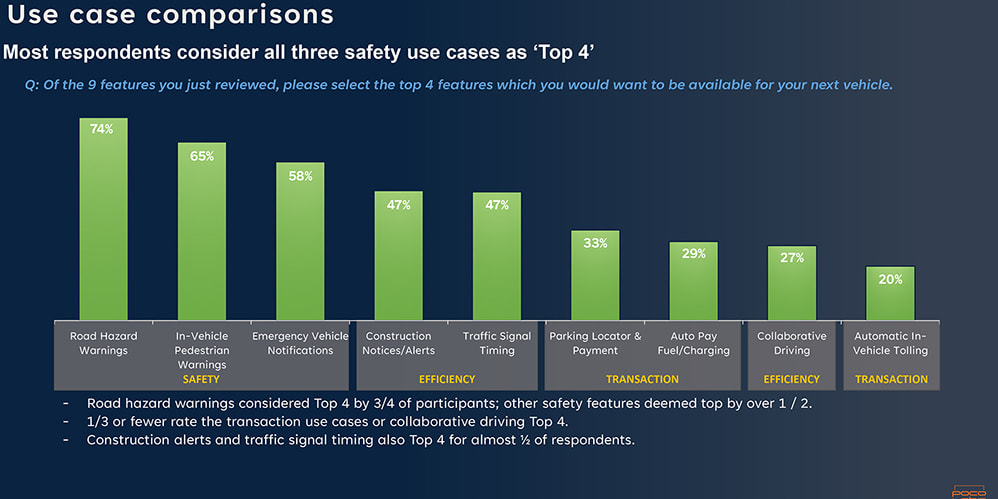
Safety was the most wanted, frequently cited and most valuable item to consumers. More than half of the survey respondents said safety was their No. 1 priority. For example, road hazard identification topped the list, followed by pedestrian warnings and emergency vehicle notifications. These priorities applied roughly equally across all demographic groups.
Efficiency
Efficiency use cases, such as a vehicle being able to influence the timing of traffic signals and awareness of construction notices, were generally more valued by consumers than the transaction use cases frequently cited by OEMs.
Traffic signal timing was of most interest to respondents living in the suburbs. Collaborative driving, however, appealed more to urban dwellers and early adopters, who tend to drive more highway.
Transactions
The least-desired V2X features surrounded transactions, such as automatic parking locator and payment and auto pay at gas stations. There was interest among younger drivers and early tech adopters. EV owners also showed intense interest in auto pay at charging stations, pointing to a market of possible revenue growth for that kind of transaction support.
SAE Media spoke with Thomas Pavlak, founder and president of Poco Labs, ahead of his Tuesday presentation. He said that while transactions were low priorities in the minds of consumers, other developments, such as wide adoption of V2X safety tech, might change their perceptions. “Safety is the foundational pillar of a lot of other experiences that can actually be monetized,” he said, adding that it’s widely known that OEMs want more revenue streams from the vehicles they sell.
He said that after this report, two natural areas in which to do more research are how much people would pay for various features, as well as regional differences in people’s attitudes toward V2x technologies. “A driver in Peoria is going to have a different set of needs than a driver in Los Angeles,” he said.
Pavlak said that at least one area was a hard “no” from consumers, and that was the possibility of V2X tech detecting construction zones and taking control of the car from the driver, even if it meant increased safety. People were loving the idea of construction zone help, but stopped short of saying ‘yes, take over my car,’ “ he said.
More From SAE Media Group
Autonomous Vehicle Engineering
New EU Patent System Could Unify and Simplify Process
Off-Highway Engineering
Ford Expands EV Lineup with E-Transit Cargo Van
Automotive Engineering
Key ‘Plug and Charge’ Agreement Could Eliminate EV Charging-Payment Headaches
Autonomous Vehicle Engineering
Industry Remains Unsettled on Vehicle Connectivity Standard
Automotive Engineering
Cellular V2X Pilot Launching in Virginia
Automotive Engineering
Jaguar, Waymo to Partner for Automated Driving with New I-Pace EV
Automotive Engineering
UAE Previews Autonomous Future at DriftX
Automotive Engineering
Preview: SAE 2021 WCX
Automotive Engineering
The Lesson of J3400: Move Fast and Fix Things
Autonomous Vehicle Engineering
C-2VX Is Finally Gaining Momentum in the U.S.
Off-Highway Engineering
Allison Advances Commercial-Vehicle Electronic Controls
Off-Highway Engineering
Charging Infrastructure Coming – at a Cost
Automotive Engineering
United Kingdom Develops a Pop-Up Electric Vehicle Charging Station for City Streets
Automotive Engineering
2016 SAE Congress: Auto Industry Must Adopt Faster 'Clock Speed'
Off-Highway Engineering
Funding, Mandates Fuel Commercial-Vehicle Electrification
Off-Highway Engineering
Komatsu Employs “Slick” Battery Swapping for Underground LHD
Automotive Engineering
SAE Completes Next Step to Standardize Tesla-Developed EV Charging Connector
Automotive Engineering
WXC 2025: GM’s Hydrotec-Based EV Charger Takes Center Stage
Off-Highway Engineering
Electrify America Accelerates DC Fast-Charger Installation
Autonomous Vehicle Engineering
Purpose, Perceptions for Driver-Assist Tech Solidify
Automotive Engineering
SEAT to Spearhead VW's New Platform and 48V Technology
Off-Highway Engineering
Electrify America Wants an Emoji for Electric Vehicles
Automotive Engineering
Bidirectional Charging Is Nearly Mainstream
Automotive Engineering
Challenges Galore for Connected Cars
Automotive Engineering
Debating Data Monetization Vs. Privacy
Automotive Engineering
In-Vehicle Software and Services Are Transforming the Industry
Off-Highway Engineering
Nikola Producing Battery-Electric Trucks, Fuel-Cell EVs Coming
Off-Highway Engineering
Daimler Shows It's Serious About Electric and Automated Truck Development
Automotive Engineering
EV Confidence
Off-Highway Engineering
Canada Will Establish a Cross-Country Electric Vehicle Charging Network
Top Stories
NewsSensors/Data Acquisition
 Microvision Aquires Luminar, Plans Relationship Restoration, Multi-industry Push
INSIDERRF & Microwave Electronics
 A Next Generation Helmet System for Navy Pilots
INSIDERWeapons Systems
 New Raytheon and Lockheed Martin Agreements Expand Missile Defense Production
NewsAutomotive
 Ford Announces 48-Volt Architecture for Future Electric Truck
INSIDERAerospace
 Active Strake System Cuts Cruise Drag, Boosts Flight Efficiency
ArticlesTransportation

Webcasts
Aerospace
 Cooling a New Generation of Aerospace and Defense Embedded...
Energy
 Battery Abuse Testing: Pushing to Failure
Power
 A FREE Two-Day Event Dedicated to Connected Mobility
Automotive
 Quiet, Please: NVH Improvement Opportunities in the Early Design Cycle
Electronics & Computers
 Advantages of Smart Power Distribution Unit Design for Automotive &...
Unmanned Systems
 Sesame Solar's Nanogrid Tech Promises Major Gains in Drone Endurance