




Safety by Design: A Next-gen Blueprint for EV Batteries
The EV industry can – and should – stop pushing decades-old battery architecture well past its limits.

For more than three decades, the fundamental design of lithium-ion batteries has remained largely unchanged, tracing back to Sony’s original design in 1991 for small portable electronics. While impressive advancements have been made in materials, chemistry, and manufacturing efficiencies, the core design has remained the same. This legacy design, initially developed for small, low-voltage, low-energy-density applications, has now become a significant bottleneck for the automotive industry and the future of electric vehicles.
Imagine only updating the apps on your phone without ever updating the operating system. No matter how modern the apps become, the system cannot keep up with new demands. At some point, performance stalls and the system hits a wall. This is the situation the EV industry faces today. We’re pushing decades-old battery architecture well past its limits.
By just optimizing around the edges, we’re building on a flawed foundation. The conventional battery cell and pack architectures were never designed for today’s EV demands, and its limitations are clear: persistent material waste, complex thermal management, heightened safety risks, and rigid formatting that constrains manufacturability.
The trade-off trap
As EV adoption accelerates, these battery limitations translate directly into costly trade-offs for automakers. With pressure to deliver longer range, faster charging, and higher performance, engineers are forced to trade one performance metric for another. For instance, striving for higher energy density often comes at the expense of safety, while pushing for lower costs might compromise performance or quality control. This approach, despite yielding some significant improvements since Sony’s original products in the early 1990s, is now facing diminishing returns.
In the current EV landscape and given global competition, battery fire safety may be the most dangerous trade off. Range and fast charging requirements have pushed batteries to their performance limits; however, these gains often come at the expense of safety. With projections of 250 million EVs on the road by 2030, thermal incidents are expected to rise unless battery technologies become inherently safer. Markets have already seen a 33% surge in EV thermal incidents, underscoring an upward trend in both safety risks and related expenses.
In 2025, EV battery-related incidents made headlines. One incident of a cargo ship blaze that destroyed 800 EVs in the Pacific was linked directly to thermal runaway. Widespread battery-related EV and hybrid recalls highlight the scale of the problem. Each recall can cost automakers up to $1 billion per model line, creating massive financial exposure as EV markets scale globally. Combined, these incidents spread fear, hinder adoption, and reveal the steep financial cost of faulty batteries.
Battery experts now classify today’s EV batteries as a “Severity 10” risk, the highest level on the Design Failure Mode and Effects Analysis (DFMEA) automotive safety scale, where failure poses an immediate and severe risk of injury or fatality. This reflects an industry consensus that current lithium-ion designs are no longer sufficient, and that incremental process adjustments will not solve the problem. To genuinely break free from this cycle of fires, recalls, and eroding consumer trust, the industry must confront the root cause: the outdated architecture of the battery itself. What’s needed is not more patches, but a design that embeds safety into the cell from the start.
The case for a ground-up redesign
EV batteries need a redesign that enables safety, cost, and performance to advance simultaneously, rather than trading one off against another. This means embedding safety directly into the cell architecture and streamlining manufacturing processes to reduce costs. This approach unlocks innovation potential, allowing for entirely new materials, cell formats, and production methods that were previously impossible with conventional designs.
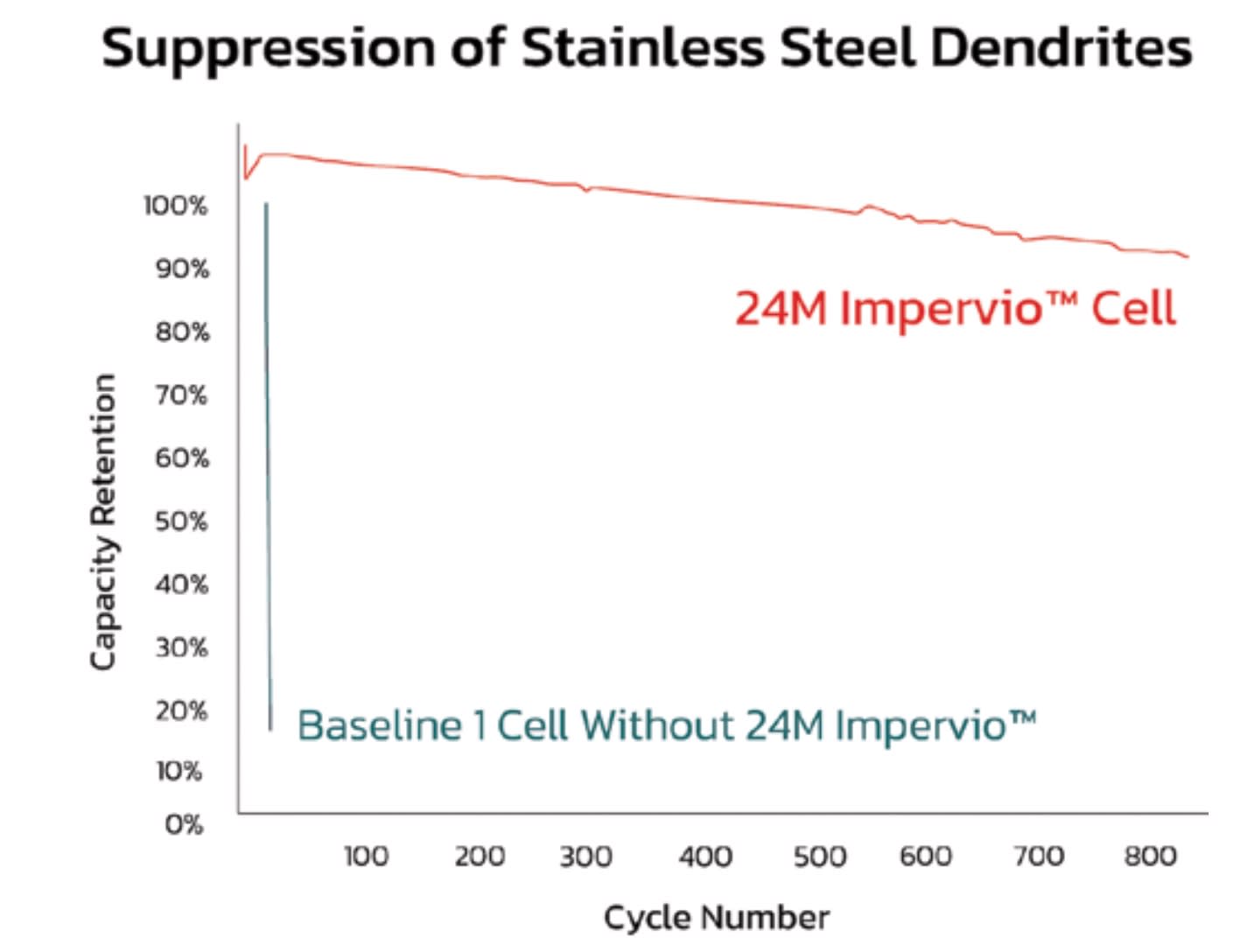
One strategy is to focus on safety and flexibility at both the electrode and pack level. One of the primary causes of internal short circuits is the growth of dendrites, which can form during overcharging or regular wear and tear. Dendrites can pierce internal components, triggering a short circuit that can lead to fire. At 24M, we’ve developed a functional battery separator that transforms what was once a passive thin polymer into an active safety component. Our 24M Impervio technology suppresses dendrite growth in the electrolyte and monitors the cell’s state-of-health. This enables it to detect internal shorts, even in overcharged batteries, before they escalate into thermal runaway. Built on conventional separator materials, 24M Impervio integrates directly into existing cells, delivering a new layer of safety from inside the battery itself.
But solving for safety alone isn’t enough. To fully unlock next-generation EV batteries, safety must be paired with better design flexibility. Electrodes that are integrated directly into the pack eliminate the need for traditional cells and modules and, at 24M, enable up to 50% more range and a more flexible design for a streamlined manufacturing process.
We need more innovations like these that move the industry beyond incremental tweaks and provide a fundamentally safer, more efficient, and more adaptable battery blueprint. By embedding safety and performance into the architecture itself, we can deliver safer EV batteries that restore consumer trust, lower costs, and accelerate mass adoption worldwide.
Stop optimizing the past, start building the future
The battery industry stands at an undeniable inflection point. Legacy designs can no longer keep up. They weren’t meant to power the current EV era and consumer demands. The path forward is not more patches, but a proven battery redesign rooted in safety and flexibility.
The next decade of EV growth will depend on solving the battery safety problem. Regulators, automakers, and consumers alike need confidence that EVs won’t trade performance gains for fire risk. At the same time, the industry must ensure resilient supply chains, scalable manufacturing, and affordable recycling solutions.
By abandoning outdated thinking and building a new foundation for energy storage, we can deliver safer, more scalable, and more flexible batteries than ever before. This new approach is necessary to enable a full transition to EVs with the implementation of new battery architectures.
Naoki Ota is president & CEO of 24M Technologies and wrote this article for SAE Media.
More From SAE Media Group
Battery & Electrification Technology
The End of the Beginning: Why the EV Market Will Overcome the Loss of Tax Credits
Automotive Engineering
Finding Solutions for Sustainable Mobility
Battery Technology
Advancing Battery Technology: THE 2021 BATTERY SHOW Preview
Battery & Electrification Technology
Battery Innovation Key for Commercial and Off-Highway EVs
Battery & Electrification Technology
Driving EV Development with a Twin-Battery Approach
Automotive Engineering
SAE WCX 2022: EV Cybersecurity Threats
Power Electronics INSIDER
Polyphase Wireless Power Transfer System
Battery & Electrification Technology
Ultracapacitor Solutions to Address Energy-Storage Needs of Vehicles
Battery & Electrification Technology
The Path to Smarter Vehicle Charging
Automotive Engineering
The Path to Better, Smarter Vehicle Charging


Battery & Electrification Technology
New Products
Battery & Electrification Technology
Refining Automotive Battery Management Systems with Lumped-Approach Thermal Modeling
Battery & Electrification Technology
Powering Light Electric Vehicles
Power Electronics INSIDER
New Smart Charger May Pave the Way for More EVs
Automotive Engineering
Mitsubishi Fuso Announces Energy Storage Demonstration
Power Electronics INSIDER
World’s Strongest Battery Paves Way for Light, Energy-Efficient Vehicles
Battery & Electrification Technology
Leading the Charge: Fast 40
Battery & Electrification Technology
The Rechargeable Renaissance
Automotive Engineering
GM: Ultium Heat-Pump System Boosts EV Range, Reduces Charge Times
Automotive Engineering
Purdue Prototypes New EV Fast-charge Cable
Battery & Electrification Technology
Overcoming Challenges and Boosting Productivity for EV Battery and E-Axle Testing
Tech Briefs
Making EV Batteries More Sustainable

Battery & Electrification Technology
Can Solid-State Batteries Commercialize by 2030?
Battery & Electrification Technology
Product Showcase
Battery & Electrification Technology
A Cleaner, Scalable Process to Recycle Lithium-Ion Batteries
Battery & Electrification Technology
Building Out the EV Battery-Recycling Ecosystem
Automotive Engineering
BYD’s Blade Runner
Top Stories
INSIDERManufacturing & Prototyping
 How Airbus is Using w-DED to 3D Print Larger Titanium Airplane Parts
NewsAutomotive
 Microvision Aquires Luminar, Plans Relationship Restoration, Multi-industry Push
INSIDERAerospace
 A Next Generation Helmet System for Navy Pilots
INSIDERDesign
 New Raytheon and Lockheed Martin Agreements Expand Missile Defense Production
ArticlesAR/AI
 CES 2026: Bosch is Ready to Bring AI to Your (Likely ICE-powered) Vehicle
Road ReadyDesign

Webcasts
Semiconductors & ICs
 Advantages of Smart Power Distribution Unit Design for Automotive...
Unmanned Systems
 Quiet, Please: NVH Improvement Opportunities in the Early Design...
Electronics & Computers
 Cooling a New Generation of Aerospace and Defense Embedded...
Power
 Battery Abuse Testing: Pushing to Failure
AR/AI
 A FREE Two-Day Event Dedicated to Connected Mobility
