




Cheaper and Safer Battery Storage
Researchers have developed a new technique to solve the problem of how to increase the capacity of sodium-ion batteries.
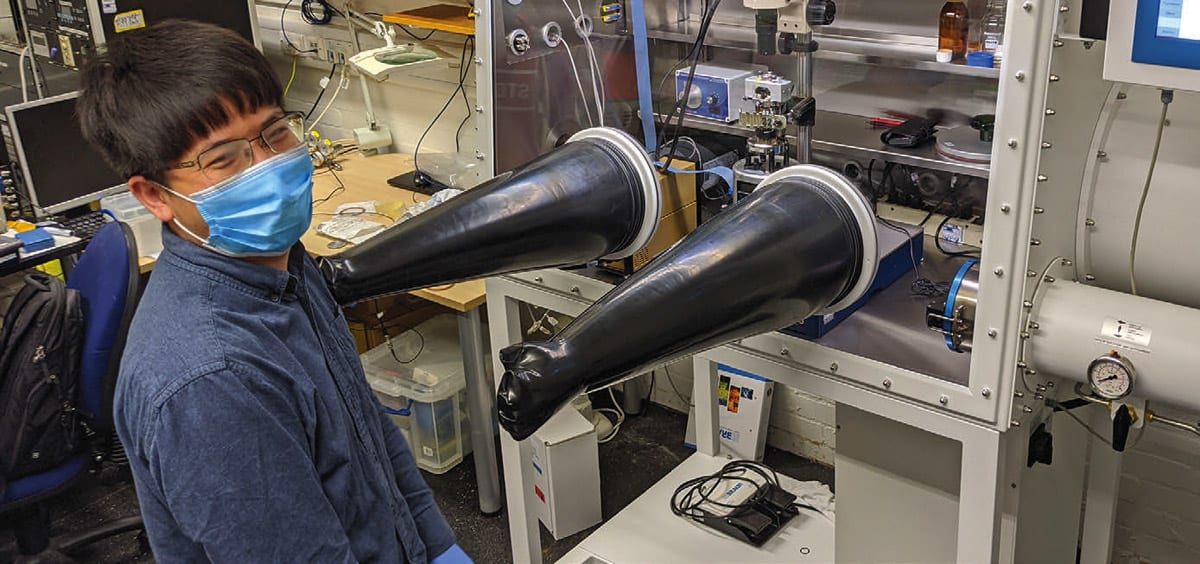
The research, published in Applied Physics Reviews, was jointly led by Professor Oleg Kolosov from Lancaster University and Professor Zhigao Huang from Fujian Normal University, with key results obtained by Associate Professor Yue Chen from both Lancaster and Fuzhou.
Professor Kolosov said: “Nanoscale studies of rechargeable storage are essential for the development of new, efficient, and safe batteries.
“This study will enable a cheaper and safer energy storage alternative to lithium-ion batteries, with lithium being much scarcer and more difficult to mine compared with sodium. This fundamental research is expected to ultimately enhance the cycle stability, lifespan, and capacity of batteries.”
The researchers developed a unique technique of electrochemical ultrasonic force microscopy (EC-UFM) for the nanoscale imaging of interfaces in rechargeable batteries directly during their operation (operando), something that was not possible using existing electrochemical characterization methods. EC-UFM allowed the researchers to observe the formation and properties of one of the crucial elements in these batteries — solid-state-interphase (SEI) — which affects their capacity, power, and longevity.
The new technique, developed as part of the Faraday Institution NEXGENNA project, solves a long-standing problem of how to increase the capacity of sodium-ion batteries. It uses solvent as a vehicle for the co-intercalation of sodium into the carbon electrode. By guiding the passivating SEI layer formation during the battery charge/discharge process, the scientists discovered how to preserve the shuttling of charge carriers between the electrolyte and electrode, resulting in efficient and powerful sodium-ion batteries.
For more information, contact press
More From SAE Media Group
Tech Briefs
Sodium-Ion Batteries
Battery & Electrification Technology
Designing Sodium-Ion Batteries with Extended Longevity
Battery & Electrification Technology
Enhancing the Performance of All-Solid-State Batteries

Battery & Electrification Technology
A New Way to Enhance Durability of Lithium Batteries
Battery & Electrification Technology
Sodium Battery Is Capable of Rapid Charging in Just a Few Seconds
Battery & Electrification Technology
An Alternative to Lithium-Ion Batteries
Tech Briefs
Solid-State Lithium-Sulfur Battery Tech
Battery Technology
Nanostructured Alloy for Battery Anodes
Tech Briefs
Building Temperature-Resilient Batteries

Tech Briefs
Stable, Efficient, Anode-Free Sodium Battery
Battery & Electrification Technology
Anode-Free Lithium Batteries with Maximized Energy Density
Battery & Electrification Technology
Recyclable ‘Water Batteries’ That Won’t Catch Fire
Green Design & Manufacturing
Nickel-Zinc Battery System Technology
Tech Briefs
A New Design for Lithium-Sulfur Batteries

Battery Technology
Doubling Battery Performance with Lithium Metal
Battery Technology
Semi-Liquid Metal Anode
Battery & Electrification Technology
Researchers Unveil Scalable Graphene Technology to Revolutionize Battery Safety and Performance

Battery & Electrification Technology
Carbon-Capture Batteries Developed to Store Renewable Energy, Help Climate
Battery Technology
Hybrid Membrane Doubles the Lifetime of Rechargeable Batteries

Battery Technology
Sustainable Aluminum-Anode Batteries

Battery & Electrification Technology
Anode-Free Sodium Solid-State Battery
Battery & Electrification Technology
High-Performance MXene Electrodes for Next-Generation Battery
Aerospace & Defense Tech Briefs
Rolls-Royce and Superdielectrics Explore Supercapacitor Technology
Top Stories
INSIDERManufacturing & Prototyping
 How Airbus is Using w-DED to 3D Print Larger Titanium Airplane Parts
NewsAutomotive
 Microvision Aquires Luminar, Plans Relationship Restoration, Multi-industry Push
INSIDERAerospace
 A Next Generation Helmet System for Navy Pilots
INSIDERDesign
 New Raytheon and Lockheed Martin Agreements Expand Missile Defense Production
ArticlesAR/AI
 CES 2026: Bosch is Ready to Bring AI to Your (Likely ICE-powered) Vehicle
Road ReadyDesign

Webcasts
Semiconductors & ICs
 Advantages of Smart Power Distribution Unit Design for Automotive...
Unmanned Systems
 Quiet, Please: NVH Improvement Opportunities in the Early Design...
Electronics & Computers
 Cooling a New Generation of Aerospace and Defense Embedded...
Power
 Battery Abuse Testing: Pushing to Failure
AR/AI
 A FREE Two-Day Event Dedicated to Connected Mobility
