




Embracing the Challenge of Smart Cities
“Smarter” cities will be better, more-productive places. But development challenges abound.

The Smart Cities of the future are closer than one might think. Just recall the last time you were in a new city for a business trip or vacation.
After getting off an airplane, it’s possible you stepped onto an automated monorail that whisked you to a self-serve kiosk where you used your credit card to retrieve the keys to your rental vehicle. Maybe you used your smartphone to secure a Lyft for the ride to your hotel. Conversation with your driver was your only human interaction, as payment and tipping for the service were handled by the app.
If you went sightseeing, you may have gone to a CoGo station to borrow a bicycle for a few hours. It’s wasn’t challenging to get around the city on two wheels, because there are clearly marked shared-use paths for bicyclists and pedestrians. The city’s free Wi-Fi service, broadcast from “intelligent” streetlights, kept you linked to the maps helping you navigate.
The embryonic signs of the Smart City of the future exist right now. We really are at the beginning of the mobility revolution, however — and for as much promise as this future presents, it will not come without significant challenges.
A smarter Columbus
In December 2015, the U.S. Dept. of Transportation launched the inaugural Smart Cities Challenge. The agency wanted mid-sized cities across the country to develop and test ideas and innovations for advanced mobility. The competition pushed cities to use data, applications and mobile technology to find ways to move people and goods quickly, cheaply and efficiently.
Seventy-eight cities entered the Challenge. Seven cities made the cut and Columbus, Ohio, where I work and live, was the winner, securing $40 million in grants from the federal government and another $10 million from Microsoft co-founder and philanthropist Paul Allen’s Vulcan Inc. to deploy and study high-tech transportation ideas and, at the same time, reduce our carbon footprint. In the next few years, the public-private partnership is expected to inspire a billion-dollar investment in mobility solutions to meet our Smart City challenges.
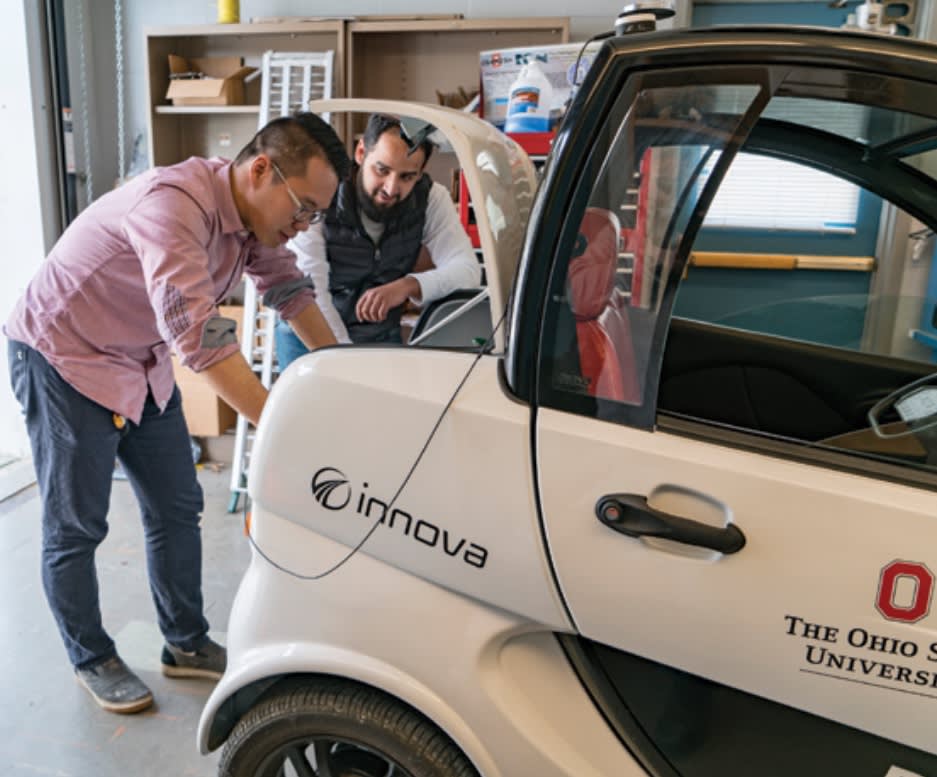
The Ohio State University is the lead researcher for the Smart Columbus project. As the university’s assistant vice president for mobility research and business development, I worked closely with the team that developed the winning proposal. Now I’m working to help test our theories in the real world. We already are testing autonomous vehicles, sensors that will make travel safer and tools to connect communities to more flexible transportation options.
One of the keys to winning the challenge was our core belief that only a holistic approach to mobility will help solve not just the transportation problems of the future, but the problems faced by a growing urban community. That approach is reflected in a proposal that calls for testing on the logistical routes that keep Columbus fueled and fed, looks to ease congestion and traffic at our shopping centers and addresses the problems of payment and access in our least-advantaged communities and neighborhoods.
A look at the future
As Columbus and Ohio State enter the testing phase of Smart Columbus, autonomous technology offers one of the most revolutionary changes in mobility. We are looking at a future that is connected, autonomous, shared — and, increasingly, electric.
What will a Smart Columbus look like? It will be home to a connected transit system guiding personal vehicles, ride-hailing vehicles like Lyft and Uber, metro lines and buses that function as organs with a common brain. Real-time data will circulate in a shared nervous system that helps people plan a commute that saves them time and money.
That shared efficiency also will have a profound impact on reducing carbon emissions and improving our natural environment. People will not have to leave their vehicles sitting in parking lots all day, waiting for the commute home. While our cars and trucks are among our most expensive investments, we end up using them less than 5% of the time we own them.
Smart Cities will fuel these new autonomous systems with greener options, including expanding the market for and use of electric vehicles. Shared driverless vehicles will require access to wirelessly-controlled charging stations. This electric vehicle adoption and the growing use of renewable energy will over time contribute to a greener commute and a healthier planet.
Why the confidence in the commercial promise of autonomous vehicles? They allow you to take your mind off transportation. You don’t have to think about parking, about traffic, about anything — when you’re traveling. You’ll be able to relax during daily commutes or long-distance trips. That’s value-added time.
And more-reliable mobility options can impact economic inequality. Researchers have shown poor public-transportation options increase unemployment and are more likely to be found in areas already under economic anxiety. It’s easy to envision a future in which advanced-mobility solutions make Columbus a more vibrant, cleaner and egalitarian place to live.
We’re not there yet
The ubiquity of the personal computer and the advances of the internet age have put information at our fingertips, revolutionized commerce and changed our lives in immeasurable ways. But they are not a panacea for society’s ills. And despite the ongoing advances in mobility technology, the Smart Cities of the future face real challenges.
Consider the potential adverse impact of autonomous vehicles. An increase in their use may encourage people to commute more, leading to more energy consumption, greater congestion, more urban sprawl, less green space. The car is a uniquely American symbol of freedom and independence. Autonomous substitutes for today’s personally-owned and -controlled vehicles will not solve the roadway congestion issue. It will take research and expertise to persuade consumers to change these attitudes. Indeed, within the academic community, Ohio State already is teaching the engineers of the future to consider environment, sociology and other fields of discipline in their product and systems designs.
Depending on their cost, autonomous vehicles also may contribute to economic and social inequity. If driverless vehicles create more congestion, that could end up hurting those who cannot afford the technology. It also could lead to vast unemployment in the transportation sector; about 3% of today’s U.S. labor force works in transportation and warehousing. That translates to about 4.5 million jobs.
Autonomous and connected vehicles invariably require special technology to operate safely. Will pedestrians and bicyclists have space on these newly-adapted roads? If not, we may see the end of “complete streets” designed to encourage pedestrians, bicyclists and cars to share the road.
We have reached a point where technology could outpace our ability to regulate rules of the road. Autonomous-vehicle testing already is underway in certain states. Will — and should — states take the lead in creating autonomous-vehicle testing standards and regulation? There is some danger in a state-by-state approach, where piecemeal regulation could make testing and approval prohibitively expensive. We’re already trying to address the issue: Ohio State is co-founder of the Smart Belt Coalition, working with academic institutions and transportation agencies in Ohio, Michigan and Pennsylvania on connected- and automated-vehicle initiatives.
The National Highway Traffic Safety Administration recently released updated guidance for Highly Automated Vehicles, providing manufacturers with recommendations on safe design and deployment and drafting a nonbinding model state policy. NHTSA proposes that states continue with previous roles — vehicle licensing and registration, traffic laws and enforcement and motor-vehicle insurance and liability oversight.
Building the future
We also have a lot of learning ahead of us as consumers. When the automated elevator was first adopted, people rejected it out of fear. It took around 50 years for the automated elevator to become standard, even though it was much safer. Elevator designers had to develop features that reassured skittish riders.
Google aims to remove the steering wheel from its autonomous vehicles. What are the design features the company will have to include to convince occupants they are safe? Before I joined Ohio State, I served as senior vice president of research and development for Nissan North America, where as a leader of engineering and development, I saw firsthand how automakers wrestle with design challenges that balance the advances in technology with the needs of consumers.
Navigating this future will take plenty of teamwork and communication. I currently serve as the vice president of automotive for SAE International and I believe our organization has a critical role to play as we confront the challenges of automated driving. We can serve as a voice for engineers and experts to help guide decision-makers to find appropriate balance.
Columbus is one year removed from winning the Smart Cities Challenge and it’s not unlike a garden recently planted. There are signs of progress beginning to sprout. Program leaders are offering incentives to owners and developers to install charging stations at apartment and condominium developments. Research is underway to develop a common payment system to help all communities access the mobility revolution. Smart Columbus is in the process of receiving applications for, among other things, the contractors needed to build the sensor networks that will link our smart city.
There is considerable work to be done. But it’s not hard to imagine the future for smart cities is closer than we think.
Carla Bailo has spent nearly 40 years in the automotive, mobility and smart city space. Currently, she is President and CEO of the Center for Automotive Research. Prior to this time, she was The Ohio State University’s assistant VP for mobility research and business development and helped coordinate OSU’s involvement as the primary research partner for Smart Columbus. As an engineer she spent 25 years at Nissan and 10 years at GM Truck & Bus. Carla also is the 2016-2018 vice president of automotive for SAE International.
More From SAE Media Group
Power Electronics INSIDER
Highway Segment Charges Electric Vehicles
Tech Briefs
EVs Are Growing Up—and Getting Practical
Power Electronics INSIDER
New Smart Charger May Pave the Way for More EVs
Power Electronics INSIDER
Polyphase Wireless Power Transfer System
Aerospace & Defense Tech Briefs
Boeing, SparkCognition Partner on Safe Integration of Autonomous Air Vehicles in Airspace
Automotive Engineering
Welcome to the Automotive Engineering Podcast
Automotive Engineering
Proving Grounds Are the Hush-Hush Heroes of the Latest Automotive Test Technology
Battery & Electrification Technology
The End of the Beginning: Why the EV Market Will Overcome the Loss of Tax Credits
Battery & Electrification Technology
Ultracapacitor Solutions to Address Energy-Storage Needs of Vehicles


Automotive Engineering
2019 World Traffic Safety Symposium Focuses on AV Regulation
Autonomous Vehicle Engineering
The Road to Automobility
Autonomous Vehicle Engineering
Autonomy: the New Age of Automobility
Battery & Electrification Technology
Hydropower Technology Swaps Dams with Electric Trucks
Tech Briefs
High-Power Direct Borohydride Fuel Cells
Automotive Engineering
Who Wants Afreecar?
Automotive Engineering
Are EV Tires a Thing?
Automotive Engineering
Sensor Fusion Expanding in Step with Advancing Vehicle Sophistication
Battery & Electrification Technology
Solving Fleet Electrification Bottlenecks with Battery-Integrated Charging Systems
Autonomous Vehicle Engineering
Standards Play a Vital Role
Tech Briefs
Charging EVs as they Travel on Highways
Motion Design INSIDER
Autonomous Bus Sounds: It’s All About When, Not How
Autonomous Vehicle Engineering
Florida’s Babcock Ranch and the Future of Autonomous Communities
Off-Highway Engineering
ZM Trucks Starts Production in Fontana, California
Top Stories
INSIDERManufacturing & Prototyping
 How Airbus is Using w-DED to 3D Print Larger Titanium Airplane Parts
INSIDERManned Systems
 FAA to Replace Aging Network of Ground-Based Radars
NewsTransportation
 CES 2026: Bosch is Ready to Bring AI to Your (Likely ICE-powered) Vehicle
NewsSoftware
 Accelerating Down the Road to Autonomy
EditorialDesign
 DarkSky One Wants to Make the World a Darker Place
INSIDERMaterials
 Can This Self-Healing Composite Make Airplane and Spacecraft Components Last...
Webcasts
Defense
 How Sift's Unified Observability Platform Accelerates Drone Innovation
Automotive
 E/E Architecture Redefined: Building Smarter, Safer, and Scalable...
Power
 Hydrogen Engines Are Heating Up for Heavy Duty
Electronics & Computers
 Advantages of Smart Power Distribution Unit Design for Automotive...
Unmanned Systems
 Quiet, Please: NVH Improvement Opportunities in the Early Design...
