




Underway on Nuclear Power
At Ford Motor Co., CTO Dr. Ken Washington is driving new approaches to technology innovation — from inside and outside the enterprise.
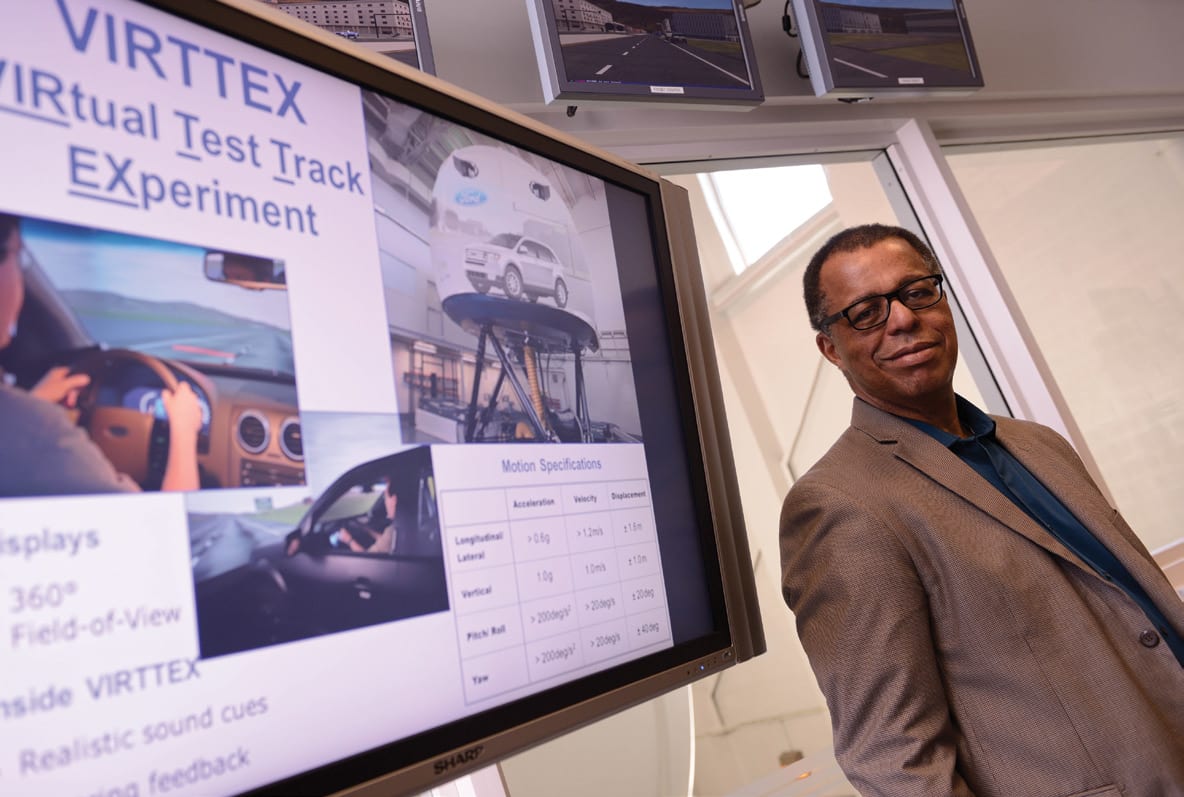
The global competition to create autonomous, connected and electrified vehicles in volume has been described as an “arms race,” which makes Dr. Ken Washington one of its top commanders.

As Ford Motor Co.’s VP Research and Advanced Engineering and Chief Technology Officer, Dr. Washington’s role is, as he puts it, “to interface with the technology world at large.” His mission is to ensure that the best ideas and highest-potential innovations from that race end up in Ford products, services and processes across the enterprise.

So, it was fun to hear a panel discussion a couple years ago in which Dr. Washington traded some tech-world observations with Jeff Owens, his CTO counterpart at Delphi. Owens proudly noted that he’d recently visited a tiny start-up company in Israel which had some promising cybersecurity software. Delphi, he indicated, had discovered a winner.
Dr. Washington listened and began to smile. Then he said, “Yes, I remember those guys. They were working in that little beach house outside of town. My team and I were there a week before you.”
Such urgency was also at the top of new CEO Jim Hackett’s agenda in 2017, as he looked to strengthen and expand Ford’s multi-billion-dollar pathway toward future mobility. One of Hackett’s early actions was to elevate Dr. Washington to a direct report, three years after the 58-year-old nuclear engineer and former VP of Lockheed Martin Space Systems’ Advanced Technology Center had joined Ford.
“I’ve only done Technology my entire life — I’m a geek at heart,” he told Automotive Engineering. “But technology on its own won’t matter unless we bring it back to the company and bring it to life inside Ford’s products, services and strategies.”
He cited seven “revolutions” erupting in Automotive — autonomy, artificial intelligence, connected car, mobility as a service, lightweighting, advanced manufacturing/robotics, and electrification — that occupy almost 90 percent of his focus. All will drive many new jobs in the mobility industry going forward. Equally vital are the development and replenishment of engineering and scientific talent. Starting at K-12, STEM is a crusade for which Dr. Washington is utterly passionate.

As the “owner” of Ford’s technology plan, he also keeps a close eye on innovations outside of automotive, including aerospace (where he regularly networks with other CTOs), computer gaming, and even medical tech. “I want to know how they’re taking advantage of AI, machine learning, advanced materials,” he said.
He also relies on the extensive “tentacles” of Ford’s cross-disciplinary Research team, which extend throughout the company as well as outside it. “We go after technology and innovation as a team sport,” he asserted. “And when I say ‘innovation’ I’m not just talking technology innovation. I mean business innovation as well. As in how we’re approaching autonomous vehicles — it’s about bringing autonomy to the masses, and helping people take advantage of an autonomous car. It’s about helping businesses reinvent themselves.”
That requires the complex task of rethinking scores of delivery mechanisms — how vehicles operate individually and in fleets, how they interact with humans and embedded infrastructure in cities, and how they can be designed and engineered to improve mobility within the societal ecosystem.
Ford’s booming tech base
Dr. Washington disagrees with the notion that fundamental research has mostly transitioned away from the OEMs and now is generated mainly by suppliers, start-ups and research universities.
“Ford’s intellectual property portfolio has never been richer,” he claimed. “We’re doing more invention disclosures than ever. We do technology across multiple time domains — we think of them as the Now, the Near, and the Far. All are in play simultaneously.” The ‘now’ are deliverables executed by Product Engineering. The ‘near’ — committed to production but not quite ready — are handled by Advanced Engineering. And the ‘far,’ in Research, are five years or more beyond the cycle plan.
Of course, not everything is developed internally. Ford is ace at leveraging its close relationships with the supply base. It’s also in the vanguard of OEMs who are steadily expanding their tech chops through inorganic acquisitions and partnerships [see table ]. The Dearborn-based company is clearly thinking big: its $1 billion investment in Argo AI is helping to speed development of Ford’s autonomous ‘driver system.’ The decision to create Ford’s own open-sourced Transportation Mobility Cloud drove the 2018 acquisition of Autonomic to do distributed software and mobility services over the web.
This is enabling Ford to take its connected-car strategies “to the next level,” Dr. Washington claimed, while helping to build nimble, fast cultures across all areas of the company where software engineering predominates. For its Mobility group, Ford created a small tech incubator called Ford X designed to quickly identify and sort out potential winners that can be scaled.
An exclusive partnership with Nirenberg Neuroscience aims to bring more “humanlike intelligence” to machine learning elements of self-driving vehicle systems. Meanwhile, the company now has over 100 engineers in-house engaged in data analytics and machine learning, according to Dr. Washington, and a fast-growing team of advanced-degree experts working on robotics and artificial intelligence.
“We’ll never make high-definition cameras, radars or LiDARs. But we’ll create the algorithms that stitch the signals from those three types of sensors together,” he said. Ford also is developing in-house the software to create its next-generation electrical architecture. He dubs it “core technology” to support the wave of new electrified vehicles with increased automated driving capability due in the early 2020s.
The new electrical platform will allow engineers to deliver over-the-air updates using in-house software innovations — and to make Ford vehicles more resilient against cyber attack.
The war for talent

As the influence of AI, robotics, batteries, cybersecurity, cloud technology, software and materials innovations expands within the industry, so too does the need to grow and sustain the professional talent base. In that regard the ongoing battle for engineers and scientists between Silicon Valley, the Midwest and other states is almost a moot point for Ford.
“If you’re a really gifted engineer or scientist you can work pretty much wherever you want,” Dr. Washington observed. “The key for Ford is to make our workplace a fun and intellectually invigorating place to be, in which you’re working on the challenging problems of society.”
He said the company, by having facilities in both Palo Alto and southeast Michigan, has learned that “if you have hard problems for people to solve, the top talent will gravitate to you. Being competitive on pay is a given. But you also must have the right environment and problems to solve. Talented people want to work on things that are meaningful.
“If you have all those things, you’ll attract the best,” he opined.
One of the first things he tells top candidates is, “If you don’t want to work in Michigan you don’t have to.” Ford’s Palo Alto site has been an effective magnet for attracting talent to the Research and Advanced Engineering skills team. After opening the facility “with 12 people and a beanbag chair,” the staff now numbers over 200—with room to expand, Dr. Washington noted.
There’s also Corktown, the historic Detroit neighborhood in which Ford’s Team Edison has established its new headquarters. Charged with creating a sustainable business ecosystem around EVs, Team Edison “is a great example of how Ford is innovating on a business front,” Dr. Washington said. While the company believes EVs are the future, it also realizes for them to be profitable (and thus sustainable) the vehicles must be part of a systems solution with charging, digital services, and connection to Ford’s Transportation Mobility Cloud.
Team Edison is tasked with helping Ford to think through how to stitch that holistic system together, a self-contained ‘atomic’ unit under one roof and outside the distractions in Dearborn. “This is really our ‘moonshot’ — figuring out how to make electrified vehicles at scale in a way that will be a success for our consumers and also a success for the company and for the planet,” he noted. “They’re one of my most important customers as a research team.
“We’re giving them a hard problem to solve,” he said. “They’re bringing fresh thinking and ideas, in an environment that’s close to the end customer. City dwellers will be the primary consumers for electrified vehicles, and the Corktown area in Detroit brings a different vibe than Dearborn or Ann Arbor.”
Ford Research gets ‘fit’
Ford’s announcement that it plans to reduce overall costs by $20 billion raised concerns across the company’s product-development groups. How will that initiative affect Research and Advanced Engineering?
“To use the athlete analogy, it’s no secret Ford as a company needs to be more fit so we can compete more effectively,” Dr. Washington replied. “We know we can be more efficient in how we engineer and design the product, how we work together and operate the company. We’re convinced that we can achieve that fitness and take billions of dollars out of how we operate the company, while still being true to our mission of delivering great products and services.”
The stringent corporate ‘fitness’ program will not curb Ford’s Research and Advanced Engineering talent plans, he pledges: “We’re key to the fitness goals of the company. You must grow in areas of high strategic importance, and in the areas where you have technology gaps. So, my commitment to the company is to make my team fit — which means fund the most important things and fund less of those less important.”
Dr. Washington plans to bring tools and technology to Ford that will allow the company to take cost out of areas where it can while being more efficient in engineering. The goal is to do things that couldn’t be done previously, and at a lower cost point.
“For example, one area of advanced manufacturing we’re highly focused on is 3D printing. I’ve got a major effort in researching the ‘art of the possible’ in 3D/additive manufacturing. How far can we push the technology? How might it change the way we design? Our investment in Desktop Metal is part of this effort.”
Last March Ford announced it was leading a $65 million venture investment in Desktop Metal, a promising 3D printing tech start-up. Dr. Washington joined Desktop Metal’s board of directors as part of the agreement. The start-up also is backed by BMW, GE and TTI.
“It’s not a stretch to realize that one day, this investment in research might lead to a game-changing engineering-design method in product development. It might allow us to make vehicles that are lower weight, or enable us to combine multiple parts to take cost out. Simplify manufacturing methods. Reduce tooling costs. It’s an example of how, when you become more ‘fit’ in Research, you can take cost out of the product.”
Could 3D printing expertise create a new ‘Highland Park’ for Ford, ushering in a new era of manufacturing dominance? “It’s too early to estimate what it might become,” Dr. Washington said. “I can tell you that this is something we’re very serious about. We’re devoted to understanding how we might transition from a research project to something that might make products that we manufacture.
“The revolution around autonomy and connected-car mobility is underway!” he exclaimed. “And at Ford we’re all leaning in. It’s an exciting time.”
More From SAE Media Group
Automotive Engineering
Manufacturers Must Take the Wheel to Scale SDV Success
Automotive Engineering
Ford Plans to Move Self-Driving and Electric Vehicle Teams to Detroit
Autonomous Vehicle Engineering
Autonomy for the Masses
Photonics & Imaging Technology
AI-Based Machine Vision & the Future of Automotive In-Cabin Technologies

Automotive Manufacturing and Machining
Smart Factories Must Be Flexible, Connected and Secure
Automotive Engineering
Company Says Tiny Motions Can Predict Big Problem: Impaired Driving
Off-Highway Engineering
Digital Tech a Las Vegas Headliner
Autonomous Vehicle Engineering
Can Autonomous Vehicles Make the Right ‘Decision?’
Autonomous Vehicle Engineering
Hopeful but Closer Scrutiny for SAE Level 4 Automation
Autonomous Vehicle Engineering
Nvidia’s ‘Kitchen Sink’ for AV Testing

Tech Briefs
AI and AM: A Powerful Synergy
Tech Briefs
A Chat with an AI CAD Designer via ChatGPT
Autonomous Vehicle Engineering
The Mind of Argo AI

Automotive Engineering
Engineering at the Crossroads
Automotive Engineering
Accelerating Down the Road to Autonomy

Autonomous Vehicle Engineering
Navigating Deep Learning to Improve ADAS
Autonomous Vehicle Engineering
Rewriting the Code
Tech Briefs
AI Discovers Stiff and Tough Microstructures
Off-Highway Engineering
Off-highway Innovators to Demo Digital Prowess at CES 2026
Sensor Technology
What Will 5G Do for the IoT/IIoT?
Automotive Engineering
Tuning-Up AI’s ‘Understanding’ to Make Safer ADAS, AVs
Automotive Engineering
Xcelerating Innovation, Honda-Style
Medical Design Briefs INSIDER
MD&M South Debuts in Charlotte, NC
Autonomous Vehicle Engineering
Autonomy Takes Off-Highway
Tech Briefs
Machine Learning Software for 3D Printing
Top Stories
INSIDERManufacturing & Prototyping
 How Airbus is Using w-DED to 3D Print Larger Titanium Airplane Parts
INSIDERManned Systems
 FAA to Replace Aging Network of Ground-Based Radars
NewsTransportation
 CES 2026: Bosch is Ready to Bring AI to Your (Likely ICE-powered) Vehicle
NewsSoftware
 Accelerating Down the Road to Autonomy
EditorialDesign
 DarkSky One Wants to Make the World a Darker Place
INSIDERMaterials
 Can This Self-Healing Composite Make Airplane and Spacecraft Components Last...
Webcasts
Defense
 How Sift's Unified Observability Platform Accelerates Drone Innovation
Automotive
 E/E Architecture Redefined: Building Smarter, Safer, and Scalable...
Power
 Hydrogen Engines Are Heating Up for Heavy Duty
Electronics & Computers
 Advantages of Smart Power Distribution Unit Design for Automotive...
Unmanned Systems
 Quiet, Please: NVH Improvement Opportunities in the Early Design...
