




Macromolecular Carriers for Nanomedicine and Nano Devices
Magnetic nano and microspheres coated with polymers have potential applications in drug delivery, biological sensors, nano motors, and other nano devices.
Tailoring the surface properties of biodegradable nanospheres and microspheres for in-vivo blood-contacting applications includes defining relationships among chemical composition, processing parameters, nanosphere sizes and size distributions, and surface structure. Developments include: 1) a facile method for achieving magnetite-polylactide nanospheres that can be dispersed in aqueous media; 2) methods for functionalizing the termini of the hydrophilic brushes on the nanospheres in order to conjugate targeting moieties; 3) development of a nanosphere processing approach that yields nanospheres in the desired size range with a narrow distribution of sizes; and 4) maintainence of all of these characteristics with up to approximately 60 weight percent of magnetite incorporated into the nanospheres.
Poly(D,L-lactide)s were prepared with molecular weights that are sufficiently high to afford good mechanical properties, functionalize one end of the polylactides with carboxylic acids that adsorb well onto hydrophobic magnetite nanoparticles, and complex the polymer to the magnetite. This polylactide-magnetite complex comprises the base nanosphere material. Also prepared was a poly(ethylene oxide-b-D,L-lactide) (PEO-b-PDLA) block copolymer. The hydrophilic PEO terminus was functionalized with a chemical group that can covalently bond targeting moieties onto the nanosphere surfaces after they are fabricated.
A precise confined impingement jet (CIJ) mixer was constructed for fabricating the nanospheres through controlled nucleation and growth of nanospheres. Low concentrations of the PEO-b-PDLA (i.e., 2 weight percent) are blended with the base polylactide-magnetite nano-sphere material in DMSO (a solvent for both) and this is placed in one jet stream of the mixer. The other stream comprises alcohol-water mixtures that are non-solvents for the nanospheres, but that extract the DMSO. The nanospheres are fabricated in the CIJ process and the block copolymer self-assembles at the nanosphere-nonsolvent interface. The process has been demonstrated with amine and maleimide functional groups at the surfaces of the nanospheres.
A fabrication procedure was developed for the magnetite-PDLA nano-spheres that utilizes blends of the block copolymer surface modifiers, and the PEO that assembles onto the nanosphere surfaces forms a brush layer that allows the nanospheres to disperse in aqueous physiological media. The self- assembly process was quantified utilizing the aminofunctional copolymers and reacting the surfaces with FITC after the nanospheres were formed.
Biodegradable polylactide nanospheres carrying up to 70 weight percent of superparamagnetic magnetite can be dispersed in water by tailoring their surfaces. The approach of simply blending two weight percent of an amphiphilic multiphase diblock copolymer with the magnetite-polylactide base material, and precipitating into a hydrophilic medium leads to rapid self-assembly of the PEO component at the surface. The effect is sufficient to render these nanospheres dispersible in water, even though they contain significant magnetite with a density of 5.17 g mL-1. Moreover, when the termini of the PEO surface chains are amino groups, the amino groups have been shown to react under mild physiological conditions with a fluorescent dye (fluorescein isothiocyanate). This demonstrates that the blending technique leads not only to dispersibility, but also to nanospheres with reactive surfaces. The effect was also demonstrated with maleimide groups on the PEO termini. These were designed to react with targeting moieties such as antibodies bearing sulfhydryl groups, again under mild physiological conditions.
This work was done by Judy S. Riffle of Virginia Tech for the Air Force Office of Scientific Research.
AFRL-0102
This Brief includes a Technical Support Package (TSP).
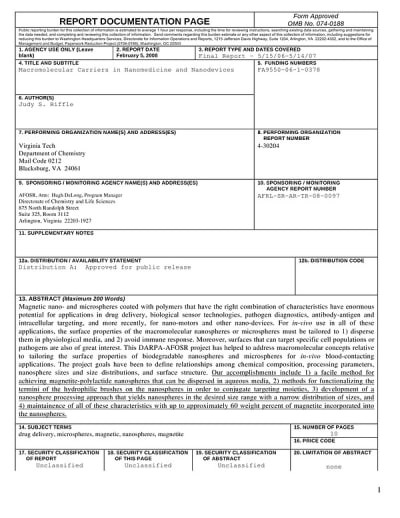
Macromolecular Carriers for Nanomedicine and Nano Devices
(reference AFRL-0102) is currently available for download from the TSP library.
Don't have an account?
More From SAE Media Group
Medical Design Briefs
Killing Cancer Cells May Be Possible With “Hairy” Nanorods
Medical Design Briefs
3D Printable Polymer Nanocomposite Ink
Medical Design Briefs
Transforming Plastic Parts into High-Value Products
Medical Design Briefs
Simple Method Developed for 3D Biofabrication Based on Bacterial Cellulose
Medical Design Briefs
Silicone Solutions for Lubrication in Medical Applications
Medical Design Briefs
Nontoxic, Flexible Energy Converters Could Power Wearable Devices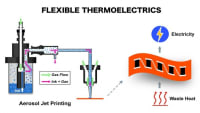
Medical Design Briefs
Encapsulated Nanoparticles Offer Promise for Biomedical Applications
Medical Design Briefs
Jetprinting Nanostructures with Self-Assembling Material
Medical Design Briefs
Thermometer Can Be Stretched and Crumpled by Water
Medical Design Briefs
New Material Family Could Build Realistic Prosthetics
Medical Design Briefs
Patch Delivers Insulin in Cheeks
Medical Design Briefs
Researchers Create Soft, Flexible Materials with Enhanced Properties
Medical Design Briefs
Malleable ‘Electronic Skin’ Self-Healable, Recyclable
Medical Design Briefs
Wearable Gas Sensor Enhances Sensitivity
Medical Design Briefs
Tubing Coated with Light-Powered Catalysts Aids Drug Manufacturing
Medical Design Briefs
Impact Modified Acrylic Copolymers: Understanding Chemical Resistance
Medical Design Briefs
Printable Nanoparticles Enable Mass Produced Biosensors
Medical Design Briefs
Plasma Treatment: Transforming Plastic Parts into High-Value Products
Medical Design Briefs
Skin Sensors Monitor Health
Medical Design Briefs
Biodegradable Polymer Is Stronger and Longer Lasting
Medical Design Briefs
The Use of Parylene-Coated Mandrels in the Balloon Catheter Manufacturing Process
Medical Design Briefs
Improved Polymer Electrode for Electronic Skin
Medical Design Briefs
Wearable Sensors Printed Directly on Skin with No Heat
Medical Design Briefs
From Research to Diagnostics: Plasma Treatments Improve Quality, Function
Medical Design Briefs
Sensor Detects Early-Stage Parkinson’s
Medical Design Briefs
Biomedical Skin-Like Bandage Is Stretchy, Durable, and Long Lasting
Medical Design Briefs
Mighty Morphing Composite Material
Medical Design Briefs
Wound Dressings Made of Drug-Releasing Polymers
Medical Design Briefs
3D Printing Shape-Changing Materials
Overview
The document presents a report on the advancements in macromolecular carriers for nanomedicine and nano-devices, focusing on magnetic nano- and microspheres coated with polymers. These carriers have significant potential for various applications, including drug delivery, biological sensor technologies, pathogen diagnostics, antibody-antigen interactions, intracellular targeting, and the development of nano-motors.
A key aspect of the research is the need to tailor the surface properties of these nanospheres and microspheres for in-vivo applications. The surface modifications are crucial for two main reasons: to ensure the carriers can disperse effectively in physiological media and to avoid triggering an immune response. Additionally, the ability to target specific cell populations or pathogens is highlighted as an area of great interest.
The project, funded by DARPA and AFOSR, aimed to explore the relationships among chemical composition, processing parameters, nanosphere sizes, size distributions, and surface structures. The accomplishments of the research include:
-
Development of Magnetite-Polylactide Nanospheres: A method was established to create magnetite-polylactide nanospheres that can be effectively dispersed in aqueous media, which is essential for biological applications.
-
Functionalization Techniques: The researchers developed methods to functionalize the termini of hydrophilic brushes on the nanospheres, allowing for the conjugation of targeting moieties. This enables the nanospheres to specifically bind to desired cells or pathogens.
-
Nanosphere Processing Approach: A novel processing technique was introduced that produces nanospheres within a desired size range while maintaining a narrow distribution of sizes. This uniformity is critical for consistent performance in medical applications.
-
High Magnetite Incorporation: The research demonstrated the ability to maintain the desired characteristics of the nanospheres even with up to approximately 60 weight percent of magnetite incorporated, which enhances their magnetic properties for targeted delivery.
Overall, the report underscores the innovative approaches being taken to enhance the functionality and effectiveness of macromolecular carriers in nanomedicine. The findings contribute to the ongoing development of advanced drug delivery systems and diagnostic tools, paving the way for more effective treatments and technologies in the biomedical field. The research is unclassified and publicly available, reflecting its significance in advancing nanotechnology applications in medicine.
Top Stories
INSIDERDesign
 How Airbus is Using w-DED to 3D Print Larger Titanium Airplane Parts
NewsSensors/Data Acquisition
 Microvision Aquires Luminar, Plans Relationship Restoration, Multi-industry Push
INSIDERManned Systems
 A Next Generation Helmet System for Navy Pilots
NewsAR/AI
 Accelerating Down the Road to Autonomy
INSIDERDefense
 New Raytheon and Lockheed Martin Agreements Expand Missile Defense Production
ArticlesAR/AI
 CES 2026: Bosch is Ready to Bring AI to Your (Likely ICE-powered) Vehicle
Webcasts
Semiconductors & ICs
 Advantages of Smart Power Distribution Unit Design for Automotive...
Unmanned Systems
 Quiet, Please: NVH Improvement Opportunities in the Early Design...
Electronics & Computers
 Cooling a New Generation of Aerospace and Defense Embedded...
Automotive
 Battery Abuse Testing: Pushing to Failure
Transportation
 A FREE Two-Day Event Dedicated to Connected Mobility
