




New Gel Polymer Electrolyte to Revolutionize the Safety of Li-ion Batteries
The non-flammable polymer semi-solid electrolyte offers a promising solution to mitigate battery fires.
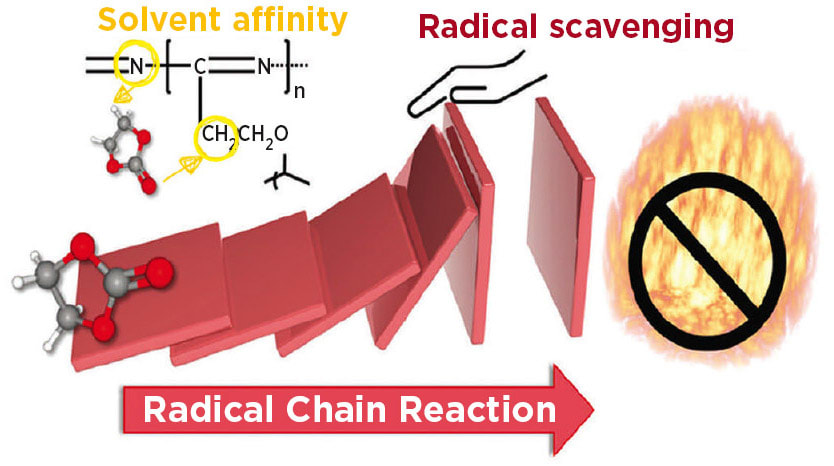
A collaborative research team, led by Professor Hyun-Kon Song in the School of Energy and Chemical Engineering at UNIST, Dr. Seo-Hyun Jung from Research Center for Advanced Specialty Chemicals at Korea Research Institute of Chemical Technology (KRICT), and Dr. Tae-Hee Kim from the Ulsan Advanced Energy Technology R&D Center at Korea Institute of Energy Research (KIER), has achieved a groundbreaking milestone in battery technology. Their remarkable achievement in developing a non-flammable gel polymer electrolyte (GPE) is set to revolutionize the safety of lithium-ion (Li-ion) batteries by mitigating the risks of thermal runaway and fire incidents.
In the past, the potential flammability of Li-ion batteries has raised significant concerns, especially in electric vehicles, where fire hazards pose a serious threat to underground parking lots. Addressing this critical issue, the research team has successfully developed a groundbreaking non-flammable polymer semi-solid electrolyte, offering a promising solution to mitigate battery fires.
Conventionally, non-flammable electrolytes have heavily relied on the incorporation of flame-retardant additives or solvents with exceptionally high boiling points. However, these methods often resulted in a considerable decrease in ion conductivity, compromising the overall performance of the electrolyte.
In their breakthrough research, the research team introduced a trace amount of polymer into the electrolyte, creating a semi-solid electrolyte. This novel approach dramatically increased the Li-ion conductivity by 33 percent compared to existing liquid electrolytes. Moreover, the pouchtype batteries incorporating this non-flammable semi-solid electrolyte exhibited a remarkable 110 percent improvement in life characteristics, effectively preventing unnecessary electrolyte reactions during the formation and operation of the solid-electrolyte interphase (SEI) layer.
The key advantage of this innovative electrolyte lies in its exceptional performance and non-combustibility. By suppressing radical chain reactions with fuel compounds during the combustion process, the polymer semi-solid electrolyte effectively inhibits the occurrence of battery fires. The research team demonstrated the excellence of the developed polymer by quantitatively analyzing its ability to stabilize and suppress radicals.
Jihong Jeong (School of Energy and Chemical Engineering, UNIST) said, “The interaction between the polymerized material inside the battery and volatile solvents allows us to effectively suppress radical chain reactions. Through electrochemical quantification, this breakthrough will greatly contribute to understanding the mechanism of non-flammable electrolytes.”
Co-first author Mideum Kim, a master student in the School of Energy and Chemical Engineering at UNIST and the Korea Research Institute of Chemical Technology (KRICT), further confirmed the exceptional safety of the battery itself through various experiments. The team’s comprehensive approach included applying the non-flammable semi-solid electrolyte to pouchtype batteries, ensuring the evaluation of electrolyte non-combustibility extended to practical battery applications.
For more information, contact UNIST Public Relations at
More From SAE Media Group
Battery & Electrification Technology
Cobalt-Free Batteries Could Power EVs of the Future
Battery & Electrification Technology
Developing Safer Batteries with Solid-State Polymer Electrolytes

Battery & Electrification Technology
New Priming Method for Improving Battery Lifecycle
Battery & Electrification Technology
New Polymer Coating Could Boost EV Batteries
Battery & Electrification Technology
New Hybrid Electrolyte for High-Performance Lithium-ion Batteries


Tech Briefs
New Polymer Coating Could Boost EV Batteries
Battery & Electrification Technology
Improving and Increasing Energy Density of Batteries
Battery & Electrification Technology
Manufacturing Advances in Solid-State Batteries
Tech Briefs
Dry Manufacturing Process for EV Batteries
Battery & Electrification Technology
Emerging Plasma FIB-SEM Techniques Advancing Battery Innovation
Automotive Engineering
NAWA Aims for 5-Minute EV Charge
Battery & Electrification Technology
Enhancing the Performance of All-Solid-State Batteries
Battery & Electrification Technology
Designing Safer, Higher-Performance Lithium Batteries
Battery & Electrification Technology
Increased Storage Capacity in Water-Based Batteries
Tech Briefs
5 Ws of the SAFIRE Lithium-Ion Battery
Battery & Electrification Technology
Cobalt-Free Electrodes Achieved with Nickel Ions
Tech Briefs
New Fluids Coming for EV Thermal Management
Battery & Electrification Technology
Researchers Unveil Scalable Graphene Technology to Revolutionize Battery Safety and Performance
Battery & Electrification Technology
A Solvent-Free Process to Make Better, Cheaper Li-ion Battery Electrodes


Battery Technology
Flexible, Thin-Film Battery
Battery & Electrification Technology
Iron Could Be Key to Less Expensive, Greener Lithium-Ion Batteries
Tech Briefs
Developing Fast-Charging Lithium-Metal Batteries
Top Stories
INSIDERManufacturing & Prototyping
 How Airbus is Using w-DED to 3D Print Larger Titanium Airplane Parts
NewsAutomotive
 Microvision Aquires Luminar, Plans Relationship Restoration, Multi-industry Push
INSIDERAerospace
 A Next Generation Helmet System for Navy Pilots
INSIDERDesign
 New Raytheon and Lockheed Martin Agreements Expand Missile Defense Production
ArticlesAR/AI
 CES 2026: Bosch is Ready to Bring AI to Your (Likely ICE-powered) Vehicle
Road ReadyDesign

Webcasts
Semiconductors & ICs
 Advantages of Smart Power Distribution Unit Design for Automotive...
Unmanned Systems
 Quiet, Please: NVH Improvement Opportunities in the Early Design...
Electronics & Computers
 Cooling a New Generation of Aerospace and Defense Embedded...
Power
 Battery Abuse Testing: Pushing to Failure
AR/AI
 A FREE Two-Day Event Dedicated to Connected Mobility
