




Films Containing Nanostructures and/or Reactive Scavengers
Films can be tailored to reduce permeability or to enable filtration.
Several advances have been made in research in the art of tailoring polymeric films to be, variously, (1) much more effective as barriers to diffusion of liquids and gases than they would otherwise be or (2) porous, with pore sizes suitable for filtration of selected gases or liquids. The part of the research addressing the barrier problem has provided a scientific basis for reducing the permeabilities of paints and packaging films to small fractions of the permeabilities of corresponding paints and packaging materials now in common use. In this part of the research, consideration was given to two strategies, described below, that can be used separately or together.
The other diffusion-barrier strategy is to incorporate a sacrificial scavenger material that reacts chemically with diffusing molecules to trap them. This strategy can increase the lag by a large factor. Of course, this strategy does not inhibit steady-state diffusion because it ceases to be effective once all the scavenger material has been consumed. The effectiveness of this strategy was demonstrated in experiments in which iron nanoparticles were incorporated as a scavenger material into polyethylene films like those used as barriers in landfills. The lag in diffusion of chlorinated hydrocarbons through the iron-containing films was 300 times that through non-iron-containing films.
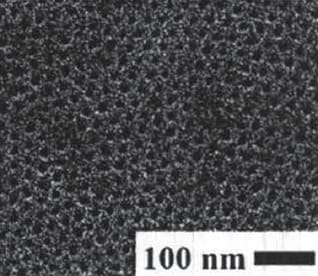
The portion of the research addressing porosity has been motivated by the prospect of using films containing nanoscopic pores for filtering water. Several approaches to utilization of the tendency of block copolymers to assemble themselves into aligned structures have been investigated. The most promising approach is based on the observation that when a diblock copolymer is cast rapidly from a highly volatile solvents, under some circumstances, the polymer blocks segregate themselves so as to form cylinders of one polymer, oriented perpendicularly to the surface, within a matrix of the other polymer. Then the cylinder polymer can be etched away, leaving a porous film consisting of the matrix polymer (see figure).
This work was done by Edward L. Cussier of the University of Minnesota for the Air Force Research Laboratory.
AFRL-0052
This Brief includes a Technical Support Package (TSP).
Films Containing Nanostructures and/or Reactive Scavengers
(reference AFRL-0052) is currently available for download from the TSP library.
Don't have an account?
More From SAE Media Group
Tech Briefs
Copolyimide Surface-Modifying Coating
Tech Briefs
Stretchable Thermoelectric Generators

Tech Briefs
High Thermally Conductive Polymeric Composites

Medical Design Briefs
Silicone Solutions for Lubrication in Medical Applications
Tech Briefs
Precision CNT Cutting Mechanism

Aerospace & Defense Tech Briefs
Biobased Carbon Fibers and Thermosetting Resins for Use in DOD Composites Applications
Medical Design Briefs
Researchers Create Soft, Flexible Materials with Enhanced Properties
Tech Briefs
Fast-Acting Molecular Probe
Air Force Research Laboratory Technology Horizons
Conductive Polymeric Nanocomposite Materials
Tech Briefs
Self-Growing 3D Objects

Medical Design Briefs
3D Printable Polymer Nanocomposite Ink

Tech Briefs
Conductive Carbon Fiber Polymer Composite

Medical Design Briefs
Tubing Coated with Light-Powered Catalysts Aids Drug Manufacturing

Tech Briefs
Advanced Carbon Aerogels for Energy Applications


Overview
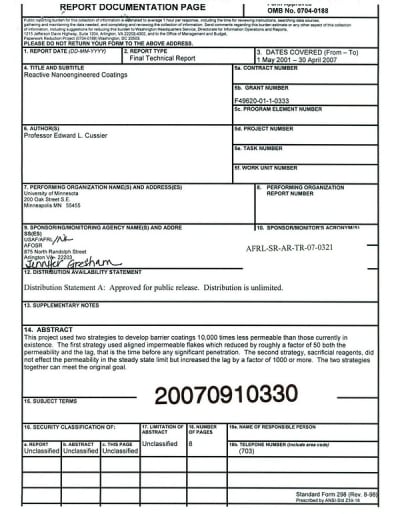
The document presents a final technical report on a research project focused on developing reactive nanoengineered coatings, aimed at significantly reducing the permeability of barrier films, such as those used in paints and packaging. Conducted by Professor Edward L. Cussler and his team at the University of Minnesota, the project was funded by the Air Force Office of Scientific Research and spanned from November 2006 to October 2007.
The research employed two primary strategies to achieve a permeability reduction of up to 10,000 times compared to existing materials. The first strategy involved the incorporation of aligned impermeable flakes into the film, which reduced both the permeability and the lag time (the time before significant penetration occurs) by approximately a factor of 50. The second strategy utilized sacrificial reagents that, while not affecting the steady-state permeability, increased the lag time by a factor of 1000 or more. This combination of strategies effectively met the project's original goals.
The report details the scientific principles behind these strategies, explaining how the addition of impermeable flakes forces solutes to navigate a tortuous path, thereby delaying their penetration. The sacrificial reagents consume diffusing solutes before they can cross the membrane, further enhancing the barrier's effectiveness. The research also highlights the importance of characterizing barrier films by their lag time and leak rate, with findings exemplified through studies on the diffusion of chlorinated hydrocarbons across polyethylene films.
Additionally, the report discusses the use of block copolymers to create self-assembled aligned flakes, allowing for the development of flexible yet low-permeability materials. The project also explored the potential of nanoparticles, such as zero valent iron, to enhance the lag time in barrier films.
Future work is suggested to extend these findings to other systems, aiming to test different polymers and solvents for ultrafiltration membranes. Although the grant has expired, the researchers express a commitment to continue their experiments and share their successes.
Overall, the document encapsulates a significant advancement in material science, with implications for environmental protection, particularly in applications like landfill barriers and water purification. The innovative approaches outlined in the report could lead to the development of more effective and sustainable barrier materials.
Top Stories
NewsSensors/Data Acquisition
 Microvision Aquires Luminar, Plans Relationship Restoration, Multi-industry Push
INSIDERRF & Microwave Electronics
 A Next Generation Helmet System for Navy Pilots
INSIDERWeapons Systems
 New Raytheon and Lockheed Martin Agreements Expand Missile Defense Production
NewsAutomotive
 Ford Announces 48-Volt Architecture for Future Electric Truck
INSIDERAerospace
 Active Strake System Cuts Cruise Drag, Boosts Flight Efficiency
ArticlesTransportation

Webcasts
Aerospace
 Cooling a New Generation of Aerospace and Defense Embedded...
Energy
 Battery Abuse Testing: Pushing to Failure
Power
 A FREE Two-Day Event Dedicated to Connected Mobility
Automotive
 Quiet, Please: NVH Improvement Opportunities in the Early Design Cycle
Electronics & Computers
 Advantages of Smart Power Distribution Unit Design for Automotive &...
Unmanned Systems
 Sesame Solar's Nanogrid Tech Promises Major Gains in Drone Endurance