




Paradigm Shift in NVH
A new wave of vehicle technologies is changing the way Brüel & Kjaer attacks noise, vibration and harshness.
When you’re in the business of NVH solutions, you get to know noise and vibration up close and personal. And for these experts, it can be difficult to sequester the ‘N and V’ throughout their own day. Ask Dr. Gabriella Cerrato, manager of global sound and vibration engineering services at Brüel & Kjaer.
“I can’t be in a hotel room and not be aware of things like the refrigerator compressor, the ice maker, or the air conditioning,” she noted. “Although I’m not a geek about it—I don’t immediately ponder the sources and potential noise paths of the hotel HVAC, for example — it sometimes drives me nuts.”
That’s likely not surprising to industry engineers wrestling with sound and vibration challenges in a world that’s increasingly attuned to the effects of noise pollution on one hand, while thrilling to the growl of a Corvette on wide-open throttle—or the serenity of an electric luxury sedan on the highway.
“Fundamentally, our approach to NVH is to create a quality sound and feel for the driver,” Dr. Cerrato explained, while meeting the acoustic and harmonic challenges that come with vehicle lightweighting, electrified propulsion and automated driving. Brüel & Kjaer (known simply as ‘B&K’ among industry engineers) is even addressing the subject of adding electronic ‘sound enhancement’ to EVs.
“We have an area in ‘sound design’ where we are helping several OEMs design the best sound for the interior or exterior of their EVs. No one knows what that sound should be – what an electric Ford or an electric Ferrari should sound like,” she explained. “To me, it’s a push-button gadget. It’s a very geographic thing, I think.”
On a higher frequency

Dr. Cerrato’s route to the Denmark-based company [bksv.com] started with her Ph.D in fluid dynamics and led into the acoustics realm and co-ownership of an NVH consulting firm. She recently sat down with Automotive Engineering to talk about how NVH analysis and technologies are evolving to meet future technology and market trends. The emerging EV and self-driving frontiers generated much discussion.
“I don’t consider EVs to be as much of a paradigm shift as autonomous driving. EVs still have motors and generate gear whine and high frequency noise at 6000 Hertz and above,” she said. “You just need to set targets and work with the motor and gear manufacturers. We’ve done several projects with a number of CAE companies and take their outputs and plug it into our simulator model. We’re launching a series of seminars with them.”
EVs don’t fundamentally change the NVH approach, to create a good sound and feel for the driver, she opined, because “they have the same ‘receiver’ — a human driver.”
Driverless AVs, however, are the true paradigm shift for B&K and others in the NVH field because they don’t have a clear receiver.
“It’s a passive experience; you may want to have a meeting or make a phone call or watch a movie; it’s all about maximizing the user experience,” said Dr. Cerrato. “The issues are about infotainment, comfort, and speech intelligibility. It’s a challenge for us; we must adapt. Sound quality and how it engages us with the vehicle, has become irrelevant to a certain extent.”
She compares the NVH challenges with AVs to the acoustic challenges in building architecture — except with AVs, ‘the building’ is moving. B&K’s next major opportunity is to further develop the tools and processes for addressing NVH in the user experience, she said.
The industry’s growing focus on AVs also is causing a shift at the OEMs in terms of their NVH engineering staffs. According to Dr. Cerrato, many NVH specialists—whose focus had been in abating road noise, powertrain NVH, suspension harshness — are moving into different areas and are now focused on user experience.
High-fidelity inputs
B&K’s expanding product portfolio is notably heavy with software-based toolsets aimed at identifying root-cause NVH sources and their pathways. It also features a series of NVH simulation tools, developed within the context of vehicle development and design.
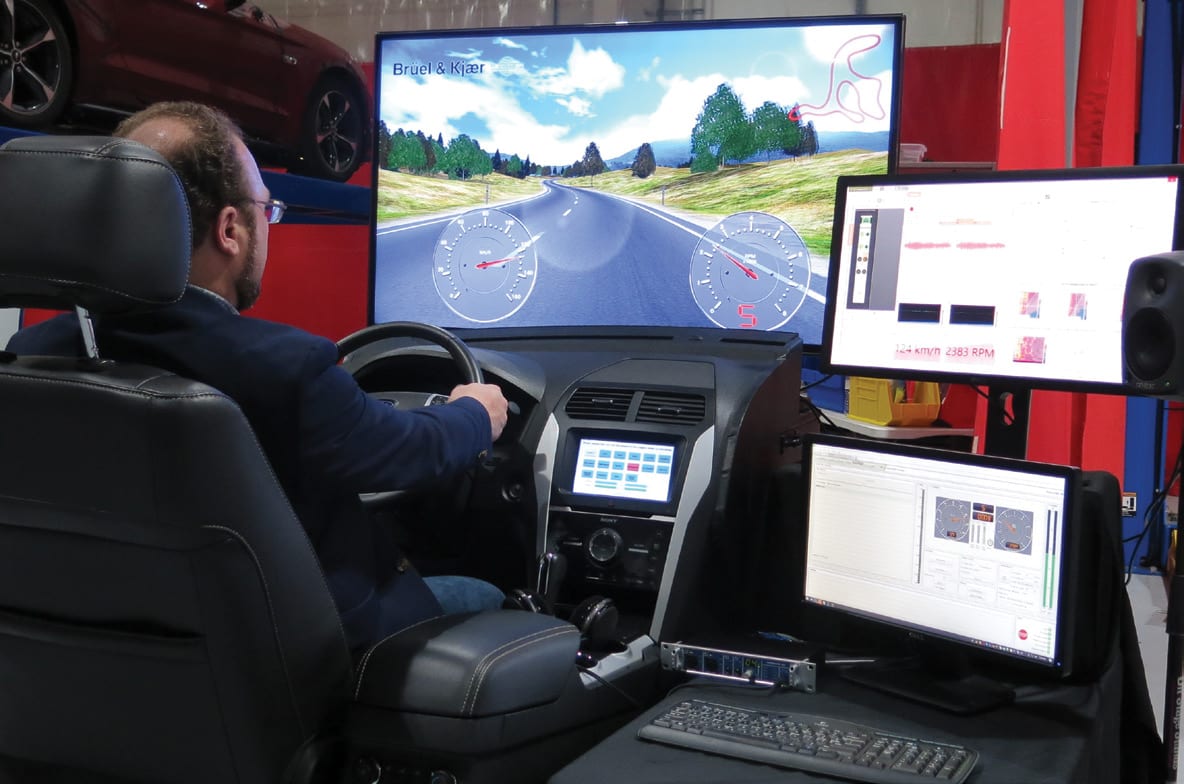
For vehicle development teams, the Brüel & Kjaer NVH simulators have proved to be popular tools for establishing NVH goals early in vehicle development, before the design and hardware are finalized. Most automakers and some Tier 1s own one, according to Dr. Cerrato.
The tool’s software is commonly paired with a steering wheel and pedals to allow drivers to experience the sound and vibration data. High-fidelity vehicle sound is played through headphones or speakers, allowing the ‘driver’ to experience the vehicle sound quality throughout the dynamic aspects of driving such as accelerating and traversing different surfaces. Such realistic immersion helps in selecting appropriate sounds, comparing alternative designs and, B&K claims, increasing confidence in evaluating concepts or physical prototype updates.
“We take a production vehicle and sort of ‘break it down’ into the various noise and vibration sources and paths, and how they transfer to the driver,” she explained. “Then we put it back together in the lab so you can actually shift gears and hear the sounds. That is so important in developing the new vehicle, particularly when we want to use the existing powertrain — which is very typical in the industry. With a new body you have different isolation from the outside, different noise paths.”
Added Gary Newton, B&K’s director, Automotive Americas, as he demonstrated an NVH simulator to AE: “We can link the CAE outputs to the previous generation vehicle’s benchmark data. We can generate what that vehicle should sound like, is going to sound like, then play the ‘what if’ scenarios to optimize that platform with accurate design and engineering decisions going forward.”
Newton admitted that a lot of subjectivity exists in the traditional vehicle sign-off process. Typically, all the ‘ears’ involved don’t come into play until four or five prototype iterations down the road.
“Here’s what often happens,” he said. “The development team sits in a room, as I have, where you have 2-D graphs on the board and everybody is arguing over some breach in the target that may or may not be an issue – and they’re arguing about investing engineering resources over the next three months for a fix. That’s what the simulator was designed to avoid,” he said.
More From SAE Media Group
Off-Highway Engineering
Arctic Autonomy
Automotive Engineering
Snapdragon Ride Flex Puts Safety, Infotainment onto Single Chip

Off-Highway Engineering
PACCAR CTO Offers Insights on SDVs, AVs and BEVs
Autonomous Vehicle Engineering
GM Announces Door-To-Door Ultra Cruise ADAS
Automotive Engineering
GM Confirms Cause of Bolt Battery Fires, Rolls out New Monitoring Software
Automotive Engineering
Engineering Volvo’s Next Big Leap
Off-Highway Engineering
Digitalization of Product Engineering
Automotive Engineering
Electrification Forces Fresh Perspectives on Vehicle NVH
Tech Briefs
EV Battery Innovation - November 2023

Autonomous Vehicle Engineering
Going the Last Mile
Automotive Engineering
EV Motor Development Is on the Move
Automotive Engineering
Airflow Concept Presents Chrysler EV Direction
Automotive Engineering
Mercedes-Benz Product Boss: Europe, North America EVs, EV Charging to Rapidly Get Better
Tech Briefs
Videos of the Month
Automotive Engineering
GM’s Barra: Electric Vehicles Are Still the Future
Off-Highway Engineering
Modern Approaches to Electric Vehicle Noise and Vibration
Automotive Engineering
Hitachi-Astemo and the Electrified Future
Off-Highway Engineering
Software’s Hard Challenges
Tech Briefs
Simulation of Autonomous Vehicles
Automotive Engineering
Magna Prepared for AV “Marathon”
Automotive Engineering
GM Readies Comprehensive New Vehicle-Software Platform
Automotive Engineering
The Navigator: The Not-So-Hidden Cost of “Free”
ADAS & Autonomous Vehicle Engineering
Mercedes-Benz Architecting Its Own Operating System
Autonomous Vehicle Engineering
Delivering on Autonomous Transport

Autonomous Vehicle Engineering
BMW 7-Series Drives Itself Through Own Assembly
Automotive Engineering
Ford Unveils 2021 Mustang Mach-E Electric Vehicle
Automotive Engineering
EVs Pressure Supplier Value-add
Top Stories
INSIDERManufacturing & Prototyping
 How Airbus is Using w-DED to 3D Print Larger Titanium Airplane Parts
INSIDERManned Systems
 FAA to Replace Aging Network of Ground-Based Radars
NewsTransportation
 CES 2026: Bosch is Ready to Bring AI to Your (Likely ICE-powered) Vehicle
NewsSoftware
 Accelerating Down the Road to Autonomy
EditorialDesign
 DarkSky One Wants to Make the World a Darker Place
INSIDERMaterials
 Can This Self-Healing Composite Make Airplane and Spacecraft Components Last...
Webcasts
Defense
 How Sift's Unified Observability Platform Accelerates Drone Innovation
Automotive
 E/E Architecture Redefined: Building Smarter, Safer, and Scalable...
Power
 Hydrogen Engines Are Heating Up for Heavy Duty
Electronics & Computers
 Advantages of Smart Power Distribution Unit Design for Automotive...
Unmanned Systems
 Quiet, Please: NVH Improvement Opportunities in the Early Design...
