




Solid-State EV Batteries Project to Low Penetration in 2030

Although the automotive industry sees solid-state batteries as the next game-changer for EV driving range, performance and safety, the technology is projected to penetrate the market at a 5 percent rate at best by 2030, said one battery-development expert speaking at the 2023 Battery Show North America in Novi, MI. Another presenter said solid-state technology still has several significant challenges to overcome before being commercially viable for mass-market EVs.
Bill Kephart of P3 Group, an automotive-industry consultancy, said to expect a 3 percent to 5 percent penetration rate for solid-state batteries in 2030. He cited four factors — performance, manufacturability, supply chain, and cost — as the primary areas in which solid-state technology must improve before being able to reach high-volume potential.
Kephart said there are “very few know facts about manufacturability,” and added that the supply chain for solid-state batteries “is at a very low maturity.” He mentioned questions about the supply of solid electrolytes and lithium metal anodes as specific examples.
In a separate presentation titled “Status, Challenges and Needs of Solid-State Batteries, Alvaro Masias, Cell Technology Research Supervisor at Ford, said bluntly that while good progress has been made in development of solid-state batteries, it is “very difficult to see [the technology] would be cost-competitive in the near-term.”
Masias cited ongoing support from the United States Advanced Battery Consortium (USABC) as an enabler of ongoing R&D and noted that the USABC’s target of a battery chemistry to deliver an energy density of 450 watt-hours per kilogram requires a significant upgrade over current lithium-ion batteries, which offer around 350 Wh/kg and “doesn’t support our long-term goals.”
He said there is ongoing development of aspects of solid-state design, such as “hybrid” or semi-solid electrolytes, but there are any number of performance- and cost-related aspects of solid-state designs that remain unresolved. Masias displayed a graphic with a maze-like matrix of collaborating automakers, battery manufacturers, and startup companies and said most companies have diversified their battery-development investments to assure a reliable supply of proven technology while supporting R&D of advanced chemistries such as solid state.
More From SAE Media Group
Tech Briefs
Factorial’s Solid-State B-Samples Send a Message
Automotive Engineering
Nissan's Innovative Solid-State Gambit
Automotive Engineering
Scaling the Solid-State Battery FEST
Battery Technology
Doubling Battery Performance with Lithium Metal
Automotive Engineering
EMBATT Technology Could Double the Driving Range of EVs
Battery & Electrification Technology
Volvo Trucks’ Battery Chemistry of Choice: NCA
Automotive Engineering
New Materials Move Li-Ion Batteries Toward the Solid-State Endgame
Battery Technology
Low-Cost, Fast Production of Solid-State Batteries
Tech Briefs
Long-Life Lithium-Metal Battery
Automotive Engineering
Launching Aerospace Battery Tech for EVs
Battery Technology
Hybrid Membrane Doubles the Lifetime of Rechargeable Batteries

Automotive Engineering
Battery Experts: Solid-State EV Tech Could Be Five Years Out
Off-Highway Engineering
Breakthroughs in 3D-Printing Give Way for Promising Textile Lithium Battery Technology
Tech Briefs
Anode Material for Safer Fast-Charging Batteries

Tech Briefs
Coating Extends Lithium Metal Battery Life

Battery & Electrification Technology
Developing High-Energy-Density Batteries Using Aluminum Foil

Battery Technology
Ultrasound Device Improves Charge Time and Run Time in Lithium Batteries
Medical Design Briefs
Flexible High-Energy Textile Lithium Battery Designed for Wearables
Battery Technology
Spreadable Way to Stabilize Solid-State Batteries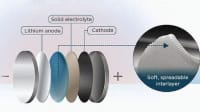
Automotive Engineering
BYD’s Blade Runner
Automotive Engineering
Can Solid-State Batteries Commercialize by 2030?

Automotive Engineering
Clarios Sees Low-Voltage Electricals as Vital in EV, AV Future
Top Stories
INSIDERDesign
 How Airbus is Using w-DED to 3D Print Larger Titanium Airplane Parts
NewsSensors/Data Acquisition
 Microvision Aquires Luminar, Plans Relationship Restoration, Multi-industry Push
INSIDERManned Systems
 A Next Generation Helmet System for Navy Pilots
NewsAR/AI
 Accelerating Down the Road to Autonomy
INSIDERDefense
 New Raytheon and Lockheed Martin Agreements Expand Missile Defense Production
ArticlesAR/AI
 CES 2026: Bosch is Ready to Bring AI to Your (Likely ICE-powered) Vehicle
Webcasts
Semiconductors & ICs
 Advantages of Smart Power Distribution Unit Design for Automotive...
Unmanned Systems
 Quiet, Please: NVH Improvement Opportunities in the Early Design...
Electronics & Computers
 Cooling a New Generation of Aerospace and Defense Embedded...
Automotive
 Battery Abuse Testing: Pushing to Failure
Transportation
 A FREE Two-Day Event Dedicated to Connected Mobility
