




Flexible Biohybrid Nanomembranes for Multifunctional Sensors
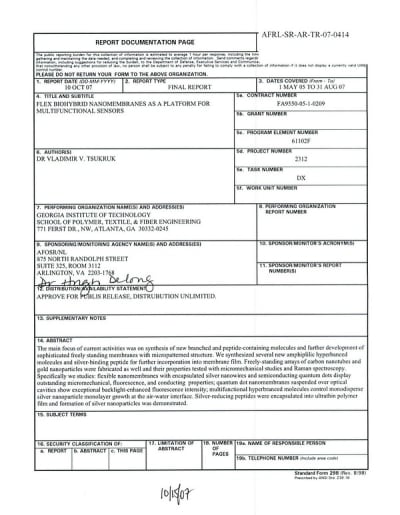
A document describes recent activities in a continuing effort to develop devices, based on biohybrid nanomembranes, that would perform diverse sensory functions. The term "biohybrid nanomembranes" signifies flexible organic/inorganic composite membranes, of the order of tens of nanometers thick, typically comprising polymeric outer supporting layers and wholly or partly inorganic (e.g., biomineralized) inner sensory layers. This development is envisioned to yield novel acoustic, infrared, and photothermal sensors characterized by extreme degrees of miniaturization and sensitivity. The main focus of recent activities was on (1) synthesis of new branched and peptide-containing molecules to be incorporated into membranes and (2) further development of sophisticated freely standing membranes with micropatterned structures. In addition, membranes encapsulating arrays of carbon nanotubes and gold nanoparticles were fabricated and tested in micromechanical Raman-spectroscopic studies. Recent findings include the following:
- Flexible nanomembranes with encapsulated silver nanowires and semiconducting quantum dots exhibit outstanding micromechanical, fluorescence, and conducting properties.
- Quantum-dot nanomembranes suspended over optical cavities exhibit exceptional backlight enhanced fluorescence intensity.
- Multifunctional hyperbranched molecules control the growth of monolayers of monodisperse silver nanoparticles at air-water interfaces.
- Silver-reducing peptides can be encapsulated in ultrathin polymer films and there utilized to effect formation of silver nanoparticles.
This work was done by M. Stone, R. Naik, and T. Bunning of the Air Force Research Laboratory, and Vladimir V. Tsukruk, M. Ornatska, B. Rybak, M. Lemieux, Y. H. Lin, C. Jiang, M. McConney, K. Bergman, and E. Kharlampieva of Georgia Institute of Technology.
AFRL-0067
This Brief includes a Technical Support Package (TSP).
Flexible Biohybrid Nanomembranes for Multifunctional Sensors
(reference AFRL-0067) is currently available for download from the TSP library.
Don't have an account?
More From SAE Media Group
Medical Design Briefs
3D Printable Polymer Nanocomposite Ink
Tech Briefs
High Thermally Conductive Polymeric Composites

Tech Briefs
Nanoscale Pillars Act as Memory Foam
Tech Briefs
Conductive Carbon Fiber Polymer Composite
Medical Design Briefs
New Thermofluidic Improves Lab-On-a-Chip Applications
Aerospace & Defense Tech Briefs
Design of New Piezoelectric Composites Using Nanocellulose
Tech Briefs
Stretchable Thermoelectric Generators
Tech Briefs
Sound Waves Power Advances in Smart Materials

Tech Briefs
Metallic Hollow Nanoparticle Fabrication

Tech Briefs
Water Purification System Engineered from Wood
Tech Briefs
Fiber-Metal Laminate Manufacturing Technique
Tech Briefs
Advanced Carbon Aerogels for Energy Applications
Tech Briefs
Copolyimide Surface-Modifying Coating
Tech Briefs
Technique Creates Adaptive Materials

Tech Briefs
VaCNT Makes Up a Promising Membrane Material
Tech Briefs
Scaling Up Nano for Sustainable Manufacturing

Medical Design Briefs
Hybrid Material Enables Next-Gen E-Skin

Aerospace & Defense Tech Briefs
Biobased Carbon Fibers and Thermosetting Resins for Use in DOD Composites Applications
Tech Briefs
Precision CNT Cutting Mechanism
Tech Briefs
Stretchable, Flexible Biofuel Cell Runs on Sweat
Medical Design Briefs
Multimodal Graphene-Based E-Textiles
Overview
The document presents a final report on the research conducted by Dr. Vladimir V. Tsukruk and his team at the Georgia Institute of Technology, focusing on the development of flexible biohybrid nanomembranes for multifunctional sensors. The research spans from May 2005 to August 2007 and emphasizes the synthesis of new branched and peptide-containing molecules, as well as the creation of sophisticated freely-standing membranes with micropatterned structures.
Key highlights of the research include the assembly of ultrathin layer-by-layer (LbL) nanomembranes, which were fabricated using spin coating techniques. These membranes exhibited remarkable mechanical properties, including a high elastic modulus of 6-8 GPa and an ultimate tensile strength of up to 100 MPa, significantly surpassing conventional polymer composites. The study also explored the multilength unfolding patterns of silk fibroin, revealing complex interactions between hydrophilic and hydrophobic domains that contribute to the material's mechanical behavior.
The report outlines the importance of understanding nanoscale interactions and structures for the successful assembly of highly sensitive nanomembranes. The research aims to enhance the performance of sensor arrays for applications in thermal, acoustic, chemical, and photothermal detection. The focus areas include the directed assembly of multilayered organic-inorganic membranes, the investigation of hierarchical nanostructural organization, and the design of effective elastic nanoscale matrices for free-standing membranes.
Additionally, the document discusses the integration of flexible nanomembranes into microfabricated arrays, which could lead to significant advancements in sensor technology. The research also highlights the potential for miniaturization and improved sensitivity in hybrid sensor arrays, making them suitable for various applications.
Overall, the report emphasizes the innovative approaches taken in the synthesis and characterization of nanomaterials, showcasing their potential for future applications in sensing technologies. The findings contribute to the broader understanding of nanostructured materials and their mechanical properties, paving the way for advancements in flexible and multifunctional sensor platforms.
Top Stories
INSIDERManufacturing & Prototyping
 How Airbus is Using w-DED to 3D Print Larger Titanium Airplane Parts
NewsAutomotive
 Microvision Aquires Luminar, Plans Relationship Restoration, Multi-industry Push
INSIDERAerospace
 A Next Generation Helmet System for Navy Pilots
INSIDERDesign
 New Raytheon and Lockheed Martin Agreements Expand Missile Defense Production
ArticlesAR/AI
 CES 2026: Bosch is Ready to Bring AI to Your (Likely ICE-powered) Vehicle
Road ReadyDesign

Webcasts
Semiconductors & ICs
 Advantages of Smart Power Distribution Unit Design for Automotive...
Unmanned Systems
 Quiet, Please: NVH Improvement Opportunities in the Early Design...
Electronics & Computers
 Cooling a New Generation of Aerospace and Defense Embedded...
Power
 Battery Abuse Testing: Pushing to Failure
AR/AI
 A FREE Two-Day Event Dedicated to Connected Mobility
