




New Polycarbonates Provide ‘Sensor Transparency’

The sensor arrays that currently reside on the roofs of development mules will be hidden from view on future production vehicles. But how to conceal them without affecting their safety-critical performance? This design and engineering challenge, along with the growing trend toward larger, multifunction interior and exterior displays, is driving new polycarbonate solutions at Covestro, which was spun off from Bayer Materials Science in 2015. For insights into this new family of materials, editor Lindsay Brooke spoke with Paul Platte, a mechanical engineer by training who now is part of Covestro’s marketing team.
The term ‘optical purity’ is used to describe requirements for advanced headlamp modules that incorporate forward-looking sensors. What’s your take on that?
Optical purity of the sensor’s cover lens, or any surface that protects an optical sensor, is important for that sensor’s acuity. With lidar for example, as the emitted light passes through the cover lens and returns, any impurities in the material can degrade the fidelity of the signal itself. We’re developing solutions to improve the purity of our polycarbonate materials, not only the grades but also the coloring systems.
Then you must validate it.
Yes, and because it’s a safety-related item it requires more time to validate. Some developers who didn’t think they needed the higher-performance material have observed what I’ll call ‘application-level’ defects. Traditionally in automotive you start with the lower-cost materials and see if they work, and we’ve already had people who found that they really do need the more optically-pure polycarbonates and come back to us with that request.
Exterior designers say integrating lidar into the bodywork is a looming challenge.
For integrating lidar, we now have sensor-transparent grades of material. We have had our AL [automotive lens] grade used in headlamps for years. We enhance that to achieve higher purity, toward an AX [exterior polycarbonate family] or an Ai if it’s in the interior. But to have sensor transparency, you also must consider the base material and color combinations. Making something that looks simple and homogeneous can be challenging. Designers want their new displays to appear ‘hidden until lit.’ They want a deep, glass-like, piano-black surface until it’s back-illuminated. Sometimes the items behind that surface are translucent, transparent, or opaque, requiring three different color matches to sustain a consistent surface appearance. In increases the materials complexity three-fold.
Our sensor-transparent polycarbonate grades are designed to be virtually opaque to the human eye, with the rich high-gloss finish, while they’re actually transparent to lidar’s 905- and 1550-nanometer wavelengths. This is where OEMs are headed now, in terms of hiding their sensor arrays. And located next to that lidar behind the front-end panel, you might have a headlamp whose light must shine through. And next to the hidden headlamp you might have a micro-LED or OLED display. Those displays are offering increasing resolution. The industry is taking technology from consumer electronics and bringing it into automotive. Covestro’s approach is we want to work with customers on whatever route they take.
Is the trend toward larger UX displays in cabins driving more focus on greater polycarbonate acuity?
Yes. Internally we talk about a three-dimensional surface that has radius of curvature in two directions, like a horse saddle. And those radii are getting tighter and tighter. That solution is viable in polycarbonate. It’s been part of our polycarbonate-windows discussion for a while. That kind of surface form factor is coming to both interior displays and to the large front-end panels of electric vehicles, as shown in concept by Mercedes, BMW and others. That surface is going to have sensors and displays behind it — the exterior displays being used for differentiation and for pedestrian protection.
More From SAE Media Group
Electronics & Sensors INSIDER
Manufacturing the World's Tiniest Light-Emitting Diodes
Power Electronics INSIDER
World’s Strongest Battery Paves Way for Light, Energy-Efficient Vehicles
Automotive Engineering
Universal Vision Sensor
Tech Briefs
Wavy Surfaces for Better Light Control

Medical Design Briefs
Optical Design Considerations for Additive Manufacturing

Automotive Engineering
Ceres Holographics, Appotronics Team for Windshield-Wide Laser HUD
Photonics & Imaging Technology
New Products
Tech Briefs
2025 Award Finalists
Motion Design INSIDER
Microdrones With Light-Driven Nanomotors
Tech Briefs
New Family of Glass for Lens Applications
Tech Briefs
Inkjet Printing of Metamaterials
Electronics & Sensors INSIDER
Researchers Have Developed the World’s Smallest Ultrasound Detector
Photonics & Imaging Technology INSIDER
Coherent Establishes 6-inch InP Wafer Fabrication Capability
Power Electronics INSIDER
An Electrifying Improvement in Copper Conductivity
Battery & Electrification Technology
Fully Stretchable Fabric-Based Lithium-Ion Battery
Off-Highway Engineering
Liebherr Reveals ‘Hybrid’ CFRP Cylinders and Parallel-Pump Concept
Photonics & Imaging Technology
Light-Analyzing ‘Lab on A Chip’ Opens Door to Widespread Use of Portable Spectrometers
Photonics & Imaging Technology
Ultrafast Laser Micromachining
Tech Briefs
Manufacturing Ultra-Thin Camera Lenses
Photonics & Imaging Technology
SPIE Photonics West 2023 Preview
Photonics & Imaging Technology INSIDER
Researchers 3D Print Metamaterials with Novel Optical Properties
Medical Design Briefs
Tiny Spectral Sensor Identifies Materials

Automotive Engineering
The Inside Story on Glass Lamination Film Technology for Tomorrow’s Vehicles
Autonomous Vehicle Engineering
Sensors Step Out While Startups Stutter
Tech Briefs
An Automatic Drawing Machine for Metamaterials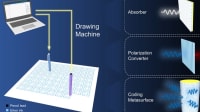
Top Stories
NewsSensors/Data Acquisition
 Microvision Aquires Luminar, Plans Relationship Restoration, Multi-industry Push
INSIDERRF & Microwave Electronics
 A Next Generation Helmet System for Navy Pilots
INSIDERWeapons Systems
 New Raytheon and Lockheed Martin Agreements Expand Missile Defense Production
NewsAutomotive
 Ford Announces 48-Volt Architecture for Future Electric Truck
INSIDERAerospace
 Active Strake System Cuts Cruise Drag, Boosts Flight Efficiency
ArticlesTransportation

Webcasts
Aerospace
 Cooling a New Generation of Aerospace and Defense Embedded...
Energy
 Battery Abuse Testing: Pushing to Failure
Power
 A FREE Two-Day Event Dedicated to Connected Mobility
Automotive
 Quiet, Please: NVH Improvement Opportunities in the Early Design Cycle
Electronics & Computers
 Advantages of Smart Power Distribution Unit Design for Automotive &...
Unmanned Systems
 Sesame Solar's Nanogrid Tech Promises Major Gains in Drone Endurance