




C++ Architecture for Simulating UAVs
A conference paper describes the use of the CADAC++ software system for simulating operations of uninhabited aerial vehicles (UAVs) in conjunction with moving ground targets while interacting with other UAVs and with satellites that assist in targeting. CADAC++ was developed by rewriting the prior Fortran-language CADAC software to take advantage of features of C++ that enable multiple instantiation of UAVs, targets, and satellites, thereby enabling the study of such phenomena as fly-out trajectories, third-party targeting, and distributed information sharing. [CADAC (Com puter Aided Design of Aerospace Con cepts) is chiefly an engineering tool to aid in developing aerospace vehicles.] The architecture of CADAC++ is based on the hierarchical structure of inherited classes, wherein, among other things, every instantiated vehicle object is encapsulated with its methods and data. The paper discusses this architecture in more detail, outlining its class structure and a global data bus through which encapsulated vehicle-objects communicate. The paper then discusses a simulation involving a generic UAV model having five degrees of freedom in order to demonstrate the interactive features of the simulation and to support the conclusion that C++ is the programming environment of choice for networked simulations.
This work was done by Peter H. Zipfel of the Air Force Research Laboratory.AFRL-0056
This Brief includes a Technical Support Package (TSP).
C++ Architecture for Simulating UAVs
(reference AFRL-0056) is currently available for download from the TSP library.
Don't have an account?
More From SAE Media Group
Aerospace & Defense Tech Briefs
Adamant: A Soon-to-be Open Source, Mission-Critical Flight Software Framework Written in Ada
Aerospace & Defense Tech Briefs
Queuing Model for Supervisory Control of Unmanned Autonomous Vehicles
Air Force Research Laboratory Technology Horizons
Coordination of Autonomous Unmanned Air Vehicles
Aerospace & Defense Tech Briefs
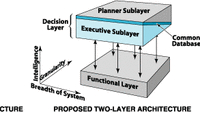
Deterministic and Modular Architecture for Embedded Vehicle Systems
Tech Briefs
Open Software Options for Automation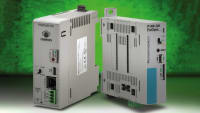

Photonics & Imaging Technology
Total Versatility: Flexible Test Station With a Cobot and Camera
Software Tech Briefs
Policy-Based Negotiation Engine for Cross-Domain Interoperability
Aerospace & Defense Tech Briefs
Two-Processor Autopilot System for a UAV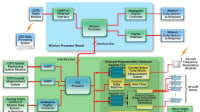
Tech Briefs
Designing Application Software for DSP Chips


Aerospace & Defense Tech Briefs
FACE Technical Standard Offers MOSA Lessons for Safety-Critical Software in Any Sector
Tech Briefs
Fused Analytic Desktop Environment (FADE)


Aerospace & Defense Tech Briefs
Supervisory Control State Diagrams to Depict Autonomous Activity

Aerospace & Defense Tech Briefs
One Person Can Supervise a Swarm of 100 Unmanned Autonomous Vehicles
Aerospace & Defense Tech Briefs
Automatic Abstraction of Information From Digitized Images
Tech Briefs
Ontology-Driven Information Integration
Tech Briefs
Digital Twins: The Next Steps


Tech Briefs
5G, AI Team Up to Optimize Military Fueling
Tech Briefs
Active State Model for Autonomous Systems

Robotics & Automation INSIDER
Teaching Robots to Serve Humans
Overview
The document titled "C++ Architecture for UAV Simulations" by Peter H. Zipfel, presented at the AIAA InfoTech @ Aerospace Conference in May 2007, discusses the development of a C++ architecture specifically designed for simulating unmanned aerial vehicles (UAVs). The paper emphasizes the importance of object-oriented programming (OOP) in creating net-centric aerospace simulations, which are essential for modern UAV operations.
The architecture described in the document is built around a hierarchical structure that utilizes abstract base classes, allowing for the modeling of various aerospace vehicles as derived classes. This design facilitates the creation of component modules that function as class methods, enabling a modular approach to simulation development. The CADAC++ framework is highlighted as a key example, featuring a five degrees of freedom (DoF) model for turbojet-driven bank-to-turn vehicles, as well as models for ground targets and satellites in orbit.
The document outlines the functionalities of the UAV simulations, including waypoint guidance and targeting capabilities. The UAV can navigate from waypoint to waypoint using onboard guidance systems and can engage targets using either its onboard seeker or satellite-derived coordinates. The autopilot system is described as comprising multiple controllers that manage various flight phases, including bank angle control, altitude control, and heading control.
Additionally, the paper addresses the importance of documentation and error checking within the simulation modules. It emphasizes the need for clear documentation of module variables, which govern input/output and data transfer between modules. The document also discusses the implementation of error-checking mechanisms to ensure compatibility and adherence to defined rules within the simulation environment.
The paper concludes by underscoring the significance of collaborative efforts in advancing UAV technology and the potential of the proposed C++ architecture to enhance the fidelity and effectiveness of UAV simulations. The open-source availability of the CADAC++ framework is also noted, promoting further development and research in the field.
Overall, the document serves as a comprehensive guide to the architecture and functionalities of UAV simulations, highlighting the role of C++ programming in creating sophisticated and reliable simulation environments for aerospace applications.
Top Stories
INSIDERDesign
 How Airbus is Using w-DED to 3D Print Larger Titanium Airplane Parts
NewsSensors/Data Acquisition
 Microvision Aquires Luminar, Plans Relationship Restoration, Multi-industry Push
INSIDERManned Systems
 A Next Generation Helmet System for Navy Pilots
NewsAR/AI
 Accelerating Down the Road to Autonomy
INSIDERDefense
 New Raytheon and Lockheed Martin Agreements Expand Missile Defense Production
ArticlesAR/AI
 CES 2026: Bosch is Ready to Bring AI to Your (Likely ICE-powered) Vehicle
Webcasts
Semiconductors & ICs
 Advantages of Smart Power Distribution Unit Design for Automotive...
Unmanned Systems
 Quiet, Please: NVH Improvement Opportunities in the Early Design...
Electronics & Computers
 Cooling a New Generation of Aerospace and Defense Embedded...
Automotive
 Battery Abuse Testing: Pushing to Failure
Transportation
 A FREE Two-Day Event Dedicated to Connected Mobility
