




Use of a Heat Pipe to Cool Aircraft Electronics
Effects of acceleration, speed, and altitude are considered.
The first steps have been taken in a continuing project to study the suitability of dissipating heat from electronic and electric-actuator equipment aboard an aircraft by using a loop heat pipe, containing water as the working fluid, that delivers the heat to the exterior aircraft skin. The first steps include the following:
- Partial design and partial construction of an apparatus for experimentation on a heat pipe in a pre-existing centrifuge table test bed, wherein the centrifuge table will be used to simulate acceleration of a high-performance aircraft;
- Upgrading of the test bed; and
- Mathematical analysis of transfer of heat from a heated plate (a surrogate for the portion of the aircraft skin receiving the heat from the heat pipe) to air flowing along the plate at zero angle of attack, as a function of altitude and speed.
The experimental apparatus is intended to include a high-temperature fluid loop, a low-temperature fluid loop, various sensors, and a data-acquisition system. As part of the overall design, construction, and upgrading effort, the entire wiring system of the centrifuge has been analyzed and rebuilt. Wiring panels have been built to facilitate the wiring of future experiments. New data-acquisition equipment and a control-and-data-acquisition computer running LabVIEW software have been purchased. The centrifuge table is now controlled by specifying centrifugal acceleration directly (instead of specifying a control voltage proportional to the square root of centrifugal acceleration, as was done prior to the upgrade). Work on developing a hightemperature fluid loop for removing heat from the loop heat pipe has been started. A recirculating chiller that is part of the test bed and has not been used in recent years was flushed and prepared to be filled with new coolant liquid (ethylene glycol) for use in the experiments.
The mathematical analysis of the transfer of heat from a heated plate has provided important insights for the contemplated use of an aircraft skin to reject heat. It was found that the altitude and speed of the aircraft would significantly affect the amount of heat that could be rejected from the skin:
- Aerodynamic heating of the skin would reduce the heat transfer, and if the Mach number was high enough, no heat would be transferred from the skin to the air.
- The altitude of the aircraft would affect the free-stream temperature and density, which, in turn would affect the overall heat-transfer coefficient.
It was also shown that assumption of a "standard atmosphere" could result in significant errors in the prediction of the heat dissipation, as compared to the predicted heat dissipation for the atmosphere on an unusually hot or unusually cold day. Finally, the analysis showed that the aircraft skin temperature, which would be directly influenced by an actuator thermalmanagement system, would exert a strong effect on the heat-dissipation rate, especially at low altitude.
This work was done by Scott K. Thomas and Andrew J. Fleming of Wright State University for the Air Force Research Laboratory.
This Brief includes a Technical Support Package (TSP).
Use of a Heat Pipe to Cool Aircraft Electronics
(reference AFRL-0073) is currently available for download from the TSP library.
Don't have an account?
More From SAE Media Group
Aerospace & Defense Tech Briefs
Thermal Management Techniques in Avionics Cooling
Aerospace & Defense Tech Briefs
Acceleration Resistant HiK Heat Spreader
Tech Briefs
Composite Panel with Integrated Thermal Control
Electronics Tech Briefs
Heat Pipes for Temperature Control in Electronics
Embedded Technology
Direct Spray Liquid Cooling Systems
Medical Design Briefs
Thermal Management Solutions for Medical Electronics
Aerospace & Defense Tech Briefs
Two-Phase Electronics Cooling for Vehicle Applications
Battery Technology
An Immersive Solution for Thermally Safer EV Batteries
Embedded Technology
Filtered Conduction Empowers Mil-Spec Desert Systems

Aerospace & Defense Tech Briefs
Loop Thermosyphons
Aerospace & Defense Tech Briefs
Ruggedization of Electronics for Deployed Military Environments
Embedded Technology
When the Going Gets Tough...
Tech Briefs
How Much Do You Know About Thermal Management?
Aerospace & Defense Tech Briefs
Thermostatic Solutions for Temperature Control Applications
Aerospace & Defense Tech Briefs
Active Heat Sink Technology to Improve Thermal Performance of Military Systems
Embedded Technology
Techniques for Cooling Power and Other Electronic Devices
Embedded Technology
Thin Cavity Cooling of Electronic Circuitry
Electronics & Sensors INSIDER
New Cooling Technique Could Make Computer Chips More Powerful
Battery Technology
Venting for EV Battery Packs
Aerospace Manufacturing and Machining
Why Heat Exchanger Manufacturers Need to Rethink Design and Fabrication
Tech Briefs
Q&A: Electricity-Free Cooling
Embedded Technology INSIDER
Thermal Invisibility Cloak Actively Redirects Heat
Aerospace & Defense Tech Briefs
Considerations for Thermal Management of Printed Wiring Boards

Tech Briefs
Wearable Air Conditioning

Overview
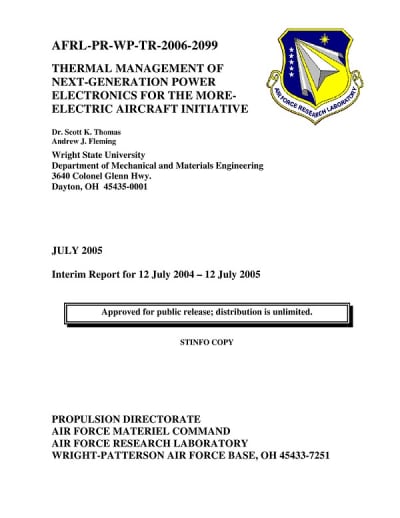
The document titled "Thermal Management of Next-Generation Power Electronics for the More-Electric Aircraft Initiative" is an interim report authored by Dr. Scott K. Thomas and Andrew J. Fleming from Wright State University. It focuses on the critical area of thermal management in power electronics, which is essential for the advancement of more electric aircraft (MEA).
The report outlines the objectives of the project, which include evaluating the suitability of using loop heat pipes with water as the working fluid for dissipating heat from electronics onboard aircraft. This approach is significant as it addresses the increasing thermal challenges posed by the integration of advanced electronic systems in aviation, which are necessary for improving efficiency and performance.
The document includes a Gantt chart (Figure 1.18) that illustrates the progress made to date and the projected schedule for the project, providing a visual representation of the timeline and milestones. Additionally, it references a table (Table 2.3) that likely contains relevant data or findings related to the project, although specific details from the table are not provided in the excerpts.
The report emphasizes the importance of effective thermal management solutions in ensuring the reliability and safety of electronic systems in aircraft. As the aviation industry moves towards more electric systems, the need for innovative cooling methods becomes increasingly critical. The use of loop heat pipes is presented as a promising technology that could enhance thermal performance while being lightweight and efficient.
Furthermore, the document includes a notice regarding the use of government drawings and specifications, clarifying that their use does not confer any rights to manufacture or sell patented inventions. It also states that the report has been cleared for public release by the Air Force Research Laboratory, making it accessible to the general public, including foreign nationals.
In summary, this interim report serves as a foundational document for ongoing research into thermal management solutions for next-generation power electronics in aircraft. It highlights the project's goals, methodologies, and the significance of developing effective cooling systems to support the future of aviation technology.
Top Stories
INSIDERDesign
 How Airbus is Using w-DED to 3D Print Larger Titanium Airplane Parts
NewsSensors/Data Acquisition
 Microvision Aquires Luminar, Plans Relationship Restoration, Multi-industry Push
INSIDERManned Systems
 A Next Generation Helmet System for Navy Pilots
NewsAR/AI
 Accelerating Down the Road to Autonomy
INSIDERDefense
 New Raytheon and Lockheed Martin Agreements Expand Missile Defense Production
ArticlesAR/AI
 CES 2026: Bosch is Ready to Bring AI to Your (Likely ICE-powered) Vehicle
Webcasts
Semiconductors & ICs
 Advantages of Smart Power Distribution Unit Design for Automotive...
Unmanned Systems
 Quiet, Please: NVH Improvement Opportunities in the Early Design...
Electronics & Computers
 Cooling a New Generation of Aerospace and Defense Embedded...
Automotive
 Battery Abuse Testing: Pushing to Failure
Transportation
 A FREE Two-Day Event Dedicated to Connected Mobility
