




Analysis of Pathways to Reach Net Zero Naval Operations by 2050
With the backdrop of net-zero emissions as an essential element of national security, this study undertook an analytical approach to evaluate current Department of the Navy (DON) emissions and understand energy needs to support mission readiness while reducing emissions over time.
This report is based on a broad study of strategies for the Department of the Navy (DON) to achieve net zero global emissions by 2050 to comply with recent Executive Orders and goals set out for the Department of Defense (DOD) and the DON (Melillo, 2022). In January 2021, Executive Order 14008 called for a government-wide approach for meeting climate related challenges in the U.S. and set goals for agencies. In December 2021, Executive Order 14057 set the specific goal of net zero emissions from overall federal operations, including DOD, by 2050 and a 65 percent emissions reduction by 2030.
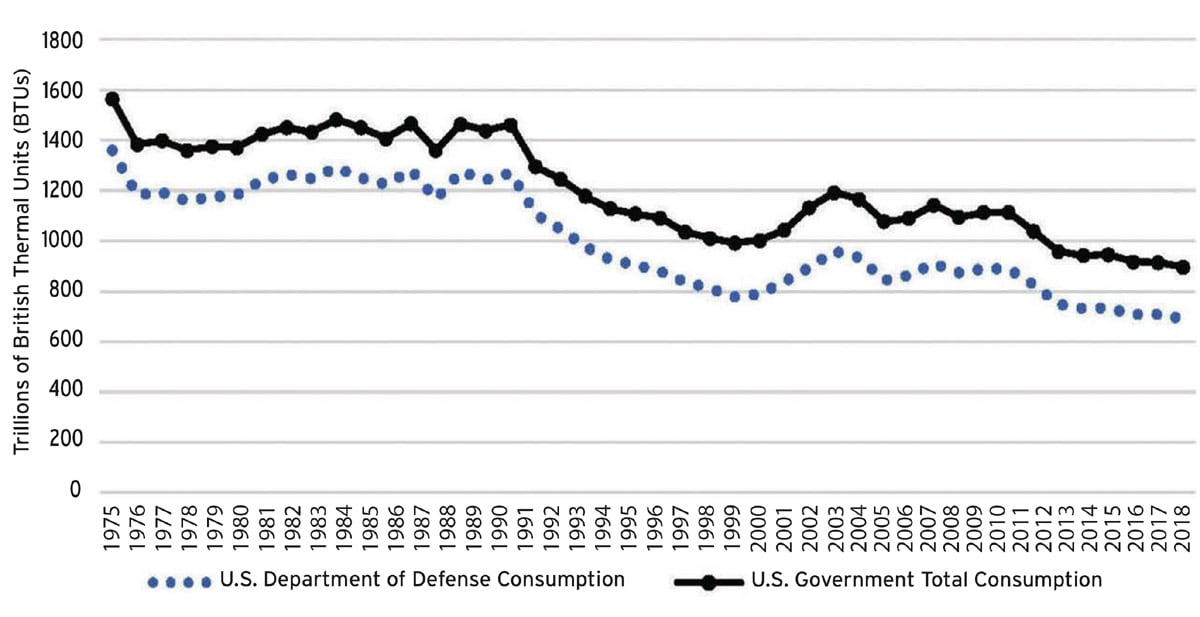
These are challenging targets for the DOD: 2019 data shows that the DOD consumed 682 trillion BTUs, which represents up to 77 percent of federal government energy use. The Navy uses fuel for jets, vehicles, ships, ground equipment, and for generating electricity for forces in the field and for powering operations at Navy installations. Fuel is required for mission readiness and fuel demand depends on operational needs and the tempo of operations. Depending on the year, up to 75 percent of that energy use is operational; for the DON, that means ships and aircraft – two of the most difficult sectors to decarbonize, both in the military and in the private sector.
With the backdrop of net zero emissions as an essential element of national security, this study undertook an analytical approach to evaluate current DON emissions and to understand energy needs to support mission readiness. In this report, researchers present current and proposed low-carbon energy sources as possible pathways for shifting DON to net zero by 2050 with models presenting four pathway options. The research leverages existing net zero strategies and findings developed by the public and private sectors and identifies challenges and gaps to advance future research and analysis to further emissions reduction by the DON.
The relationship of climate change to national security is well-documented. Most recently, the DON opened its climate strategy, Climate Action 2030, with the statement Noting that the climate threat for the DON is existential, the strategy acknowledges increased instability across the globe while simultaneously affecting the DON’s ability to respond. Moreover, most DON installations are coastal and sea level rise will test the ability for these installations to continue to meet their missions. Furthermore, the DOD has found that climate change is reshaping the geostrategic, operations and tactical environments with significant implications for U.S. national security and defense.
As a destabilizing force, climate change demands new missions of the DOD and DON and can alter the operational environment (Department of Defense [DOD Adaptation], 2021). Climate change exacerbates existing threats, especially in vulnerable parts of the world where the Navy and Marine Corps are called upon for Humanitarian Aid and Disaster Response (HADR) missions and may experience increased conflict from resource competition or scarcity and environmental changes. Impacts of climate change also are felt at installations which affect key warfighting capabilities. It is within this context that the Navy Climate Strategy sets mitigation measures to reduce the impact and speed of climate change by reducing emissions of greenhouse gases (GHG) or taking steps to remove carbon dioxide from the atmosphere. Accelerating these efforts would help to modernize Naval forces and reduce costs and operational vulnerabilities related to fossil fuel-based energy.
This work was performed by Kristin Flecher, Marina Less, Brandon Naylor and Jonathan Lussier for the Naval Postgraduate School. For more information, download the Technical Support Package (free white paper) here under the Vehicles and Robotics category. NPS-2098
This Brief includes a Technical Support Package (TSP).
Analysis of Pathways to Reach Net Zero Naval Operations by 2050
(reference NPS-2098) is currently available for download from the TSP library.
Don't have an account?
More From SAE Media Group
Aerospace & Defense Tech Briefs
Army Researchers Examine Nanotechnology for Climate Solutions
Photonics & Imaging Technology
New Computer Vision-Based System Monitors Seasonal Dynamics of Tropical Water

Green Design & Manufacturing
Sustainable Biochar to Mitigate Climate Change

Tech Briefs
5 Ws of Unmanned Lasers for Methane Detection
Green Design & Manufacturing
Geologic Carbon Sequestration
Off-Highway Engineering
SAE WCX 2022: The Road to Zero Emissions Has Many Lanes
Green Design & Manufacturing
A Designer's Carbon Calculator
Green Design & Manufacturing
NASA Study Shows How Oil Production Impacts Climate
Tech Briefs
Converting Waste Streams into Biofuel
Tech Briefs
Rising Star Award Winner 2024: Sustainability
Tech Briefs
Designing to Minimize Environmental Impact
Aerospace INSIDER
Rising Temps Could Limit Aircraft Takeoffs
Tech Briefs
Pulling Carbon Dioxide Out of the Air
Tech Briefs
How Much Do You Know About Sustainability?
Green Design & Manufacturing
Environmental Monitoring in Costa Rican Rainforest
Off-Highway Engineering
Response to More-Rigid NOx and GHG Regs
Green Design & Manufacturing
New Geoengineering Approaches Offset Global Warming More Efficiently
Tech Briefs
Saline Aquifers: Storage for Greenhouse Gases
Green Design & Manufacturing
Electricity and Carbon Offsets from Hog Waste
Tech Briefs
Sustainable Aviation: The Race to Net-Zero
Aerospace INSIDER
Plant-Based Jet Fuel Could Reduce Emissions by 68%
Tech Briefs
How Much Do You Know About Jet Engines?



Tech Briefs
The Path to Net-Zero with Green Propane
Tech Briefs
3 New Sustainable Technologies
Overview
The document titled "Analysis of Pathways to Reach Net Zero Naval Operations by 2050" is a technical report that outlines strategies for the Department of the Navy to achieve net-zero greenhouse gas emissions by the year 2050. The report emphasizes the importance of addressing climate change as a critical national security issue and explores various pathways to reduce emissions associated with naval operations.
The report begins with an introduction that establishes the relationship between climate change and national security, highlighting the potential risks and challenges posed by climate-related events. It underscores the necessity for the Navy to adapt its operations and strategies in response to these challenges.
Key sections of the report delve into the drivers of climate change and emissions, examining the current state of emissions within naval operations and identifying areas for improvement. The analysis includes a review of existing technologies and practices that can be leveraged to reduce the carbon footprint of naval activities.
The report outlines several pathways to achieve net-zero emissions, including the adoption of low-carbon energy sources, improvements in energy efficiency, and the implementation of innovative operational practices. It discusses the potential for integrating renewable energy technologies, such as solar and wind, into naval operations, as well as the use of alternative fuels and energy storage solutions.
Additionally, the report emphasizes the importance of collaboration and partnerships with other governmental and non-governmental organizations to share knowledge, resources, and best practices. It advocates for a comprehensive approach that includes research and development, policy changes, and investment in new technologies to facilitate the transition to net-zero operations.
The document concludes with recommendations for the Navy to prioritize sustainability in its strategic planning and operational decision-making. It calls for ongoing assessment and adaptation of strategies to ensure that the Navy remains resilient in the face of climate change while maintaining its mission readiness.
Overall, the report serves as a roadmap for the Department of the Navy, providing actionable insights and recommendations to achieve a sustainable and secure future in naval operations while addressing the pressing challenges posed by climate change.
Top Stories
NewsRF & Microwave Electronics
 Microvision Aquires Luminar, Plans Relationship Restoration, Multi-industry Push
INSIDERAerospace
 A Next Generation Helmet System for Navy Pilots
INSIDERDesign
 New Raytheon and Lockheed Martin Agreements Expand Missile Defense Production
INSIDERMaterials
 How Airbus is Using w-DED to 3D Print Larger Titanium Airplane Parts
NewsPower
 Ford Announces 48-Volt Architecture for Future Electric Truck
ArticlesAR/AI

Webcasts
Electronics & Computers
 Cooling a New Generation of Aerospace and Defense Embedded...
Automotive
 Battery Abuse Testing: Pushing to Failure
Power
 A FREE Two-Day Event Dedicated to Connected Mobility
Unmanned Systems
 Quiet, Please: NVH Improvement Opportunities in the Early Design Cycle
Automotive
 Advantages of Smart Power Distribution Unit Design for Automotive &...
Energy
 Sesame Solar's Nanogrid Tech Promises Major Gains in Drone Endurance