




The Future of Space Propulsion
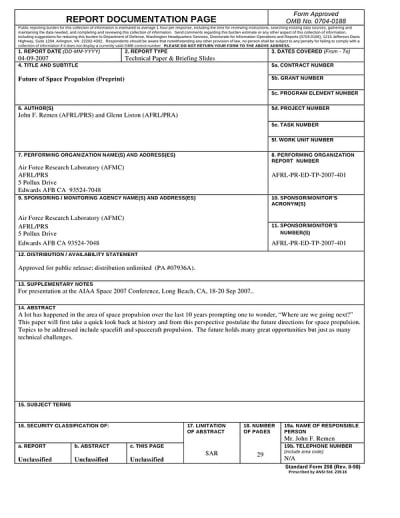
A paper presents an overview of state of the art of space propulsion, oriented toward attempting to understand recent history in order to make some predictions about future developments. As used here, "space propulsion" refers generally to what are now called "spacelift" and "spacecraft propulsion." Further, as used here, "spacelift" refers generally to large rockets, associated equipment, and other resources for launching spacecraft into outer space, while "spacecraft propulsion" refers generally only to systems for propelling spacecraft once they are in outer space. The paper includes a summary of recent history of spacecraft propulsion, with greatest emphasis on spacelift systems, from the perspective of striving to maintain the military superiority and economic competitiveness of the United States in the face of the rapid international evolution of space technology. Advantages and disadvantages of various engine designs and propellant substances, and considerations of cost and development time, are discussed. Trends in spacelift (and, to a lesser extent, trends in spacecraft propulsion) are discussed. An attempt is made to predict the general nature of future developments by extrapolating the trends into the foreseeable future.
This work was done by John F. Remen and Glenn Liston of the Air Force Research Laboratory.
This Brief includes a Technical Support Package (TSP).
The Future of Space Propulsion
(reference AFRL-0063) is currently available for download from the TSP library.
Don't have an account?
More From SAE Media Group
Aerospace & Defense Tech Briefs
Lightcraft Propulsion for Launching a Small Satellite
Tech Briefs
ARTEMIS: Back to the Moon

Aerospace & Defense Tech Briefs
Thrust in Space - The Nuances of Thruster Valve Design
NASA Spinoff
Separation Device Launches New Science Payloads
Tech Briefs
NASA’s John F. Kennedy Space Center
Tech Briefs
ARTEMIS I: Our Return to the Moon Begins
Tech Briefs
Lightweight Crane Technology for the Moon
Motion Design
Component Helps Perseverance Sample Mars


Tech Briefs
NASA at 60: 1958-2018 Decades of Discovery
Tech Briefs
Force/Torque Sensor Helps Rover Sample Mars
Aerospace & Defense Tech Briefs
The Future of Space Propulsion
Tech Briefs
ARTEMIS II: Astronauts on Board


Tech Briefs
SMART Solar Sail

Tech Briefs
Mars 2020 – Getting to Mars

Tech Briefs
Flexible, Spinning Heat Shield for Spacecraft
Tech Briefs
ARTEMIS III: Return to the Surface


Aerospace Manufacturing and Machining INSIDER
New Defense Department Contract to Expand Domestic Rocket Motor Manufacturing
Overview
The document discusses significant challenges and advancements in space propulsion over the past decade, particularly in the context of changing geopolitical landscapes and technological developments. It highlights the impact of the end of the Cold War, which has led to both positive and negative consequences for U.S. space capabilities. The military's need to project power globally and the vulnerability of U.S. space assets in asymmetric warfare scenarios are emphasized.
The document notes that many operational systems are now functioning well beyond their intended design life, leading to issues such as parts and technology obsolescence. This situation is compounded by an aging workforce and limited opportunities for developing new systems. The U.S. has seen a dramatic decline in its share of the launch market, dropping from nearly 80% to only 20%, raising concerns about the future viability of legacy systems like the RL-10, which has faced reliability and production challenges.
Despite these challenges, the U.S. has made significant strides in space technology, particularly through the Integrated High Payoff Rocket Propulsion Technology (IHPRPT) program, which has achieved important milestones. The successful flight of scramjet propulsion and advancements in physics-based modeling and simulation are notable achievements aimed at addressing industry shortfalls in designing new systems.
The document also discusses the emergence of commercial companies entering the spacelift market with small, cost-effective launch vehicles, as well as the growing interest in microsatellites. It outlines the need for responsive spacelift capabilities to meet the demands of modern warfare, including the ability to quickly replace affected satellites and accommodate various satellite sizes.
Future spacelift propulsion strategies are explored, emphasizing the importance of responsive systems that can launch on schedule, whether reusable or expendable. The document suggests that revolutionary capabilities can be achieved through evolutionary science and technology developments, without necessarily requiring extreme performance metrics.
In conclusion, the document serves as a comprehensive overview of the current state and future directions of space propulsion, highlighting the interplay between technological advancements, military needs, and market dynamics in shaping the future of space exploration and utilization.
Top Stories
INSIDERMaterials
 How Airbus is Using w-DED to 3D Print Larger Titanium Airplane Parts
NewsSensors/Data Acquisition
 Microvision Aquires Luminar, Plans Relationship Restoration, Multi-industry Push
INSIDERDesign
 A Next Generation Helmet System for Navy Pilots
NewsManned Systems
 Accelerating Down the Road to Autonomy
INSIDERWeapons Systems
 New Raytheon and Lockheed Martin Agreements Expand Missile Defense Production
ArticlesDesign
 CES 2026: Bosch is Ready to Bring AI to Your (Likely ICE-powered) Vehicle
Webcasts
Transportation
 Advantages of Smart Power Distribution Unit Design for Automotive...
Automotive
 Quiet, Please: NVH Improvement Opportunities in the Early Design...
Electronics & Computers
 Cooling a New Generation of Aerospace and Defense Embedded...
Power
 Battery Abuse Testing: Pushing to Failure
AR/AI
 A FREE Two-Day Event Dedicated to Connected Mobility
