




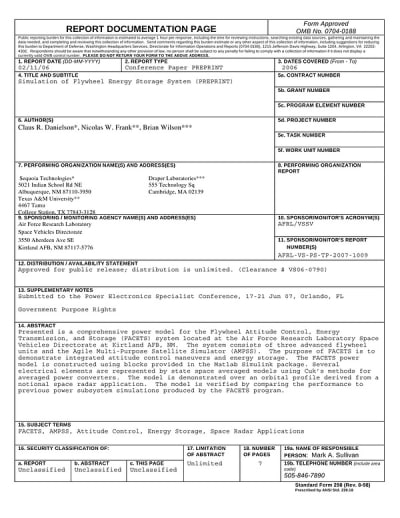
Simulation of a Flywheel Energy-Storage System
Wheel acceleration, wheel deceleration, and switching voltage transients are represented.
A computational model has been developed to simulate the operation of a laboratory flywheel energy-storage system that is a subsystem of the Flywheel Attitude Control, Energy Transmission, and Storage (FACETS) system located at Kirtland Air Force Base in New Mexico. The FACETS, which includes three advanced flywheel energy-storage units and an apparatus denoted the Agile Multi- Purpose Satellite Simulator (AMPSS), is used to demonstrate conceptual spacecraft operations involving integral combinations of attitude-control maneuvers and energy-storage operations. The flywheel units include high-hoop-strength carbon composite rotors that turn on magnetic bearings. The flywheels have a maximum rated angular speed of 40,000 rpm, making it possible to store as much a 1 kW·hr of energy in each unit. An air bearing supports the entire AMPSS test article allowing three-axis rotation with minimal damping. In addition to the flywheel units, the system includes DC-to-DC power converters and a three-phase rectifier.
The FACETS power system operates in three modes: charge, discharge, and standby. The charge mode corresponds to the power mode of a notional spacecraft when the Sun is visible from the spacecraft and the power demand is less than the incoming solar power. In this mode, solar photovoltaic arrays that are parts of the notional spacecraft provide the power to spin up the flywheels and satisfy the housekeeping power demand of the spacecraft. The discharge mode takes place during eclipse or high power demand. In this mode, the flywheels provide power to the notional spacecraft and space radar systems. The standby mode corresponds to the notional spacecraft power mode in which sunlight is available but the flywheels have reached their maximum rated angular speed.
The computational model of the FACETS flywheel energy-storage system was constructed partly by use of permanent- magnet synchronous-machine and the universal-bridge blocks provided in the Matlab Simulink software package. High-fidelity electrical models of the DC-to-DC power converters and the three-phase rectifier were found to be too computationally intensive and, therefore, were replaced with state-space- averaged models.
A notional space radar application was selected for the FACETS mission profile. Space radar requires extremely large pulse power and, therefore, is an ideal application for flywheel energy storage. The model was demonstrated over an orbital profile derived from the notional space radar application. The model was verified by comparing its output with results of prior power-subsystem simulations performed in the FACETS program. Realistic phenomena represented by the results of the simulations included increase of flywheel speed during charge, steady flywheel speed during standby, decreasing flywheel speed during discharge, and voltage transients during transitions between charge and discharge.
This work was done by Claus R. Danielson of Sequoia Technologies, Nicolas W. Frank of Texas Agricultural and Mechanical University, and Brian Wilson of Draper Laboratories for the Air Force Research Laboratory.
This Brief includes a Technical Support Package (TSP).
Simulation of a Flywheel Energy-Storage System
(reference AFRL-0062) is currently available for download from the TSP library.
Don't have an account?
More From SAE Media Group
Tech Briefs
Product of the Month

Software Tech Briefs
Covariance Analysis Tool (G-CAT) for Computing Ascent, Descent, and Landing Errors

Tech Briefs
Air Force Research Laboratory
NASA Spinoff
Cutting-Edge Computing Goes Spaceborne
Tech Briefs
New on the Market
NASA Spinoff
Expertise Flows from Computer Cognition
Power Electronics INSIDER
Sustainable Energy using “Information Batteries”

NASA Spinoff
Hard(ware) to the Core
NASA Spinoff
Make Way for Satellites
NASA Spinoff
Intelligent Processing at the Edge

Tech Briefs
Solving AI’s Power Problem at the Chip Level
Tech Briefs
Los Alamos National Laboratory
NASA Spinoff
Commercial Space: NASA Has an App for That
NASA Spinoff
Keeping the Connection
Aerospace & Defense Tech Briefs
Adamant: A Soon-to-be Open Source, Mission-Critical Flight Software Framework Written in Ada
NASA Spinoff
Tiny Star Trackers Help Spacecraft Find Their Place
Software Tech Briefs
Automating Hyperspectral Data for Rapid Response in Volcanic Emergencies
NASA Spinoff
Using AI to Predict the Sky
Aerospace & Defense Tech Briefs
New Products

NASA Spinoff
Communicating via Long-Distance Lasers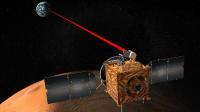
Tech Briefs
A ‘Smarter’ Way to Protect an Electric Grid
Overview
The document presents a comprehensive overview of the Flywheel Attitude Control, Energy Transmission, and Storage (FACETS) system, developed at the Air Force Research Laboratory's Space Vehicles Directorate in Kirtland AFB, NM. The FACETS system is designed to demonstrate integrated attitude control maneuvers and energy storage capabilities for spacecraft, particularly in the context of space radar applications.
The power subsystem of FACETS consists of three advanced flywheel units connected in parallel to a 150V main bus, which is also linked to a solar array. This configuration allows the system to efficiently manage power distribution for various operational modes: charge, discharge, and standby. In charge mode, the flywheels are connected to the main bus through a buck converter, which regulates the DC voltage of the inverter and controls the spin-up rate of the flywheels. During discharge mode, the flywheels supply power to the spacecraft via a rectifier and boost converter. Standby mode occurs when sunlight is available, and the flywheels have reached their maximum spin speeds, allowing for energy storage without active power generation.
The document details the modeling of the FACETS power system using Matlab Simulink, employing state space averaged models based on Cuk’s methods for averaged power converters. This modeling approach enables the simulation of the system's performance over an orbital profile derived from a notional space radar application. The results of the simulations are compared to previous power subsystem simulations conducted by the FACETS program, validating the effectiveness of the model.
The authors, Claus R. Danielson, Nicolas W. Frank, and Brian Wilson, emphasize the importance of flywheel energy storage systems in modern spacecraft design, particularly for applications requiring rapid power delivery and efficient energy management. The FACETS system serves as a critical tool for advancing the understanding of energy storage technologies and their integration into spacecraft power systems.
Overall, the document highlights the innovative use of flywheel technology in aerospace applications, showcasing its potential to enhance the performance and reliability of spacecraft power systems while supporting advanced mission profiles.
Top Stories
INSIDERMaterials
 How Airbus is Using w-DED to 3D Print Larger Titanium Airplane Parts
NewsSensors/Data Acquisition
 Microvision Aquires Luminar, Plans Relationship Restoration, Multi-industry Push
INSIDERDesign
 A Next Generation Helmet System for Navy Pilots
NewsManned Systems
 Accelerating Down the Road to Autonomy
INSIDERWeapons Systems
 New Raytheon and Lockheed Martin Agreements Expand Missile Defense Production
ArticlesDesign
 CES 2026: Bosch is Ready to Bring AI to Your (Likely ICE-powered) Vehicle
Webcasts
Transportation
 Advantages of Smart Power Distribution Unit Design for Automotive...
Automotive
 Quiet, Please: NVH Improvement Opportunities in the Early Design...
Electronics & Computers
 Cooling a New Generation of Aerospace and Defense Embedded...
Power
 Battery Abuse Testing: Pushing to Failure
AR/AI
 A FREE Two-Day Event Dedicated to Connected Mobility
