




New Hybrid Electrolyte for High-Performance Lithium-ion Batteries
This polymeric solid electrolyte not only shows high performance as an electrolyte but is also expected to be effective in deterring the formation of dendritic crystals.
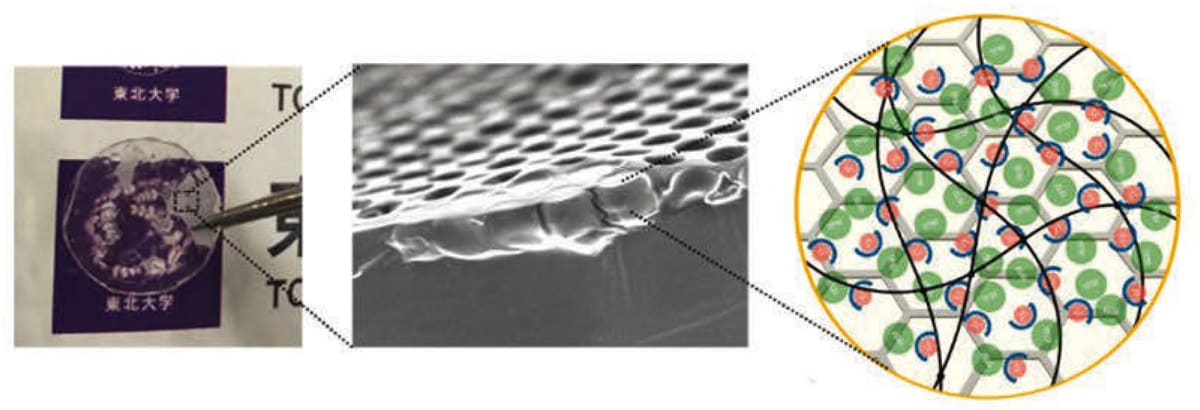
Lithium-ion (Li-ion) batteries are one of the most used batteries that support modern ITC society, including smartphones and EVs. These batteries are repeatedly charged and discharged by Li-ions passing back and forth between the positive and negative electrodes, with the Li-ion electrolyte acting as a passageway for the ions.
Normally, organic electrolytes such as liquid ethylene carbonate (EC) and their gels have been used as the Li-ion electrolyte due to their voltage resistance and ionic conductivity. However, as liquids and gels are flammable, a switch to safer polymeric solid electrolytes is preferable.
Polymeric solid electrolytes such as polyethylene glycol (PEG) have been proposed as impact-resistant Li-ion electrolytes. However, PEG-based polymer electrolytes crystallize near room temperature, resulting in a significant drop in Li-ion conductivity to around 10-6 S/cm at room temperature.
To solve this problem, a research group has invented a new type of polymeric solid electrolyte by combining a porous polymer membrane with several micron pores and a photo-cross-linkable polyethylene glycol PEG-based polymer electrolyte. The polymeric solid electrolyte realized a wide potential window (4.7 V), a high Li-ion conductivity in the 10-4 S/cm class, which is equivalent to a liquid and sufficient for practical use, and a high Li-ion transference number (0.39). Li-ions transferring in the electrolyte move in various directions due to natural diffusion. The distance is several μm to 10 μm and does not always move linearly between electrodes, which is one of the reasons for the decrease in ionic conductivity. In the current study, therefore, the performance of photo-cross-linked PEG-based solid polymer electrolytes improved by compositing them with micron-sized porous membranes.
This polymeric solid electrolyte not only shows high performance as an electrolyte but is also expected to be effective in deterring the formation of Li dendrites (dendritic crystals), which can cause ignition, due to the inclusion of a porous membrane. Through the realization of safe, high-performance Li-ion batteries, this achievement will contribute to the realization of a sustainable energy supply.
For more information, contact Hiroshi Yabu at
More From SAE Media Group
Battery & Electrification Technology
New Gel Polymer Electrolyte to Revolutionize the Safety of Li-ion Batteries
Battery & Electrification Technology
Anode-Free Lithium Batteries with Maximized Energy Density

Tech Briefs
Safer, Longer-Lasting, Solid-State Batteries
Battery & Electrification Technology
Developing Safer Batteries with Solid-State Polymer Electrolytes
Battery & Electrification Technology
New Polymer Coating Could Boost EV Batteries
Battery & Electrification Technology
A Breakthrough in Solid-State Electrolytes for All-Solid-State Batteries
Tech Briefs
Building Temperature-Resilient Batteries
Battery Technology
Low-Cost, Fast Production of Solid-State Batteries
Battery & Electrification Technology
Cobalt-Free Batteries Could Power EVs of the Future
Battery & Electrification Technology
Folded or Cut, This Lithium-Sulfur Battery Keeps Going


Battery & Electrification Technology
Technique Extends Next-Generation Lithium Metal Batteries
Tech Briefs
A New, Low-Cost Aluminum-Sulfur Battery
Battery & Electrification Technology
New Priming Method for Improving Battery Lifecycle
Battery Technology
Flexible, Thin-Film Battery
Tech Briefs
Flexible, Water-Based Lithium-Ion Batteries
Tech Briefs
5 Ws of the SAFIRE Lithium-Ion Battery

Battery Technology
Electrolyte Design Improves Anode Capacity in Lithium-Ion Batteries
Battery Technology
Spreadable Way to Stabilize Solid-State Batteries

Battery Technology
Method Tracks What Happens Inside Batteries
Battery & Electrification Technology
Iron Could Be Key to Less Expensive, Greener Lithium-Ion Batteries
Top Stories
INSIDERDefense
 New Raytheon and Lockheed Martin Agreements Expand Missile Defense Production
NewsAutomotive
 Ford Announces 48-Volt Architecture for Future Electric Truck
INSIDERManufacturing & Prototyping
 Active Strake System Cuts Cruise Drag, Boosts Flight Efficiency
ArticlesTransportation
 Accelerating Down the Road to Autonomy
INSIDERMaterials
 How Airbus is Using w-DED to 3D Print Larger Titanium Airplane Parts
Road ReadyTransportation

Webcasts
Electronics & Computers
 Cooling a New Generation of Aerospace and Defense Embedded...
Power
 Battery Abuse Testing: Pushing to Failure
Connectivity
 A FREE Two-Day Event Dedicated to Connected Mobility
Automotive
 Quiet, Please: NVH Improvement Opportunities in the Early Design Cycle
Transportation
 Advantages of Smart Power Distribution Unit Design for Automotive &...
Aerospace
 Sesame Solar's Nanogrid Tech Promises Major Gains in Drone Endurance