




Simplifying the Production of Lithium-ion Batteries
MIT spinout 24M Technologies designed a method that reduces the cost of manufacturing lithium-ion cells.
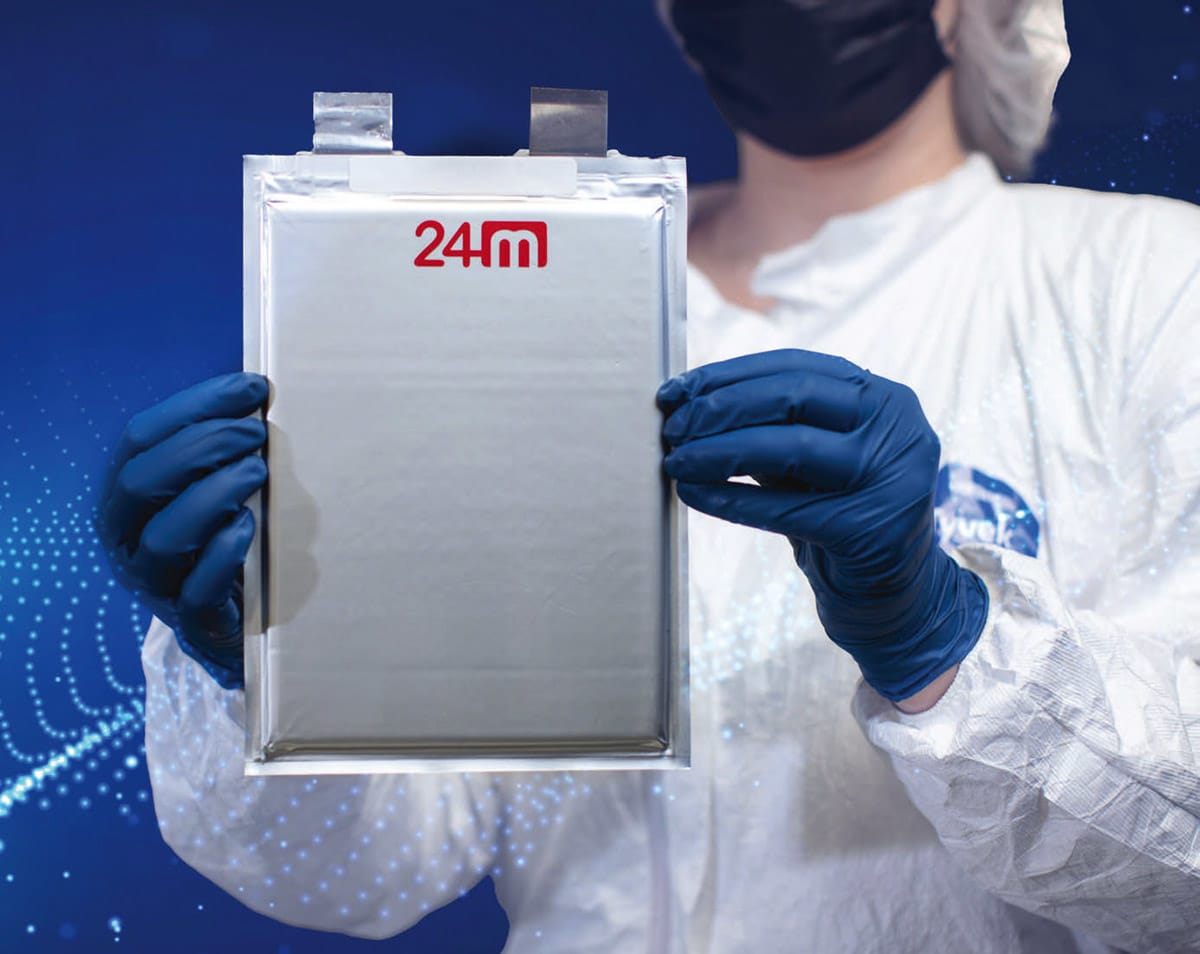
When it comes to battery innovations, the importance of production processes for bringing down costs is often overlooked. Now the MIT spinout 24M Technologies has simplified lithium-ion (Li-ion) battery production with a new design that requires fewer materials and steps to manufacture each cell. According to the company the design, which it calls “SemiSolid” for its use of gooey electrodes, reduces production costs by up to 40 percent. The approach also improves the batteries’ energy density, safety, and recyclability.
“The SemiSolid platform has been proven at the scale of hundreds of megawatts being produced for residential energy-storage systems. Now we want to prove it at the gigawatt scale,” said 24M CEO Naoki Ota, whose team includes 24M Co-Founder, Chief Scientist, and MIT Professor Yet-Ming Chiang.
Establishing large-scale production lines is only the first phase of 24M’s plan. Another key draw of its battery design is that it can work with different combinations of Li-ion chemistries. That means 24M’s partners can incorporate better-performing materials down the line without substantially changing manufacturing processes.
The kind of quick, large-scale production of next-generation batteries that 24M hopes to enable could have a dramatic impact on battery adoption across society — from the cost and performance of electric cars to the ability of renewable energy to replace fossil fuels.
The main components of batteries are the positive and negatively charged electrodes and the electrolyte material that allows ions to flow between them. Traditional Li-ion batteries use solid electrodes separated from the electrolyte by layers of inert plastics and metals, which hold the electrodes in place.
Stripping away the inert materials of traditional batteries and embracing the gooey electrode mix gives 24M’s design a number of advantages. For one, it eliminates the energy-intensive process of drying and solidifying the electrodes in traditional Li-ion production. According to the company, it also reduces the need for more than 80 percent of the inactive materials in traditional batteries, including expensive ones like copper and aluminum. The design also requires no binder and features extra thick electrodes, improving the energy density of the batteries.
“This is a platform technology,” Ota said. “We’re not just a low-cost and high-reliability operator. That’s what we are today, but we can also be competitive with next-generation chemistry. We can use any chemistry in the market without customers changing their supply chains. Other startups are trying to address that issue tomorrow, not today. Our tech can address the issue today and tomorrow.”
Judging by industry interest, 24M is onto something. Since coming out of stealth mode in 2015, 24M has licensed its technology to multinational companies including Volkswagen, Fujifilm, Lucas TVS, Axxiva, and Freyr. Those last three companies are planning to build gigafactories (factories with gigawatt-scale annual production capacity) based on 24M’s technology in India, China, Norway, and the United States.
For more information, contact Abby Abazorius at
More From SAE Media Group

Battery & Electrification Technology
Recyclable ‘Water Batteries’ That Won’t Catch Fire
Battery Technology
Low-Cost, Fast Production of Solid-State Batteries
Battery Technology
Cobalt-Free Cathodes for Lithium-Ion Batteries
Automotive Engineering
EMBATT Technology Could Double the Driving Range of EVs
Battery & Electrification Technology
Anode-Free Lithium Batteries with Maximized Energy Density
Automotive Engineering
Are We Stuck with Lithium-Ion?
Automotive Engineering
Honda Unveils Solid-State Battery Demonstration Production Line
Tech Briefs
Factorial’s Solid-State B-Samples Send a Message

Battery Technology
Hybrid Membrane Doubles the Lifetime of Rechargeable Batteries
Battery & Electrification Technology
Volvo Trucks’ Battery Chemistry of Choice: NCA
Battery & Electrification Technology
Researchers Unveil Scalable Graphene Technology to Revolutionize Battery Safety and Performance
Battery & Electrification Technology
Oxygen-Ion Battery: A Solution for Large Energy Storage Systems
Battery & Electrification Technology
New Polymer Coating Could Boost EV Batteries
Battery Technology
New Materials Move Li-Ion Batteries Toward the Solid-State Endgame
Battery Technology
New Approach Makes Lighter, Safer Lithium-Ion Batteries

Tech Briefs
A New, Low-Cost Aluminum-Sulfur Battery
Battery & Electrification Technology
Manufacturing Advances in Solid-State Batteries

Battery & Electrification Technology
Enhancing the Performance of All-Solid-State Batteries
Tech Briefs
A New Design for Lithium-Sulfur Batteries

Tech Briefs
Building Temperature-Resilient Batteries
Battery Technology
Spreadable Way to Stabilize Solid-State Batteries
Battery Technology
Doubling Battery Performance with Lithium Metal
Battery & Electrification Technology
Fully Stretchable Fabric-Based Lithium-Ion Battery
Tech Briefs
Developing Fast-Charging Lithium-Metal Batteries
Tech Briefs
Dry Manufacturing Process for EV Batteries
Top Stories
INSIDERDesign
 How Airbus is Using w-DED to 3D Print Larger Titanium Airplane Parts
NewsSensors/Data Acquisition
 Microvision Aquires Luminar, Plans Relationship Restoration, Multi-industry Push
INSIDERManned Systems
 A Next Generation Helmet System for Navy Pilots
NewsAR/AI
 Accelerating Down the Road to Autonomy
INSIDERDefense
 New Raytheon and Lockheed Martin Agreements Expand Missile Defense Production
ArticlesAR/AI
 CES 2026: Bosch is Ready to Bring AI to Your (Likely ICE-powered) Vehicle
Webcasts
Semiconductors & ICs
 Advantages of Smart Power Distribution Unit Design for Automotive...
Unmanned Systems
 Quiet, Please: NVH Improvement Opportunities in the Early Design...
Electronics & Computers
 Cooling a New Generation of Aerospace and Defense Embedded...
Automotive
 Battery Abuse Testing: Pushing to Failure
Transportation
 A FREE Two-Day Event Dedicated to Connected Mobility
