




Advances in Materials for Photonic Applications
Novel photoactive compounds, solutions, and nanocomposites have been studied.
Air Force Research Laboratory, Wright-Patterson Air Force Base, Ohio Aprogram of research has addressed multiple topics in the design, development, characterization, and utilization of new materials for photonic applications. These materials include compounds, solutions, and nanocomposites that exhibit diverse types of single- and multiple-photon activity. The accomplishments of this research can be grouped into four main categories and summarized as follows:
Multiphoton-absorbing materials for applications in which there are requirements to limit and stabilize optical power.
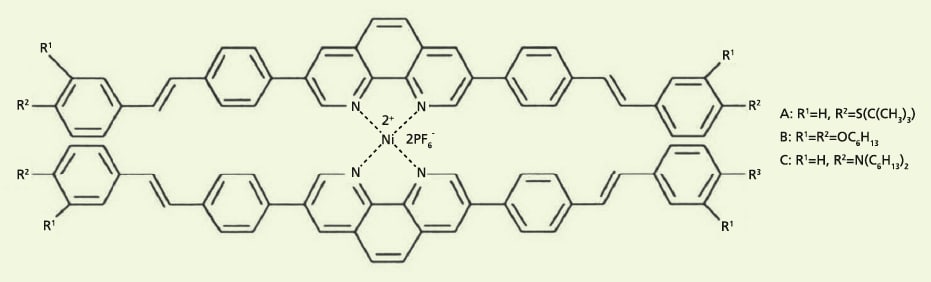
Accomplishments in this category include investigation of degenerate nonlinear absorption and optical-power-limiting properties of asymmetrically substituted stilbenoid chromophores; synthesis and characterization of novel two-photonabsorbing, 1,10-phenanthroline-containing, p-conjugated chromophores and nickel( II)-chelated complexes thereof (see figure) with quenched emissions; synthesis and characterization of two- and three-photon- absorbing novel fluorene-containing ferrocene derivatives; synthesis and testing of novel-conjugated dendritic nanosized chromophores with enhanced two- and three-photon absorption; and demonstration of limiting and stabilization of optical power by use of novel two-photon-absorbing liquid dye salt systems. The major advantage of using a neat liquid dye salt as the two-photon-absorbing medium is that the concentration of two-photon-absorbing chromophores is unusually high (of the order of 1 M) and it can withstand a relatively high-input laser power and energy.
Advanced materials for photorefractive and electro-optical devices.
Accomplishments in this category include demonstration of efficient photosensitization and high optical gain in a quantum-dot sensitized hybrid photorefractive nanocomposite at the telecommunication wavelength of 1.34 μm; design of new organically-modified-silica precursor material systems for electro- optical devices; and demonstration of photoconductivity and photorefractivity at infrared wavelengths in hybrid nanocomposites.
Novel organic dyes for multiphoton-pumped frequency-up-conversion lasing.
Two-, three-, and four-photon-pumped stimulated emission (cavityless lasing) properties of ten stibazolium dyes in solution were studied comprehensively.
A new type of stimulated Rayleigh-Bragg scattering generated in a novel two-photonabsorbing- dye solution.
This scattering is, more specifically, a two-photon-excitation-enhanced backward stimulated Rayleigh scattering. This stimulated scattering shows no frequency shift, and therefore, is different from most other known stimulated scattering processes. The principle of this effect can be highly useful for optical phase conjugation and optical-power limiting.
This work was done by Paras N. Prasad and Guang S. He of the University of Buffalo for the Air Force Research Laboratory.
AFRL-0044
This Brief includes a Technical Support Package (TSP).

Advances in Materials for Photonic Applications
(reference AFRL-0044) is currently available for download from the TSP library.
Don't have an account?
More From SAE Media Group

Photonics & Imaging Technology
A First-Of-Its-Kind Integrated Optical Isolator
Aerospace & Defense Tech Briefs
On the Pulsed Laser Ablation of Metals and Semiconductors
Photonics & Imaging Technology
A Laser That Could Reshape the Landscape of Integrated Photonics
Photonics & Imaging Technology
Using Magnets to Toggle Nanolasers Leads to Better Photonics
Aerospace & Defense Tech Briefs
Analysis of Broadband Metamaterial Shielding for Counter-Directed Energy Weapons
Photonics & Imaging Technology
Ultrafast Beam-Steering Breakthrough at Sandia Labs
Photonics & Imaging Technology
Pratt & Whitney, Virginia Tech Pioneer Laser-Optical Approach for Turbofan Engine Thrust Measurement
Photonics & Imaging Technology
New Device Modulates Visible Light with the Smallest Footprint and Lowest Power Consumption
Photonics & Imaging Technology
A Sharper Look at the Interior of Semiconductors
Photonics & Imaging Technology INSIDER
Unique Nanodisk Holds Major Potential for Future of Photonic Research
Photonics & Imaging Technology
Ultra-Narrowband Optical Filters Pushing Boundaries from the UV to the LWIR
Air Force Research Laboratory Technology Horizons
Patterned Gallium Arsenide Devices for Infrared Countermeasures
Tech Briefs
Low-Energy Nanolaser Shines in all Directions

Photonics & Imaging Technology INSIDER
Quantum Dot Breakthrough Could Create Cheaper Infrared Sensors
Tech Briefs
Nanoscale LED Also Functions as a Laser
Photonics Tech Briefs
Using Fan-poled Crystals to Tune Ti:S Lasers
Medical Design Briefs
Scientists Create Continuously Emitting Microlasers With Nanoparticle-Coated Beads
Aerospace & Defense Tech Briefs
Frequency Agile Plasmonic Antennas and Sensors

Tech Briefs
High-Power, Portable Terahertz Laser

Photonics & Imaging Technology INSIDER
Can a Breakthrough in Photonic Time Crystals Change How We Use and Control Light?
Aerospace & Defense Tech Briefs
Development of Photoacoustic Sensing Platforms
Tech Briefs
Optical Device Fine-Tunes the Color of Light
Photonics & Imaging Technology
Photonics West 2021 Preview
Photonics & Imaging Technology
A New Optical Metamaterial Makes True One-Way Glass Possible
Tech Briefs
Light-Based Tech to Navigate the Moon
Overview
The document presents significant research achievements in the development of multi-photon active materials and novel nanocomposites for opto-electronic technology. It highlights the exploration of nonlinear optical properties, particularly focusing on a two-photon absorbing liquid dye salt system. This system demonstrates superior optical stabilization, effectively reducing the relative fluctuation of nanosecond laser pulses by more than two times when passed through the highly concentrated nonlinear absorbing medium.
The study utilized a 1-cm long liquid dye salt sample and employed nanosecond 1064-nm laser pulses with a variable repetition rate from 1 to 10 Hz. The research indicates that the power stability of the output laser pulses is significantly better when using a Pockels' cell as an electro-optic Q-switch compared to a BDN dye-doped polymer sheet. The pulse duration was approximately 10 ns with the Pockels' cell and 13-15 ns with the BDN sheet.
Additionally, the document discusses the phenomenon of backward stimulated scattering observed when the input laser energy exceeded a certain threshold (around 60 µJ or 40 MW/cm²). A Fabry-Pérot interferometer was used to analyze the spectral properties of the stimulated scattering, revealing a spectral resolution of 0.025 cm⁻¹. The nonlinear transmission of the input pump beam and the energy of the backward stimulated scattering were measured as functions of the input laser energy.
The research also emphasizes the advantages of using a neat liquid dye salt as a two-photon absorbing medium, which allows for a significant increase in effective molar concentration and the ability to withstand higher input laser energies and intensities. Furthermore, a new type of stimulated Rayleigh-Bragg scattering was identified, characterized by two-photon excitation enhanced backward stimulated Rayleigh scattering in a nonlinearly absorbing dye solution, which shows no frequency shift, distinguishing it from other known stimulated scattering processes.
Overall, the document encapsulates the advancements in nonlinear optical limiting and stabilization techniques, showcasing the potential applications of these materials in telecommunications and other opto-electronic fields. The findings contribute to the understanding and development of materials that can enhance the performance of optical systems.
Top Stories
NewsSensors/Data Acquisition
 Microvision Aquires Luminar, Plans Relationship Restoration, Multi-industry Push
INSIDERRF & Microwave Electronics
 A Next Generation Helmet System for Navy Pilots
INSIDERWeapons Systems
 New Raytheon and Lockheed Martin Agreements Expand Missile Defense Production
NewsAutomotive
 Ford Announces 48-Volt Architecture for Future Electric Truck
INSIDERAerospace
 Active Strake System Cuts Cruise Drag, Boosts Flight Efficiency
ArticlesTransportation

Webcasts
Aerospace
 Cooling a New Generation of Aerospace and Defense Embedded...
Energy
 Battery Abuse Testing: Pushing to Failure
Power
 A FREE Two-Day Event Dedicated to Connected Mobility
Automotive
 Quiet, Please: NVH Improvement Opportunities in the Early Design Cycle
Electronics & Computers
 Advantages of Smart Power Distribution Unit Design for Automotive &...
Unmanned Systems
 Sesame Solar's Nanogrid Tech Promises Major Gains in Drone Endurance