




All-Dielectric, Non-Electronic Radio-Receiver Front Ends
Receivers would be made much less vulnerable to electromagnetic weapons.
All-dielectric, non-electronic, photonicassisted front ends are being developed as alternatives to traditional metal antennas and the associated metal connections and input electronic circuitry of radio receivers — especially microwave receivers. The main motivation for this development is the need to make radio receivers much less vulnerable to electromagnetic weapons.
An electromagnetic weapon produces an electric power surge capable of destroying or damaging sensitive electronic circuitry. The trend toward reduced feature size and reduced voltage renders modern electronic circuitry increasingly susceptible to such damage. Radio communication systems are particularly vulnerable because antennas and other traditional front-end parts serve as direct ports of entry for undesired radio-frequency (RF) electromagnetic radiation. In equipping a receiver with a non-electronic, alldielectric front end, one would eliminate the traditional metal antenna and the associated metal interconnections and input electronic circuitry, thereby eliminating the main traditional points of electromagnetic vulnerability.

An optical carrier signal is generated by a laser. A single-mode optical fiber couples the optical carrier signal from the laser to the electro-optical microdisk; another single-mode optical fiber couples the optical signal from the microdisk into a photodiode. By virtue of the electro-optical effect in the microdisk, the optical signal becomes modulated by the resonant RF signal. The modulation is present in the photodiode output and is subsequently processed by conventional receiver electronic circuitry. The laser, the photodiode, and all of the conventional receiver electronic circuitry can be enclosed in electromagnetic shielding to further reduce susceptibility to undesired electromagnetic radiation.
In addition to the absence of metal and delicate electronic components that could be damaged by the intense RF field from an electromagnetic weapon, the all-dielectric front end offers the advantage of electrical isolation of the RF electronic circuitry. Yet another advantage is that because of the high permittivity of the dielectric antenna material, the antenna can be smaller than a metallic antenna that resonates at the same frequency.
A front end of this type for an operating frequency of 7.38 GHz was built and tested in a proof-of-concept experiment. The main part of the resonator consisted of a BaTiO3 (relative permittivity = 38) cylinder 9 mm in axial length and 11.25 cm in diameter. The electro-optical microdisk was made of LiNbO3. The dimensions of the cylinder were chosen to obtain 7.38-GHz resonance in a mode in which the maximum enhancement of the electric field occurred at the center of an end face, where the electro-optical microdisk was located. The front end was found to be capable of detecting a 7.38-GHz signal with a sensitivity of 4.3 x 10⁻³ V/mHz1/2.
This work was done by Bahram Jalali of the University of California for the Air Force Research Laboratory.
This Brief includes a Technical Support Package (TSP).
All-Dielectric, Non-Electronic Radio-Receiver Front Ends
(reference AFRL-0042) is currently available for download from the TSP library.
Don't have an account?
More From SAE Media Group
Photonics Tech Briefs
Stabilization of Phase of a Sinusoidal Signal Transmitted Over Optical Fiber

Photonics Tech Briefs
White-Light Whispering-Gallery-Mode Optical Resonators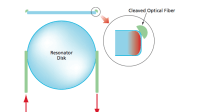
Electronics & Sensors INSIDER
New Tech May Lead to Smaller, More Powerful Wireless Devices

Tech Briefs
Deployable Fresnel Rings

Aerospace & Defense Tech Briefs
This Laser Clock Could Transform Satellite Navigation Accuracy
Software Tech Briefs
Analysis of Spiral Resonator Filters
Photonics Tech Briefs
Delaying Trains of Short Light Pulses in WGM Resonators

Tech Briefs
Products of Tomorrow
Tech Briefs
Tunable, Narrow Linewidth, Chip-Scale Lasers
Tech Briefs
Extended-Range Passive RFID and Sensor Tags
Tech Briefs
Series-Coupled Pairs of Silica Microresonators

Tech Briefs
Compact Microwave Fourier Spectrum Analyzer
Power Electronics INSIDER
Powerful and Precise Multi-color Lasers Now Fit on a Single Chip
Photonics & Imaging Technology
Ultra-Narrowband Optical Filters Pushing Boundaries from the UV to the LWIR
Electronics & Sensors INSIDER
Blocking Electromagnetic Radiation with the Flip of a Switch
RF & Microwave Technology
Antenna Electronically Steered Using MEMS Phase Shifters
Tech Briefs
Protein Sensors Based on Optical Ring Resonators

Aerospace & Defense Tech Briefs
Traveling-Wave Wide-Band Microstrip Antennas


Photonics Tech Briefs
Control Program and Optical Improvements of Fresnel Microspectrometer
Overview
The document is the Final Technical Report on the Non-Electronic Radio Front-End (NERF) project, conducted by researchers at the University of California and sponsored by the Defense Advanced Research Projects Agency (DARPA). The report, dated April 2007, outlines the development and experimental demonstration of a novel radio front-end technology that aims to enhance the performance of radio frequency (RF) communication systems.
The report begins with a summary highlighting the increasing vulnerability of modern electronics to high power electromagnetic weapons, particularly in the post-September 11 context. These weapons can produce power surges that damage sensitive circuitry, making RF communication systems especially at risk due to their direct exposure through antennas.
The introduction section provides background on the need for improved RF front-end technologies, emphasizing the limitations of current electronic systems in terms of resilience and performance. The NERF project aims to address these challenges by exploring non-electronic methods for RF signal processing, which could potentially offer greater robustness against electromagnetic interference.
The methods, assumptions, and procedures section details the experimental setup used to demonstrate the new device. This includes the design and implementation of a photonic-assisted all-dielectric RF front-end technology, which leverages optical components to enhance signal detection and processing capabilities.
Results and discussion are presented, showcasing the performance of the prototype receiver developed during the project. The report includes various figures illustrating the optical resonance spectrum, electro-optic modulation, and the measured transfer characteristics of the prototype. These results indicate promising advancements in receiver sensitivity and the ability to detect free space RF signals.
The conclusion summarizes the findings and implications of the research, suggesting that the NERF technology could significantly improve the resilience and efficiency of RF communication systems. The report emphasizes the importance of continued research in this area to further develop non-electronic solutions that can withstand the threats posed by electromagnetic weapons.
Overall, the document serves as a comprehensive overview of the NERF project, detailing its objectives, methodologies, experimental results, and potential impact on the field of RF communication technology. It underscores the critical need for innovative approaches to enhance the security and reliability of electronic systems in an increasingly complex threat landscape.
Top Stories
INSIDERManufacturing & Prototyping
 How Airbus is Using w-DED to 3D Print Larger Titanium Airplane Parts
INSIDERManned Systems
 FAA to Replace Aging Network of Ground-Based Radars
NewsTransportation
 CES 2026: Bosch is Ready to Bring AI to Your (Likely ICE-powered) Vehicle
NewsSoftware
 Accelerating Down the Road to Autonomy
EditorialDesign
 DarkSky One Wants to Make the World a Darker Place
INSIDERMaterials
 Can This Self-Healing Composite Make Airplane and Spacecraft Components Last...
Webcasts
Defense
 How Sift's Unified Observability Platform Accelerates Drone Innovation
Automotive
 E/E Architecture Redefined: Building Smarter, Safer, and Scalable...
Power
 Hydrogen Engines Are Heating Up for Heavy Duty
Electronics & Computers
 Advantages of Smart Power Distribution Unit Design for Automotive...
Unmanned Systems
 Quiet, Please: NVH Improvement Opportunities in the Early Design...
