




Research on Quantum Communication Repeaters
Quantum-based techniques for transferring and storing information have been demonstrated.
A program of research during the years 2001 through 2006 was devoted to building theoretical and practical foundations for the development of quantum repeaters as means of overcoming losses of photons in long-distance quantum communication systems. The idea underlying this research was to investigate means of utilizing suitably prepared ensembles of atoms (e.g. rubidium vapors) as means of storing and transferring the information encoded in the states of photons. The main accomplishments of this research, in approximate chronological order, include the following:
- Quantum repeaters based on ensembles of atoms, atom-atom correlations mediated by dark-state polaritons, and generation of stationary pulses of light were proposed and analyzed theoretically.
- Experiments were performed to demonstrate atomic memory for correlated photon states, stationary pulses of light, and shaping of quantum pulses via atomic memory.
- In the first realization of a two-node quantum network, generation and storage of single-photon pulses in two remote ensembles of atoms connected via a single photon was demonstrated.
- A method involving the use of fixed, minimal physical resources was proposed to achieve generation and nested purification of quantum entanglement for quantum communication over arbitrarily long distances. In one embodiment of this method, the fixed, minimal resources are solid-state single-photon emitters, each having two internal degrees of freedom formed by an electron spin and a nuclear spin. These resources would be used to build intermediate nodes in a quantum channel. It was shown that the fixed, minimal physical resources should suffice to correct arbitrary errors, making a quantumbased communication protocol robust to all realistic sources of decoherence. Recently, a node that utilized nitrogenvacancy centers in a room-temperature diamond lattice was demonstrated.
This work was done by Mikhail Lukin, Alexander Zibrov, Ehud Altman, Vlatko Balic, Gurudev Dutt, Dimitry Petrov, Anatoli Polkovnikov, Andre Sorensen, Casper van der Wal, Philip Walther, Daw-wei Wang, Tomasso Calarco, Ana Maria Rey, Axel Andr, Michal Bajscy, Darrick Chang, Lilian Childress, Matthew Eisaman, Mohammad Hafezi, Michael Hohensee, Jiang Liang, Aryesh Mukherjee, Alex Nemiroski, Jacob Taylor, Emre Togan, Saijun Wu, Florent Massou dit Labaquere, and Sidharth Shenai of Harvard College; Philip Hemmer and Mughees Khan of Texas A&M University; Peter Zoller of the University of Innsbruck; Ronald Walsworth of the Smithsonian Astrophysical Observatory; and Charles Marcus of Harvard University for the Naval Research Laboratory.
This Brief includes a Technical Support Package (TSP).
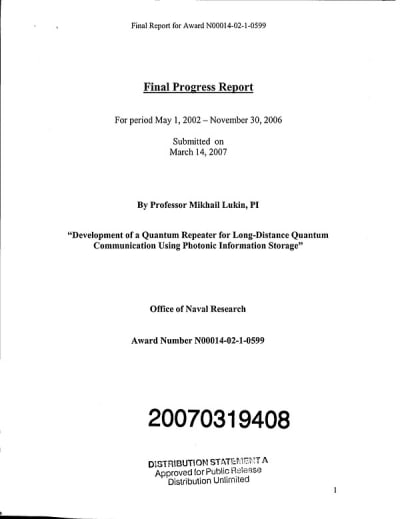
Research on Quantum Communication Repeaters
(reference NRL-0017) is currently available for download from the TSP library.
Don't have an account?
More From SAE Media Group
Tech Briefs
Platform for Quantum Technologies Using Gold
Aerospace & Defense Tech Briefs
Detection with Quantum Radar
Tech Briefs
Engineering the Flow of Light

Tech Briefs
Did You Ever See a Photon?

Photonics & Imaging Technology INSIDER
Strengthening Electron-Triggered Light Emission
Photonics & Imaging Technology
Using Magnets to Toggle Nanolasers Leads to Better Photonics
Photonics & Imaging Technology
An Electron Caught in the Act
Photonics & Imaging Technology INSIDER
Researchers Teleport Particle of Light Six Kilometers
Aerospace & Defense Tech Briefs
Could Metasurfaces Be The Next Quantum Information Processors?
Tech Briefs
Material Increases Efficiency of LED Devices

Photonics & Imaging Technology
A Laser That Could Reshape the Landscape of Integrated Photonics
Photonics & Imaging Technology
A First-Of-Its-Kind Integrated Optical Isolator


Photonics & Imaging Technology INSIDER
Thin Device Triggers One of Quantum Mechanics’ Strangest Phenomena
Tech Briefs
Quantum Sensing to Engineer Photonic Sensors
Tech Briefs
How Metasurfaces Can Act as Quantum Upgrades
Photonics & Imaging Technology
Nanoscale Machines Convert Light into Work
Photonics & Imaging Technology
On-Chip Optical Filter Processes Wide Range of Light Wavelengths

Photonics & Imaging Technology
Researchers Demonstrate Noise-Free Communication with Structured Light
Photonics & Imaging Technology
Light-Analyzing ‘Lab on A Chip’ Opens Door to Widespread Use of Portable Spectrometers
Photonics & Imaging Technology INSIDER
Scientists Use Photons as Threads to Weave Novel Forms of Matter
Tech Briefs
Optimal Information About the Invisible

Photonics & Imaging Technology INSIDER
Tiny Diamond Mirrors Could Smooth Out Already Revolutionary X-Ray Lasers
Overview
The document is the final report for Award N00014-02-1-0599, submitted by Professor Mikhail Lukin on March 14, 2007, detailing research conducted from May 1, 2002, to November 30, 2006. The project focused on the development of a quantum repeater for long-distance quantum communication using photonic information storage, a pioneering effort in the field.
The report begins with a statement of the problem studied and an abstract that outlines the project's objectives and achievements. The research aimed to address the challenges of photon loss in long-distance quantum communication, which is critical for the advancement of quantum networking technologies. The work has been influential, inspiring subsequent research in the field.
Key highlights of the project include theoretical proposals for quantum repeaters based on atomic ensembles, which were published in notable journals such as Nature and Physical Review Letters. The report details several significant experimental demonstrations, including the creation of atomic memory for correlated photon states, the generation of stationary pulses of light, and the shaping of quantum pulses via atomic memory. One of the major accomplishments was the realization of a two-node quantum network that involved the generation and storage of single photon pulses in two remote atomic ensembles.
The report also includes a comprehensive listing of publications and technical reports supported under the grant, categorized into peer-reviewed journals, non-peer-reviewed journals, conference proceedings, and invited presentations. Additionally, it lists manuscripts submitted but not yet published, showcasing the ongoing contributions to the field.
The document emphasizes the collaborative nature of the research, highlighting the participation of various scientific personnel and their contributions, including any advanced degrees earned during the project. It also notes the honors received and other sponsored support related to the research.
Overall, the report serves as a significant record of the advancements made in quantum communication technology, particularly through the innovative use of atomic ensembles for photon-state storage and the implementation of quantum repeaters. The findings have laid the groundwork for future developments in quantum networking, making it a vital resource for researchers and practitioners in the field.
Top Stories
INSIDERManufacturing & Prototyping
 How Airbus is Using w-DED to 3D Print Larger Titanium Airplane Parts
NewsAutomotive
 Microvision Aquires Luminar, Plans Relationship Restoration, Multi-industry Push
INSIDERAerospace
 A Next Generation Helmet System for Navy Pilots
INSIDERDesign
 New Raytheon and Lockheed Martin Agreements Expand Missile Defense Production
ArticlesAR/AI
 CES 2026: Bosch is Ready to Bring AI to Your (Likely ICE-powered) Vehicle
Road ReadyDesign

Webcasts
Semiconductors & ICs
 Advantages of Smart Power Distribution Unit Design for Automotive...
Unmanned Systems
 Quiet, Please: NVH Improvement Opportunities in the Early Design...
Electronics & Computers
 Cooling a New Generation of Aerospace and Defense Embedded...
Power
 Battery Abuse Testing: Pushing to Failure
AR/AI
 A FREE Two-Day Event Dedicated to Connected Mobility
