




All-Electric Commuter Aircraft Makes Maiden Flight
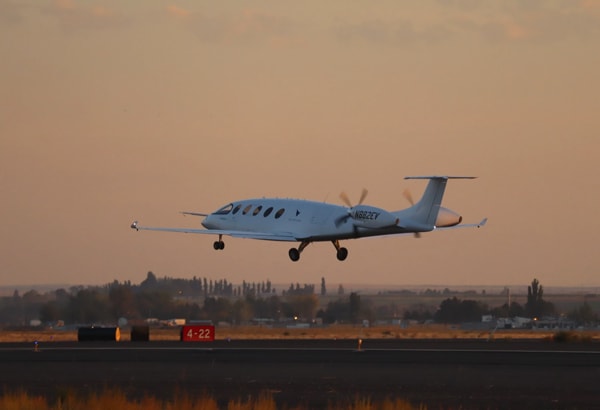
An aircraft maker from Western Washington provided a glimpse at one possible future for sustainable air travel — electric commuter planes. Eviation celebrated the maiden flight of an all-new, short hop airliner named Alice in Moses Lake. The eye-catching, vaguely spaceship-like electric airliner rolled out of its hangar at dawn and took off for the first time amid a cinematic sunrise with a belly full of batteries driving two propellers, one each on each side of its tail.
Test pilot Steven Crane was the only person on board the 9-passenger and one (or two) pilot electric plane for the maiden flight. Crane flew two loops around the airfield at about 3,500 feet altitude before setting down eight minutes later to cheers from a small number of onlookers invited by Eviation.
"It's a fast airplane, real sleek," Crane said after exiting the cockpit to a buzz of camera shutters and cell phone snaps. "Very responsive and it did well, no surprises."
Arlington, Washington-based Eviation's relatively new president and CEO, Gregory Davis, beamed with pride and accepted one congratulatory hug after another on the airport tarmac. Davis indicated the first customer deliveries may not happen before 2027 because the plane maker awaits further battery technology advancements to make the design commercially viable. The finalized model also needs to be certified by the Federal Aviation Administration, which could take a while because commercial passenger flight on electric power is so new.
Davis said when the production version enters service, Eviation wants it to have a 200 mile "useful range" on a full charge. That range would be enough to fly Seattle to Portland or Yakima to Bend, but from Seattle or Portland to Spokane would be pushing your luck. The prototype's max speed is listed as 250 knots.
Three airlines have already placed orders for the Alice model. Cape Air expressed interest in buying 75 for its short-haul routes in New England. A young charter airline out of Miami named Global Crossing recently signed up for 50. DHL ordered 12 in a cargo configuration.
Battery power might not necessarily be the propulsion source of your future flights. The weight and capacity of battery packs today make them impractical to power medium- to larger-sized aircraft, noted Ann Ardizzone, the vice president for supply chain at Alaska Airlines. Speaking at a recent Cascadia Innovation Corridor conference, Ardizzone said she is most keen on biofuels, known in this context as sustainable aviation fuel.
"We know it works," Ardizzone said. "It requires absolutely no aircraft modifications to work. It's a drop in fuel. We can use it with our existing infrastructure. And it reduces carbon emissions by 80% on a life cycle basis."
But for now, sustainable aviation fuel is hamstrung by limited production and high costs. SAF is most commonly refined from wood or agricultural wastes or made from vegetable oil or even algae.
Ardizzone said she is also curious about hydrogen as an alternative. In the same spacious Moses Lake hangar where the all-electric Alice plane parked, a different company is converting an older, slightly larger commuter plane to run on hydrogen fuel cells. The company, Universal Hydrogen, is aiming for a carbon-free maiden flight with a converted De Havilland Dash 8 possibly before the end of this year.
Moses Lake has long attracted test flight campaigns because of its good flying weather, fairly uncrowded skies and the extra-long runways at the airfield, which are a legacy from Grant County International Airport’s former life as a Cold War-era Air Force base.
More From SAE Media Group
Aerospace INSIDER
Why Hybrid-Electric is a Key Solution for Decarbonizing Aviation
Aerospace & Defense Tech Briefs
Bye Aerospace’s Sun Flyer Is Now the “EFlyer”
Aerospace INSIDER
Archer Aviation Completes Midnight eVTOL Transition Flight Milestone


Aerospace INSIDER
Safran's ENGINeUS 100 Electric Motor Earns EASA Certification
Aerospace INSIDER
Delta Air Lines, JetZero to Design Commercial Blended Wing Body Airliner
Tech Briefs
Propelling the Future of Sustainable Aviation
Aerospace & Defense Tech Briefs
MagniX and AeroTEC to Fly All-Electric ECaravan May 28

Aerospace INSIDER
Archer Achieves First Untethered Flight with Midnight eVTOL
Aerospace & Defense Tech Briefs
Air Racing Is Going Electric

NASA Spinoff
Swinging the HAMR
Aerospace & Defense Tech Briefs
Connected Aircraft Technologies Benefit Manufacturers, Airlines, and Travelers
Aerospace INSIDER
Sikorsky is Designing a New Hybrid Electric Tilt Wing VTOL Demonstrator

Aerospace INSIDER
Air Force Pioneers the Future of Synthetic Jet Fuel
Aerospace INSIDER
Collins Aerospace Completes Preliminary Design of 1MW Electric Motor
Aerospace INSIDER
Airbus and CFM International to Pioneer Hydrogen Combustion Technology
Aerospace & Defense Tech Briefs
Hybrid Electric Aircraft Demonstrator
Aerospace INSIDER
Airbus Preparing to Fly New Prototype eVTOL This Year

Aerospace & Defense Tech Briefs
Air Mobility Innovations Take Center Stage at Aerospace Systems and Technology Conference
Aerospace INSIDER
DoD's First Electric Aircraft Charging Station is a BETA Supercharger
Aerospace Manufacturing and Machining INSIDER
Amprius Eyes Mass Production for Next Generation Electric Aircraft Battery
Motion Design INSIDER
Megawatt Electrical Motor Could Help Electrify Aviation
Tech Briefs
Preventing Gridlock on the Ground
Aerospace & Defense Tech Briefs
Hybrid Electric EWIS System
Top Stories
INSIDERManufacturing & Prototyping
 How Airbus is Using w-DED to 3D Print Larger Titanium Airplane Parts
INSIDERManned Systems
 FAA to Replace Aging Network of Ground-Based Radars
NewsTransportation
 CES 2026: Bosch is Ready to Bring AI to Your (Likely ICE-powered) Vehicle
NewsSoftware
 Accelerating Down the Road to Autonomy
EditorialDesign
 DarkSky One Wants to Make the World a Darker Place
INSIDERMaterials
 Can This Self-Healing Composite Make Airplane and Spacecraft Components Last...
Webcasts
Defense
 How Sift's Unified Observability Platform Accelerates Drone Innovation
Automotive
 E/E Architecture Redefined: Building Smarter, Safer, and Scalable...
Power
 Hydrogen Engines Are Heating Up for Heavy Duty
Electronics & Computers
 Advantages of Smart Power Distribution Unit Design for Automotive...
Unmanned Systems
 Quiet, Please: NVH Improvement Opportunities in the Early Design...
