




Composites Affordability Initiative
Laser inspection method determines strength of bonded structures.
AFRL and Boeing have developed an innovative structural inspection technique for testing bonded structures. This technique provides materials engineers a first-time, validated, nondestructive capability to test for weak adhesive bonds and determine the minimum strength of adhesively bonded aerospace structures. The new method will enable aircraft designers to use bonded structures in a wider range of applications, and industry analysts predict it will provide both a 25% reduction in fabrication and assembly time and a 75% reduction in life-cycle costs.
Among the advantages that bonded structures offer aerospace weapon systems designers are lower acquisition costs, lower life-cycle costs (due to the elimination of fasteners), and smoother airflow over aerodynamic surfaces. Bonded structures also weigh less than conventional fabrications, resulting in increased range, speed, payload, and loiter capability for advanced weapon systems. The reduced structural weight is of particular importance to systems designed for long-range strike; persistent intelligence, surveillance, and reconnaissance missions; and multirole, all-environment mobility.
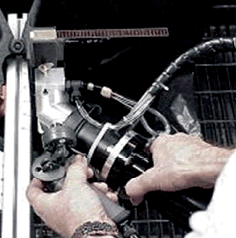
AFRL engineers launched the Composites Affordability Initiative (CAI) to focus design and manufacturing efforts on the use of bonded and integrated structures to reduce costs and increase structural efficiency in aircraft structures. Designers regularly employ bonded structures for a variety of secondary applications; however, several factors have previously inhibited their use in primary structures. One of the major inhibitors has been the lack of a nondestructive technique for assessing the strength of bonded joints. Boeing engineers led the CAI team's quality assurance technology effort, which subsequently produced the new laser bond inspection technique (patent pending).
Boeing researchers used high-peak-power, short-pulse-length laser excitation to generate stress waves in graphite epoxy, composite-to-composite structures (see figure). By interpreting the waves as they move through the structure, technicians can discriminate between weak and strong adhesive bonds in these structures. Using the laser-based bond inspection technique, they can also identify variations in surface preparation techniques, levels of surface contamination, and changes in paste adhesive mixing. The research team conducted over 3,000 laser stress wave experiments to validate the technique's repeatability and reliability in discriminating between weak and strong adhesive joints. This inspection technique has potential as a cost-effective method for ensuring that a bonded joint has a minimum load-carrying capacity immediately after its manufacture and that the joint can maintain this capacity throughout its service life.
With the help of two Small Business Innovation Research contracts, LSP Technologies, Inc., is pursuing further development of the laser bond inspection device to enable its use on the production floor. The successful introduction of this technology into standard manufacturing processes will enable the confident use of adhesively bonded structures in a variety of high performance applications.
Mr. Paul B. Hauwiller (Anteon Corporation), of the Air Force Research Laboratory's Materials and Manufacturing Directorate, wrote this article. For more information, contact TECH CONNECT at (800) 203-6451 or place a request at http://www.afrl.af.mil/techconn_index.asp . Reference document ML-H-05-08.
More From SAE Media Group
Air Force Research Laboratory Technology Horizons
Composites Design and Structural Analysis Tool
Aerospace & Defense Tech Briefs
Advances in Adhesive Joining of Structural Components Focus of New Book from SAE International
Tech Briefs
Sensor Film for Aerospace
Aerospace & Defense Tech Briefs
‘Nanostitches’ Enable Lighter and Tougher Composite Materials
Air Force Research Laboratory Technology Horizons
Innovative Processes Strengthen F-15E Vertical Stabilizers
Aerospace & Defense Tech Briefs
Composite Repair Engineering Case Studies for U.S. Army Aerostructures
Aerospace & Defense Tech Briefs
Sensing Applied Load and Damage Effects in Composites with Nondestructive Techniques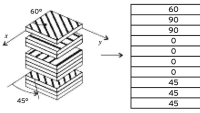
Tech Briefs
Calibration System for Automated Fiber Placement
Aerospace & Defense Tech Briefs
Robotic Paint Removal System
Tech Briefs
Thin Heat Shield for Superfast Aircraft
Aerospace & Defense Tech Briefs
Developing Thermoplastic Composites for Use in Commercial Aircraft
Tech Briefs
Self-Healing Aluminum Metal Matrix Composite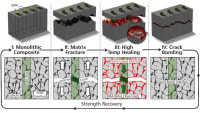
Air Force Research Laboratory Technology Horizons
Design of Lightweight and Durable Composite Structures
Tech Briefs
Strain-Detecting Composite Materials
Tech Briefs
Automated Tow/Tape Placement System

Aerospace & Defense Tech Briefs
Faster, Lighter, Stronger: Aerospace Composites Join Together Advanced Materials
Aerospace & Defense Tech Briefs
Advanced CT Inspection and Data Analysis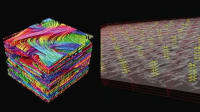
Tech Briefs
Compact, Lightweight, CMC-Based Acoustic Liner

Aerospace & Defense Tech Briefs
Cold Spray Technology
Aerospace & Defense Tech Briefs
Using Thermoplastics in Aerospace Applications
Aerospace & Defense Tech Briefs
SAE International Extends Call for Abstracts, Seeks Submissions for AeroTech Conference


Aerospace & Defense Tech Briefs
3D-Printed NACA Inlet
Aerospace & Defense Tech Briefs
How Advanced Vacuum Bag Kits Streamline Composite Parts Manufacturing
Tech Briefs
Copolyimide Surface-Modifying Coating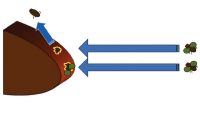
Top Stories
INSIDERManufacturing & Prototyping
 How Airbus is Using w-DED to 3D Print Larger Titanium Airplane Parts
INSIDERManned Systems
 FAA to Replace Aging Network of Ground-Based Radars
NewsTransportation
 CES 2026: Bosch is Ready to Bring AI to Your (Likely ICE-powered) Vehicle
NewsSoftware
 Accelerating Down the Road to Autonomy
EditorialDesign
 DarkSky One Wants to Make the World a Darker Place
INSIDERMaterials
 Can This Self-Healing Composite Make Airplane and Spacecraft Components Last...
Webcasts
Defense
 How Sift's Unified Observability Platform Accelerates Drone Innovation
Automotive
 E/E Architecture Redefined: Building Smarter, Safer, and Scalable...
Power
 Hydrogen Engines Are Heating Up for Heavy Duty
Electronics & Computers
 Advantages of Smart Power Distribution Unit Design for Automotive...
Unmanned Systems
 Quiet, Please: NVH Improvement Opportunities in the Early Design...
