




Evaluation and Test Requirements for Liquid Rocket Engines
This Standard establishes test and evaluation requirements related to the development, qualification (or certification), and acceptance (flight production unit) of liquid propellant rocket engines and associated propulsion systems.
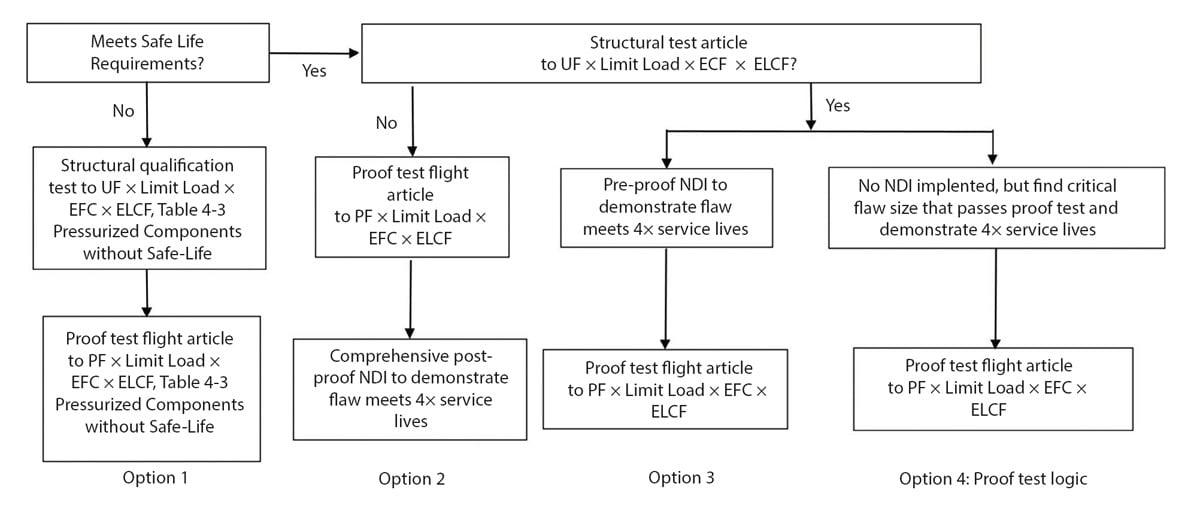
The primary objective of any test program is to maximize the probability, within programmatic constraints, that the flight design will function properly and successfully when used in actual service for the intended application. Flight risks are mitigated via prudent and effective analysis and testing. While analysis can sometimes be used in place of test, proper analytical techniques utilize test data as the basis for model correlations. The combination of analysis and test verification is used for both qualification of the LRE design as well as workmanship verification of each LRE flight unit.
Certain key tenets of testing have served the liquid propulsion test community well as it has tried to accomplish that objective. One particular “tried and true” philosophy is the “Test-Like-You-Fly” (TLYF) approach. TLYF means that testing should demonstrate engine operation with flight-representative hardware and under flight-representative conditions, including expected worst-case conditions. The overall test program should encompass and explore as much of the operational flight envelope as possible on the flight design to accomplish the ideal objective to avoid operating any particular flight hardware configuration under any particular set of conditions for the first time in flight.
Some flight environments (e.g., acceleration) cannot be replicated during ground test. Margin testing with respect to the expected flight conditions should be included to protect against known and unknown uncertainties in the flight conditions (e.g., ground-to-flight dispersions), as well as known, anticipated, and unknown hardware variations (e.g., manufacturing tolerances, non-conformances, and undetected deficiencies).
If it is impractical to test or simulate a particular flight condition on the ground, then additional margin may be appropriate. Furthermore, testing should consider and account for engine hardware experience and exposure throughout all phases of the required life cycle, including manufacturing, acceptance testing, transportation, handling, storage, vehicle integration, checkout testing, launch preparations, aborts, liftoff, and flight. Exceptions to this approach should be carefully evaluated and include a risk determination. It is prudent that LREs be deliberately designed to provide margins equal to or greater than the specified margin test requirements so as to provide high probability for test success and high reliability for flight operations.
A corollary to TLYF is the “fly-as-you-test” approach. “Fly-as-you-test” means that flight operation should remain within demonstrated ground-tested and qualified regimes, and that design and process differences between qualified test hardware and flight hardware should be minimized and ideally avoided. A successful development and qualification program will anticipate all potential flight conditions and ensure those conditions are validated by a robust test program. If an engine has multiple applications, ideally the engine should be developed and qualified to the most demanding requirements, however programmatic considerations may dictate a phased approach.
Hot-fire testing to verify that an LRE design is ready for flight typically consists of four phases of major program activity: prototype testing, development testing, qualification testing, and integrated system testing. The first three test phases typically occur at the component level as well as the engine level. The integrated system testing phase is performed at the propulsion system and/or vehicle level.
After an LRE design has completed the qualification program (i.e., production phase), each individual flight engine is acceptance tested by hot-fire to verify that specific engine’s suitability for flight. Prelaunch operational testing is performed prior to engine start and liftoff to verify readiness for launch. Finally, additional testing can be performed or additional data obtained for the system during the operational phase of a test flight or actual space launch mission.
Specific requirements are placed upon qualification, production unit acceptance testing, and integrated system testing. There is an allowance, and in fact an expectation, that engines not meeting the full requirements of qualification will be used as a part of the overall design verification effort to increase the sample size of suitable engines. “Verification engines” include qualification engines and may also include development engines that are structurally and functionally equivalent to the qualification and flight design. Hereafter, references to the qualification requirements are meant to include testing on formal qualification engines as well as development engines that are suitable as verification engines.
This work was approved by Nick Awwad, David Davis, and Thomas Fitzgerald for the Air Force Space Command. For more information, download the Technical Support Package (free white paper) here under the Test & Measurement category. AFSC-0001
This Brief includes a Technical Support Package (TSP).
Evaluation and Test Requirements for Liquid Rocket Engines
(reference AFSC-0001) is currently available for download from the TSP library.
Don't have an account?
More From SAE Media Group


Aerospace & Defense Tech Briefs
NASA Selects Frontier Aerospace to Continue Development of New Deep Space Thruster

Aerospace & Defense Tech Briefs
GKN Aerospace to Develop First Additive-Manufactured Rocket Engine Turbines in Europe for Prometheus Project
Aerospace & Defense Tech Briefs
Prototype Hypersonic Defense Engine
Aerospace & Defense Tech Briefs
SAE International Issues, Revises Technical Reports for Aerospace Engineering
Aerospace & Defense Tech Briefs
Rocket Engine Technology

Tech Briefs
Integrated Multiphysics and Advanced Diagnostics
Tech Briefs
LED Lighting Improves Efficiency and Imaging

Aerospace & Defense Tech Briefs
Industry Invited to Participate in AeroTech Aerospace and Defense Technical Program
Aerospace & Defense Tech Briefs
SAE International Extends Call for Abstracts, Seeks Submissions for AeroTech Conference
Tech Briefs
How Jet Engine Flow Can Be Controlled Optically



Tech Briefs
UCF’s Hypersonic Technology Advances


Tech Briefs
Propulsion System for Hypersonic Flight
Aerospace & Defense Tech Briefs
Combustion Characteristics of Hydrocarbon Droplets Induced by Photoignition of Aluminum Nanoparticles
Aerospace INSIDER
Ursa Major Performs First Successful Hotfire of Hypersonic Draper Engine
Aerospace & Defense Tech Briefs
Orbex Debuts Innovative Smallsat Launch Vehicle

Aerospace & Defense Tech Briefs
OmegA Rocket Sustains Explosion During First Static Test, Northrop Grumman Maintains Test Was a Success
NASA Spinoff
Software Toolkit Steadies Rockets
Overview
The SMC Standard SMC-S-025, titled "Evaluation and Test Requirements for Liquid Rocket Engines," dated 26 July 2017, serves as a comprehensive guideline for the evaluation and testing of liquid rocket engines. This document is crucial for ensuring that rocket propulsion systems meet specific performance and reliability standards.
The standard begins with an introduction that outlines its scope, purpose, and application, emphasizing the importance of rigorous testing in the development and qualification of liquid rocket engines. It establishes a framework for the testing process, detailing the necessary steps to verify that engines meet their performance requirements and functional objectives.
A key aspect of the document is its emphasis on a structured test program. It mandates that the test program must include a sufficient number of tests across various unique engine samples, as specified in Table 4-2 of the document. This ensures that all specific performance requirements are thoroughly verified. The standard allows for multiple objectives to be tested in a single test, provided that these objectives do not interfere with one another, thereby optimizing the testing process.
The document also addresses the need for delta-qualification, which refers to the process of qualifying changes in engine configuration, processes, suppliers, or facilities. It stipulates that such deviations can be approved with the concurrence of the Approval Authority, ensuring that any modifications do not compromise the engine's performance or safety.
Additionally, the standard includes sections on applicable documents and guidance, which outline the references that form part of the standard. It clarifies that in cases of conflict between this standard and other documents, the requirements of this standard take precedence, reinforcing its authority in the testing and evaluation process.
The document is structured to facilitate clear communication and understanding among stakeholders involved in the development and testing of liquid rocket engines. It includes sections for submitting change recommendations, ensuring that the standard can evolve based on feedback and advancements in technology.
In summary, SMC-S-025 is a vital resource that provides a detailed framework for the evaluation and testing of liquid rocket engines, ensuring that they meet stringent performance and reliability standards essential for successful space missions.
Top Stories
NewsRF & Microwave Electronics
 Microvision Aquires Luminar, Plans Relationship Restoration, Multi-industry Push
INSIDERAerospace
 A Next Generation Helmet System for Navy Pilots
INSIDERDesign
 New Raytheon and Lockheed Martin Agreements Expand Missile Defense Production
INSIDERMaterials
 How Airbus is Using w-DED to 3D Print Larger Titanium Airplane Parts
NewsPower
 Ford Announces 48-Volt Architecture for Future Electric Truck
ArticlesAR/AI

Webcasts
Electronics & Computers
 Cooling a New Generation of Aerospace and Defense Embedded...
Automotive
 Battery Abuse Testing: Pushing to Failure
Power
 A FREE Two-Day Event Dedicated to Connected Mobility
Unmanned Systems
 Quiet, Please: NVH Improvement Opportunities in the Early Design Cycle
Automotive
 Advantages of Smart Power Distribution Unit Design for Automotive &...
Energy
 Sesame Solar's Nanogrid Tech Promises Major Gains in Drone Endurance