




Miniature Semiconductor Diodes as Pumps and Motors
Rectification of applied AC electric fields causes electro-osmotic flows.
Experiments have shown that when a miniature semiconductor diode floats in an aqueous solution and an alternating electric field is applied, (1) the diode rectifies the alternating potential induced between the electrodes, and (2) the resulting pulsating DC potential gives rise to an electro-osmotic flow in the vicinity of the diode and associated force that orients the diode along the electric-field direction, and propels the diode through the water. The propulsive force on the diode is along the electricfield direction and can be toward the cathode or the anode end, depending on the precise nature of the surface charge on the diode and the chemical composition of the solution. It has been proposed to exploit this phenomenon in developing microscale and nanoscale pumps and motors for diverse purposes. The proposal is not as radical as it might first seem: Electro-osmosis in applied DC electric fields has been used to pump liquids in microfluidic devices.
In another family of potential applications, microscale and nanoscale pumps and mixers would be embedded at selected locations in walls and would be activated by application of global AC electric fields to effect active local control of flows. Diode-based microscale and nanoscale pumps and mixers would thus enable achievement of an unprecedented degree of complexity and performance in microfluidic applications in general, and more specifically, in manipulation (especially, separation) of biomolecules in laboratory-on-a-chip applications. In some cases, separations might be enhanced by use of combinations of AC-electric-field-actuated diode electro-osmotic pumping and DC-electric- field-actuated electrophoresis.
In yet another family of potential applications, diodes would be embedded in microscopic gears, wheels, propellers, and the like, wherein they would be positioned and oriented so that upon application of AC electric fields, the resulting electro-osmotic flows would produce torques that would cause these objects to rotate. The feasibility of this concept was demonstrated in an experiment on a macroscopic (≈1.8-cm-diameter) rotor with diodes mounted on its periphery.
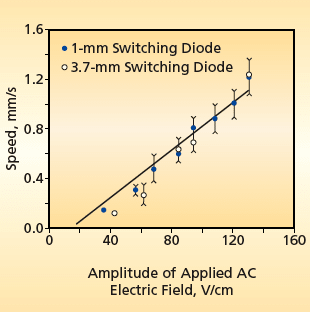
In a variation on the basic theme of these and other potential applications, diode propulsion units would be made to emit or respond to light. (In experiments, light-emitting diodes suspended in the water in the presence of a suitably strong AC electric field both propelled themselves electro-osmotically and emitted light.) In another variation, regulation of speed would be achieved through exploitation of electrical characteristics of diodes or of microcircuitry integrated with diodes: For example, in an experiment on Zener diodes, the electro-osmotic speed remained approximately constant when the magnitude of the AC field was increased beyond a point corresponding to the Zener voltage.
This work was done by Orlin D. Velev of North Carolina State University for the Air Force Research Laboratory. For more information, download the Technical Support Package (free white paper) at www.defensetechbriefs.com/tsp under the Electronics/Computers category. AFRL- 0020
This Brief includes a Technical Support Package (TSP).

Miniature Semiconductor Diodes as Pumps and Motors
(reference AFRL-0020) is currently available for download from the TSP library.
Don't have an account?
More From SAE Media Group
Power Electronics INSIDER
Superconducting Diode Bridge Efficiently Converts AC to DC for Quantum Circuits

Tech Briefs
Light-Emitting Tattoo



Tech Briefs
A Two-in-One Storage and Computing Device
Tech Briefs
New on the Market
Aerospace & Defense Tech Briefs
Low-Power Circuit for an Electromagnetic Warning System Sensor

Battery Technology
New Products

Tech Briefs
High-Voltage Droplet Dispenser


Aerospace & Defense Tech Briefs
DC Power Converter for 200°C Containing SiC Transistors
Medical Design Briefs
Flexible Screen-Printed Rechargeable Battery

Tech Briefs
Low-Inductance DC Power Bus
Automotive Engineering
Tula DMD Aims for More-Efficient E-Machines
Power Management INSIDER
Highly Sensitive Diode, Converts Microwaves to Usable Electricity
Embedded Technology INSIDER
Could Black Phosphorus be the Next Silicon?
Aerospace & Defense Tech Briefs
Silicon Carbide Junction Field-Effect Transistor Devices for Scalable Solid-State Circuit Breakers
Tech Briefs
Crane-Load Contact Sensor
Electronics & Sensors INSIDER
A New Magnetic Transistor for More Energy-Efficient Electronics


Electronics & Sensors INSIDER
New Cooling Technique Could Make Computer Chips More Powerful
Overview
The document presents research on "Autonomous Self-Propelling Microcircuit Particles," focusing on the innovative use of miniature semiconductor diodes that can function as self-propelling particles in aqueous environments when subjected to an external alternating electric field. The study highlights the ability of these diodes to rectify the voltage induced between their electrodes, generating an electroosmotic force that propels them in the direction of either the cathode or anode, depending on their surface charge.
Key findings include the characterization of the diodes' motion, which can be influenced by various parameters such as the external AC field strength and the pH of the surrounding solution. The research indicates that the velocity of the diodes is consistent across different sizes, and the direction of motion can change at a specific pH level, which corresponds to the isoelectric point of the resin body used in the experiments. Notably, the velocity is not significantly affected by the frequency of the external field up to RF frequencies, and the use of Zener diodes can limit the maximum velocity based on their reverse voltage characteristics.
The document outlines the experimental setup, which includes a model microfluidic device designed to measure the velocity and pumping rate of the floating diodes. The integration of these diodes into microfluidic channels allows for localized pumping and mixing functions, powered by a global external electric field. This capability is crucial for applications in lab-on-a-chip devices, where precise manipulation of liquids, solutes, and analytes at the nanoscale is required.
The research establishes a foundation for the design and operation of actively controlled nanofluidic-electronic chips, which could lead to advancements in integrated microfluidic systems. The potential applications of these self-propelling diodes extend to various fields, including biomedical diagnostics, environmental monitoring, and chemical analysis.
In summary, this document details a significant advancement in the field of microfluidics and nanotechnology, showcasing how miniature semiconductor diodes can be harnessed for innovative applications in liquid manipulation and autonomous micromachine development. The findings contribute to the ongoing exploration of smart materials and devices that can operate at the nanoscale, paving the way for future technological innovations.
Top Stories
INSIDERManufacturing & Prototyping
 How Airbus is Using w-DED to 3D Print Larger Titanium Airplane Parts
INSIDERManned Systems
 FAA to Replace Aging Network of Ground-Based Radars
NewsTransportation
 CES 2026: Bosch is Ready to Bring AI to Your (Likely ICE-powered) Vehicle
NewsSoftware
 Accelerating Down the Road to Autonomy
EditorialDesign
 DarkSky One Wants to Make the World a Darker Place
INSIDERMaterials
 Can This Self-Healing Composite Make Airplane and Spacecraft Components Last...
Webcasts
Defense
 How Sift's Unified Observability Platform Accelerates Drone Innovation
Automotive
 E/E Architecture Redefined: Building Smarter, Safer, and Scalable...
Power
 Hydrogen Engines Are Heating Up for Heavy Duty
Electronics & Computers
 Advantages of Smart Power Distribution Unit Design for Automotive...
Unmanned Systems
 Quiet, Please: NVH Improvement Opportunities in the Early Design...
