




Interactive DataWall
Multiple users can view and interact with information from multiple sources.
The Interactive DataWall (IDW) is a computer-driven, high-definition display, large enough to be visible simultaneously to multiple observers, that presents information from multiple sources and exploits advanced techniques of human/computer interaction and data fusion. The IDW originally was intended for collaborative use by a group of Air Force decision-makers who must consider large amounts of dynamic information (e.g., information pertinent to targeting during battle). Sources of displayed and otherwise utilized information can include sensors on terrestrial vehicles, sensors aboard satellites, databases, and video feeds from remote locations.
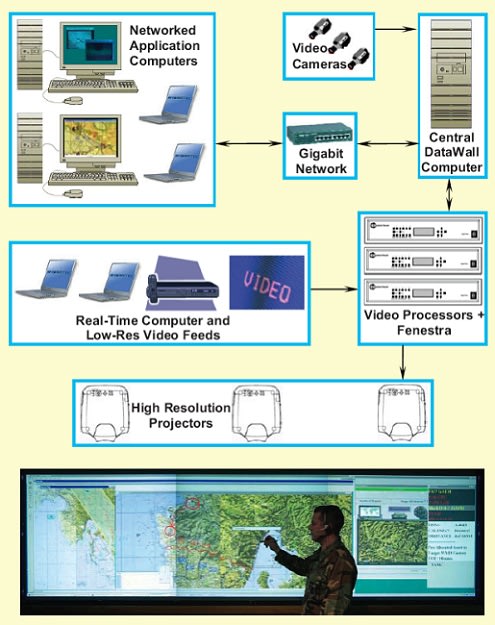
The IDW has progressed through several evolutionary versions and continues to undergo development in the Advanced Displays and Intelligent Interfaces program of the Air Force Research Laboratory. In its present form (see figure), it includes three liquid-crystal- display-based video projectors, each having a resolution of 1,280 x 1,024 pixels. These projectors are mounted side by side to form a nearly seamless single image of 3,840 x 1,024 pixels in a screen 12 ft. wide by 33 ft. high. The resulting single composite or mosaic display can be regarded as an extended desktopcomputer display.
The development of the IDW has involved utilization of commercial-off-the-shelf (COTS) hardware and software, leveraged by the use of custom hardware and software as needed. In every evolutionary version thus far, the IDW display has been driven by a single central computer system configured with either multiple graphics cards or multi-output graphics cards. Each graphics-card output constitutes a highresolution source for each tile of the display. Windows can be repositioned and resized anywhere on the display. Windows that originate from multiple sources can be projected across boundaries between projectors. Windows can be maximized to fill the entire display. Many application windows can be run simultaneously on the DataWall computer; windows of current interest can be displayed in the foreground, in background, or minimized for rapid accessibility when needed.
A vital part of the IDW is the ability not only to display information from personal computer application software but also to accept multiple inputs from various sources. For example, the IDW architecture enables the acceptance of multiple live, dynamic video streams and the display of them in any tile in a rectangular array of such tiles. This ability to display information from multiple sources simultaneously in different areas of the screen is made possible by use of three external video processors connected to the central DataWall PC system and of a custom windowing software system, called “Fenestra” (Latin for “Windows”), which leverages COTS video overlay hardware to enable the display of both live high-resolution computer video and low-resolution National Television System Committee (NTSC) video sources. A number of decision-makers can interact within the display environment simultaneously via multiple cursors generated by a collection of networked application computers. Collocated application computers can also be controlled within the display space.
A custom laser pointer input device can function similarly to a wireless computer mouse. A live video image of the display surface is processed to determine presence and position of the laser dot on the screen to enable the user to interact with the information displayed. The computer cursor can be controlled to coincide with the laser dot, and mouse buttons on the laser pointer device can be used to perform the same control actions as those of mouse buttons. With voice input via a cordless telephone, wireless control also can be exerted by use of speech-recognition hardware and software.
This work was done by Peter A. Jedrysik and Rebecca C. Alvarez of the Air Force Research Laboratory. For more information, download the Technical Support Package (free white paper) at www.defensetechbriefs.com/tsp under the Electronics/Computers category. AFRL-0017
This Brief includes a Technical Support Package (TSP).
Interactive DataWall
(reference AFRL-0017) is currently available for download from the TSP library.
Don't have an account?
More From SAE Media Group


Aerospace & Defense Tech Briefs
Rugged Server and Display System

Aerospace & Defense Tech Briefs
VITA 90: Small Form Factors for UAVs and Other Space Constrained Platforms

Tech Briefs
Desktop Computer System Processes Satellite Data
Tech Briefs
Converter Helps NASA Transmit HDTV to Earth
Embedded Technology
The Virtual Becomes Reality at Iowa State University
Photonics & Imaging Technology
Rethinking FPGAs for Smart Cameras
Tech Briefs
An Autonomous Drone Based on Animal Brains
Photonics & Imaging Technology
Detecting Threats Beyond the Limits of Human, Sensor Sight
Photonics & Imaging Technology
What's Ahead for Machine Vision Cameras?
Aerospace Manufacturing and Machining INSIDER
Army Launches CMOSS Prototyping Competition for Computer Chassis and Cards

Photonics & Imaging Technology
Optimizing Industrial Embedded Imaging Development
Embedded Technology INSIDER
How PCI Express Is Changing Machine Vision


Tech Briefs
Processor Power and Energy Efficiency
Aerospace & Defense Tech Briefs
Deterministic and Modular Architecture for Embedded Vehicle Systems
Tech Briefs
Essential Control and Visualization, Combined
Tech Briefs
Bar-Code System for a Microbiological Laboratory
Aerospace & Defense Tech Briefs
Security IP Module
Photonics & Imaging Technology
Using CoaXPress-over-Fiber for High-Speed Machine Vision
Overview
The document is a Final Technical Report titled "Advanced Displays and Intelligent Interfaces (ADII)" prepared by the Air Force Research Laboratory (AFRL), Information Directorate, and is dated July 2006. It outlines the development and evaluation of advanced display technologies and human-computer interaction (HCI) techniques aimed at enhancing Command and Control (C2) environments for the U.S. Air Force.
The report emphasizes the critical need for large, high-definition displays that can effectively manage and present vast amounts of dynamic and varied information. This information is essential for 21st-century commanders who must navigate complex data from multiple sources, including terrain maps, intelligence reports, and simulation results. The ability to assimilate and analyze this data is crucial for effective decision-making in military operations.
One of the key innovations discussed is the Portable Interactive DataWall, which was developed to bring advanced display technology out of the laboratory and into real-world applications. The AFRL recognized the potential benefits of a field-deployable version of the Interactive DataWall as early as 1998, aiming to facilitate user evaluation and guide further research and development.
The report also addresses the challenges associated with implementing these advanced display systems, including the need for robust system architecture and effective network-based control software. It highlights the importance of HCI techniques that allow users to interact intuitively with complex data sets, thereby improving situational awareness and operational effectiveness.
In summary, the report underscores the significance of integrating advanced display technologies and intelligent interfaces into military operations to meet the evolving information management needs of the Air Force. By enhancing the ability to visualize and interact with data, these innovations aim to improve decision-making processes and operational success in the field. The document is approved for public release and is intended to inform both military personnel and the general public about the advancements in display technology and HCI developed by the AFRL.
Top Stories
INSIDERDefense
 New Raytheon and Lockheed Martin Agreements Expand Missile Defense Production
NewsAutomotive
 Ford Announces 48-Volt Architecture for Future Electric Truck
INSIDERManufacturing & Prototyping
 Active Strake System Cuts Cruise Drag, Boosts Flight Efficiency
ArticlesTransportation
 Accelerating Down the Road to Autonomy
INSIDERMaterials
 How Airbus is Using w-DED to 3D Print Larger Titanium Airplane Parts
Road ReadyTransportation

Webcasts
Electronics & Computers
 Cooling a New Generation of Aerospace and Defense Embedded...
Power
 Battery Abuse Testing: Pushing to Failure
Connectivity
 A FREE Two-Day Event Dedicated to Connected Mobility
Automotive
 Quiet, Please: NVH Improvement Opportunities in the Early Design Cycle
Transportation
 Advantages of Smart Power Distribution Unit Design for Automotive &...
Aerospace
 Sesame Solar's Nanogrid Tech Promises Major Gains in Drone Endurance