




Small-Scale Combustion-Chamber Testing Facility
The facility satisfies requirements for accuracy, safety, capability, and standardization.
A small-scale combustion-chamber testing facility has been designed and partly built for use in evaluating advanced combustor designs for future gas turbine engines. The specific model combustor for which the facility was designed is an approximation of a planar section of an ultra-compact combustor (UCC). In the full-scale UCC (Figure 1), vanes in an annular cavity are positioned and oriented to cause the combustion gases to flow in a spiral pattern and the resulting centripetal acceleration in the cavity is utilized to increase the speed of combustion and thereby make it possible to design the combustion chamber to be shorter than would otherwise be necessary. In the model combustor, the spiral aspect of the flow is approximated by means of a small flow of air directed perpendicular to a main flow. The design of the facility and the model combustor provides access for off-axis optical (including visual) observation and measurement of cavity-vane interactions. The facility can also be used to test many other combustor models.

The design of this facility reflects considerations of accuracy, capability, safety, and flexibility expressed by users of other facilities. All systems and measurements are designed to comply with Aerospace Recommended Practice 1256, which is a standard published by SAE International (formerly known as the Society of Automotive Engineers). The facility includes systems that help to maintain a safe work environment: these include automatic fuel shutoff, heater shutoff, and general power-shutoff subsystems. The facility can safely accommodate testing of model combustors for which open flames are required.

The facility can supply air to the combustor model at a rate of as much as 260 standard cubic feet per minute (SCFM) [0.123 m3/s], split into two legs at 200 SCFM (0.0944 m3/s) and 60 SCFM (0.0283 m3/s), respectively. These legs can be independently heated to temperatures of as much as 500 ºF (260 ºC). The flow rates, pressures, and temperatures of air in the two legs are monitored and regulated, and are recorded along with other measurement data. Liquid fuel can be pumped to the testing volume at a maximum flow rate of 340 mL/min; gaseous fuel can be supplied at a maximum flow rate of 200 standard liters per minute. The combination of air and fuel rates can be adjusted to obtain a desired equivalence ratio (see Figure 2), which can range up to as much as 4.3 for JP-8 (a kerosine-based jet fuel).
The facility includes equipment for analyzing unburned fuel and combustion- product gases via their infrared spectra and for measuring oxygen concentrations in combustion products via the magnetic susceptibility of oxygen. Also included is an exhaust system that, if required, can pump gases out of the test volume.
This work was done by Eric R. Dittman of the Air Force Institute of Technology for the Air Force Research Laboratory. For more information, download the Technical Support Package (free white paper) at www.defensetechbriefs.com/tsp under the Manufacturing & Prototyping category. AFRL-0028
This Brief includes a Technical Support Package (TSP).
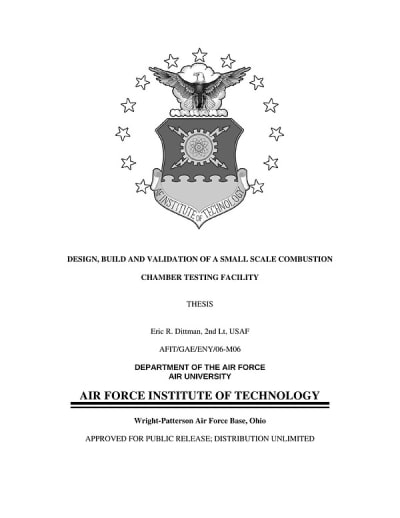
Small-Scale Combustion-Chamber Testing Facility
(reference AFRL-0028) is currently available for download from the TSP library.
Don't have an account?
More From SAE Media Group
Automotive Engineering
UAV Turbines to Tackle 200-Hp Class UAV Engines for U.S. Army

Aerospace & Defense Tech Briefs
SAE International Issues, Revises Technical Reports for Aerospace Engineering
Aerospace & Defense Tech Briefs
Engineering an Aircraft Hydrogen Powertrain
Aerospace & Defense Tech Briefs
Rolls-Royce Starts Lean-Burn Combustion Engine Icing Tests
Aerospace & Defense Tech Briefs
SAE International Extends Call for Abstracts, Seeks Submissions for AeroTech Conference

Off-Highway Engineering
Bosch Begins Production of Fuel-Cell Power Modules for Nikola

Automotive Engineering
SAE Updates Gasoline Fuel-Injection Standards, Additions Expected
Aerospace & Defense Tech Briefs
Rotating Detonation-Wave Engines
Aerospace & Defense Tech Briefs
Combustion Characteristics of Hydrocarbon Droplets Induced by Photoignition of Aluminum Nanoparticles
Aerospace & Defense Tech Briefs
FAA, SAE International Focus on Engine Fire Protection System Standards for Aerospace
Automotive Engineering
Enterprise Battery-Analysis Pioneer Voltaiq Partners with Siemens

Aerospace INSIDER
Air Force Propulsion Team Continues Flow Visualization Study

Tech Briefs
Flow-Through Transducer for Wind Tunnel Analysis
Off-Highway Engineering
Caterpillar Unveils New C13D Off-Highway Engine Platform
Tech Briefs
Device Measures Laser Power in Real Time
Medical Design Briefs
Wearable Head Scanner Allows Mobility During Brain Scans
Aerospace & Defense Tech Briefs
Industry Invited to Participate in AeroTech Aerospace and Defense Technical Program
Medical Design Briefs
The Three Challenges in Biomedical QC Testing
Automotive Engineering
Tenneco Opens Engineering, Simulation Center in Poland
Automotive Engineering
Inside GM’s Expanded Electric-Vehicle Battery Lab
Sensor Technology
Stretchable Wireless Sensor Could Monitor Healing of Cerebral Aneurysms

Overview
The document is a Master's thesis authored by 2nd Lt. Eric R. Dittman, submitted to the Air Force Institute of Technology. The thesis is titled "Design, Build and Validation of a Small-Scale Combustion Chamber Testing Facility" and covers the period from September 2004 to March 2006. It aims to address the need for a dedicated facility to test combustion processes, which are critical in various aerospace applications.
The thesis begins with an introduction that outlines the importance of combustion research in the context of aerospace engineering, particularly for improving propulsion systems and enhancing fuel efficiency. Dittman emphasizes the necessity for a controlled environment to conduct experiments that can lead to advancements in combustion technology.
The document details the design and construction phases of the testing facility, including the selection of materials, design specifications, and safety considerations. The author discusses the engineering principles applied in creating a small-scale combustion chamber that can simulate real-world conditions while allowing for precise measurements and observations.
Validation of the facility is a key focus of the thesis. Dittman describes the testing procedures implemented to ensure that the facility operates as intended. This includes calibration of instruments, testing various fuel types, and analyzing combustion efficiency and emissions. The results of these tests are presented, demonstrating the facility's capability to produce reliable data for further research.
In addition to the technical aspects, the thesis includes a chapter on conclusions and recommendations. Here, Dittman provides insights into the effectiveness of the facility and suggests areas for improvement. He discusses potential future work that could expand the facility's capabilities, such as incorporating advanced measurement techniques or exploring alternative fuels.
Overall, the thesis serves as a comprehensive guide to the development of a small-scale combustion chamber testing facility, highlighting its significance in advancing combustion research within the aerospace sector. It reflects the author's contributions to the field and provides a foundation for future studies aimed at enhancing combustion technologies. The work is positioned as a valuable resource for both academic and practical applications in aeronautical engineering.
Top Stories
INSIDERManufacturing & Prototyping
 How Airbus is Using w-DED to 3D Print Larger Titanium Airplane Parts
INSIDERManned Systems
 FAA to Replace Aging Network of Ground-Based Radars
NewsTransportation
 CES 2026: Bosch is Ready to Bring AI to Your (Likely ICE-powered) Vehicle
NewsSoftware
 Accelerating Down the Road to Autonomy
EditorialDesign
 DarkSky One Wants to Make the World a Darker Place
INSIDERMaterials
 Can This Self-Healing Composite Make Airplane and Spacecraft Components Last...
Webcasts
Defense
 How Sift's Unified Observability Platform Accelerates Drone Innovation
Automotive
 E/E Architecture Redefined: Building Smarter, Safer, and Scalable...
Power
 Hydrogen Engines Are Heating Up for Heavy Duty
Electronics & Computers
 Advantages of Smart Power Distribution Unit Design for Automotive...
Unmanned Systems
 Quiet, Please: NVH Improvement Opportunities in the Early Design...
