




Miniature Hyperspectral Sensors for Imaging on Small UAVs
Small hyperspectral imaging sensors yield critical information not available with digital video or thermal cameras.
As unmanned vehicles get smaller and smaller, operational expectations and mission objectives demand a much broader array of platform capabilities — a necessity even with reduced payloads requiring less weight, smaller size, and less power consumption. An interesting dichotomy exists between the need for increasing amounts of valuable information and the operational ability to capture and synthesize this information in real time.
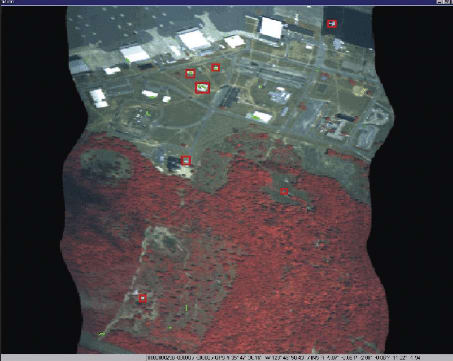
A key example is seen when one takes stock of the trends driving the development and deployment of small unmanned aerial vehicles (UAVs) and small unmanned ground vehicles (SUGVs). With obvious advantages, smaller unmanned vehicles — whether airborne systems or ground-based robots — provide substantially greater operational benefits in theater with lower risk for the warfighter. As a result, military and defense agencies are looking to increase the capabilities of unmanned vehicles by incorporating very small hyperspectral imaging sensors. These hyperspectral sensors yield critical information not available with digital video or thermal cameras concerning objects on the ground in the context of a three-dimensional view comprising both spatial position and chemical composition.

Hyperspectral imaging represents a key advancement in sensor technology that is increasingly utilized as an essential payload component. Based on reflectance spectroscopy, these microhyperspectral sensors capture all spectral information within the field of view and store this information as a hyperspectral datacube. These sensors are used to assess objects within the field of view based on unique chemical “fingerprints.” For example, camouflage netting can be easily discerned from surrounding vegetation as a result of its uniquely different chemical spectrum. Or, for any point on the ground or for any object in the scene, the complete chemical spectra can be generated and interrogated against known threats or assets. Depending upon mission objectives, the hyperspectral datacube can be processed for many applications including target identification and tracking, surveillance and reconnaissance, spectral tagging for special operations, border patrol and interdiction, and more.
Hyperspectral imaging is a proven technique that was first implemented in the 1980s for remote sensing of the Earth. In the mid 1990s, military and defense requirements spawned a new set of tasks that were well suited to the capabilities of these imaging spectrometers. With years of implementation experience, hyperspectral instruments have been designed to provide high-resolution imagery with no image distortion (typically known as keystone or smile), which is a key concern for imaging in harsh or hostile environments. This imaging performance is a result of a concentric imaging design that utilizes a high-efficiency, holographic diffraction grating as the dispersive optic in the system. Standard spectral ranges consist of the visible-near-infrared range (VNIR 400 to 1,000 nm), near-infrared (NIR 900 to 1,700nm), and shortwave infrared range (SWIR 1,000 nm to 2,500 nm).
Through careful design, small hyperspectral sensors are optimized to provide for a wide field of view (FOV) and enhanced instantaneous field of view (IFOV), which is an indicator of spectral and spatial resolving power of the sensor.
With UAVs such as the U.S. Army’s Raven (hand-launched, 4.2 pounds, 5-foot wingspan) being deployed in ever increasing numbers, sensor designers and optical engineers will continue to be challenged to develop sensing instrumentation that not only provides critical information but does so in smaller and smaller package sizes.
This article was written by David Bannon, co-founder of Headwall Photonics, Fitchburg, MA. For more information, contact Mr. Bannon at
More From SAE Media Group
Aerospace & Defense Tech Briefs
Spatial Calibration for Accurate Long Distance Measurement Using Infrared Cameras
Photonics & Imaging Technology
Thermal Imaging — Making Hidden Details Visible
Photonics & Imaging Technology
Designing Advanced IR Optical Assemblies for UAVs

Photonics & Imaging Technology
Visualizing Value at the Speed of Light
Photonics & Imaging Technology
Hyperspectral Cameras and Data Quality
Photonics & Imaging Technology
2021 OEM Photonics & Imaging Directory

Photonics & Imaging Technology
Wide-Area Surveillance Using HD LWIR Uncooled Sensors
Photonics & Imaging Technology INSIDER
Can This New Camera Enable Lower Cost High-Speed Imaging?
Photonics Tech Briefs
Coastal Research Imaging Spectrometer
Aerospace & Defense Tech Briefs
Calibrated Long-Wave Infrared (LWIR) Thermal and Polarimetric Imagery of Small Unmanned Aerial Vehicles (UAVs) and Birds
Photonics & Imaging Technology
New Products
Aerospace & Defense Tech Briefs
High-Speed Midwave Infrared Cameras Enable Military Test Range Tracking System
Aerospace & Defense Tech Briefs
Spatiotemporal Imaging Exploiting Structured Sparsity
Photonics & Imaging Technology
Researchers Use Inkjet Printing to Make a Portable Multispectral 3D Camera

Photonics & Imaging Technology
Thermal Imaging: How Does It Work?
Photonics & Imaging Technology
Hyperspectral Imaging – Teaching Robots to See
Photonics & Imaging Technology
Light-Analyzing ‘Lab on A Chip’ Opens Door to Widespread Use of Portable Spectrometers
Photonics & Imaging Technology
Researchers Create World’s Smallest LED And Holographic Microscope
Photonics & Imaging Technology
Ultrafast Beam-Steering Breakthrough at Sandia Labs
Photonics & Imaging Technology INSIDER
New Products: September 2023 Photonics & Imaging Insider
Photonics Tech Briefs
Shortwave Infrared - The Latest Weapon in the War on Terror
Photonics & Imaging Technology
Ultra-Narrowband Optical Filters Pushing Boundaries from the UV to the LWIR
Photonics & Imaging Technology
Sussex Researchers Combine Lasers, Computers & THz Waves to Build Camera That Sees ‘Unseen’ Details
Photonics Tech Briefs
All-Reflective Computed-Tomography Imaging Spectrometers
Tech Briefs
Portable Acousto-Optic Spectrometers


Top Stories
INSIDERManned Systems
 How Airbus is Using w-DED to 3D Print Larger Titanium Airplane Parts
INSIDERAerospace
 FAA to Replace Aging Network of Ground-Based Radars
NewsUnmanned Systems
 Microvision Aquires Luminar, Plans Relationship Restoration, Multi-industry Push
NewsDesign
 CES 2026: Bosch is Ready to Bring AI to Your (Likely ICE-powered) Vehicle
NewsSoftware
 Accelerating Down the Road to Autonomy
INSIDERManned Systems
 Can This Self-Healing Composite Make Airplane and Spacecraft Components Last...
Webcasts
Power
 Hydrogen Engines Are Heating Up for Heavy Duty
Transportation
 Advantages of Smart Power Distribution Unit Design for Automotive...
Automotive
 Quiet, Please: NVH Improvement Opportunities in the Early Design...
Power
 A FREE Two-Day Event Dedicated to Connected Mobility
Connectivity
 E/E Architecture Redefined: Building Smarter, Safer, and Scalable Vehicles
Manufacturing & Prototyping
 How Sift's Unified Observability Platform Accelerates Drone Innovation