




Spintronic Effects in Semiconductor Nanostructures
Theoretical advances could contribute to development of practical devices.
Progress has been made in calculation of spintronic effects in semiconductor nanostructures. The calculations contribute to the body of theoretical knowledge complementing recent experimental advances in generating, transporting, and detecting coherent spin-polarized populations of electron and nuclear spins in semiconductors. The experimental advances have demonstrated that spintronic effects could be harnessed as the basis of novel nanoscale devices. Theoretical advances are needed to understand and extend the experimental advances by enabling inference of previously unknown phenomena from results of experiments and incorporation of these phenomena into realistic models of operation and performance of spintronic devices, including devices that could be used in quantum computation.
The theoretical effort can be characterized as addressing problems arising in the following four fields of interest within the broader discipline of spintronics:
- Accurate calculations of spin coherence times for electronic systems in nanoscale structures;
- Theory of inhomogeneous spin transport and spin injection in nonmagnetic and magnetic semiconductors;
- Theory of coupling between nuclear and electronic spins and the implications for all-optical manipulation of nuclear spins; and
- Theory of Si/Ge quantum dots in inhomogeneous electric fields.
Most notable among the results of the effort are the following:
- Progress has been made in calculations of spin-coherence and spin-transport properties in nanoscale semiconductor devices, including calculations of gyromagnetic ratios ("g factors") in quantum dots, and exchange interactions in Si/Ge quantum dots.
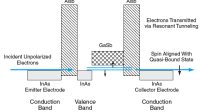
- New devices to effect tuning of electronspin coherence times, devices that would utilize spontaneous generation of spin polarization, and new designs for spin-based teleportation and spin transistors have been proposed. Especially notable is a proposed electron-spinbased device (see figure) in which teleportation would be mediated by single photons, without need for detection of correlated photons (Bell detection).
- A previously unknown mechanism of spontaneous generation of spin-polarized wave packets at room temperature in nonmagnetic semiconductors has been predicted. This mechanism is denoted the spin Gunn effect because it is a spintronic analog of the Gunn effect (in which microwave oscillations are produced in a semiconductor layer to which is applied an electric field having a strength exceeding a critical value).
- It has been predicted that orbital-angular- momentum quenching in quantum dots will drive g factors closer to 2 than previously expected.
This work was done by Michael E. Flatté of the University of Iowa for the Army Research Laboratory. For more information, download the Technical Support Package (free white paper) at www.defensetechbriefs.com/tsp under the Physical Sciences category. ARL-0015
This Brief includes a Technical Support Package (TSP).

Spintronic Effects in Semiconductor Nanostructures
(reference ARL-0015) is currently available for download from the TSP library.
Don't have an account?
More From SAE Media Group
Tech Briefs
Resonant Tunneling Spin Pump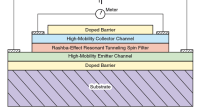
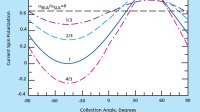
Tech Briefs
Electron-Spin Filters Based on the Rashba Effect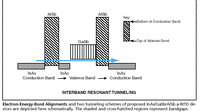
Tech Briefs
Understanding the Pseudogap
Tech Briefs INSIDER
A Spin on Semiconductors Paves the Way for Brain-Inspired Computing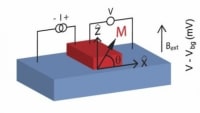
Electronics & Sensors INSIDER
A New Material That Could Change Electronics

Aerospace & Defense Tech Briefs
Physicists Measure a Key Aspect of Superconductivity in ‘Magic-Angle’ Graphene
Power Electronics INSIDER
Breaking the Thermal Conductivity Barrier with Boron Arsenide
Electronics & Sensors INSIDER
Two-Dimensional Hybrid Metal Halide Device Allows Control of Terahertz Emissions
Electronics & Sensors INSIDER
Advanced Microelectronics: Why A Next-Gen Semiconductor Doesn’t Fall to Pieces

Aerospace & Defense Tech Briefs
Expanding Possibilities for Superconducting Qubits With Niobium

Power Electronics INSIDER
Diamond Quantum Imaging Can Enable Next-Gen Power Electronics
Electronics & Sensors INSIDER
Scientists Create Superconducting Semiconductor Material
Electronics & Sensors INSIDER
Researchers Create First Functional Semiconductor Made from Graphene

Electronics & Sensors INSIDER
Scientists Have Visualized the Electronic Structure in a Microelectronic Device
Electronics & Sensors INSIDER
A New Magnetic Transistor for More Energy-Efficient Electronics
Power Electronics INSIDER
New Material To Make Next Generation of High-Power Electronics Faster and More Efficient
Electronics & Sensors INSIDER
World's First Petahertz-Speed Phototransistor in Ambient Conditions
Tech Briefs
Better Microelectronics from Coal
Electronics & Sensors INSIDER
Researchers Develop Ultra-Sensitive Device for Detecting Magnetic Fields
Power Electronics INSIDER
Improved GaN-Based Semiconductor Devices for Power Electronics

Electronics & Sensors INSIDER
New Material Will Make Locally Flexible Diodes Possible
Electronics & Sensors INSIDER
Graphene-Based Electronics
Tech Briefs
Products of Tomorrow
Overview
The document titled "Spin Coherence in Semiconductor Nanostructures," authored by Michael E. Flatté, presents significant advancements in the understanding of spin coherence and transport properties in nanoscale semiconductor structures. The report outlines the progress made in theoretical calculations and experimental observations related to spin-polarized populations of electron and nuclear spins, which are crucial for the development of novel spintronic devices.
The introduction highlights the recent experimental breakthroughs in generating, transporting, and detecting coherent spin-polarized populations, demonstrating spin coherence times exceeding 100 nanoseconds and spin diffusion lengths over 100 micrometers. These findings suggest the feasibility of utilizing spin phenomena in nanoscale electronics, paving the way for innovative device architectures.
The report identifies four primary research directions supported by the grant:
-
Accurate Calculations of Spin Coherence Times: The document discusses the dominant mechanism of spin decoherence, particularly precessional decoherence, which is influenced by inversion asymmetry in materials. The research predicts significant tuning of spin lifetimes in (110) semiconductor quantum wells, which can inform the design of new spin transistors.
-
Theory of Inhomogeneous Spin Transport: This section addresses the complexities of spin transport in both nonmagnetic and magnetic semiconductors, emphasizing the need for a theoretical framework to understand experimental results and suggest new phenomena.
-
Nuclear Spin Coupling to Electronic Spin: The implications of this coupling for all-optical manipulation of nuclear spins are explored, indicating potential advancements in quantum information processing.
-
Theory of Si/Ge Quantum Dots: The report examines the behavior of quantum dots in inhomogeneous electric fields, contributing to the understanding of spin dynamics in these systems.
The document also discusses the potential applications of these findings in semiconductor spintronic devices and quantum computation, including a novel proposal for electron-spin-based teleportation mediated by single photons. The research indicates that electric transport in nonmagnetic semiconductors may lead to the formation of spin-polarized packets at room temperature, which could have significant implications for future technologies.
Overall, the report emphasizes the importance of theoretical work in guiding experimental efforts and enhancing the understanding of spin-related phenomena in semiconductor nanostructures, ultimately contributing to the advancement of spintronics and quantum computing.
Top Stories
INSIDERDefense
 New Raytheon and Lockheed Martin Agreements Expand Missile Defense Production
NewsAutomotive
 Ford Announces 48-Volt Architecture for Future Electric Truck
INSIDERManufacturing & Prototyping
 Active Strake System Cuts Cruise Drag, Boosts Flight Efficiency
ArticlesTransportation
 Accelerating Down the Road to Autonomy
INSIDERMaterials
 How Airbus is Using w-DED to 3D Print Larger Titanium Airplane Parts
Road ReadyTransportation

Webcasts
Electronics & Computers
 Cooling a New Generation of Aerospace and Defense Embedded...
Power
 Battery Abuse Testing: Pushing to Failure
Connectivity
 A FREE Two-Day Event Dedicated to Connected Mobility
Automotive
 Quiet, Please: NVH Improvement Opportunities in the Early Design Cycle
Transportation
 Advantages of Smart Power Distribution Unit Design for Automotive &...
Aerospace
 Sesame Solar's Nanogrid Tech Promises Major Gains in Drone Endurance