




Polymeric “Smart” Skin Materials
Enhanced sensing and/or actuation functionalities are imparted to solid surfaces.
"Smart” skin materials based, variously, on polymers, dendrimers, carbon nanotubes, and/or other tailored molecular components are being developed for use as conformal coating surfaces of mechanical structures, including those of aircraft, to impart enhanced functionality to the coated surfaces. As used here, “smart” signifies that a material so characterized exhibits a useful physical response (e.g., a change in color) to a change in some aspect of its environment (e.g., temperature or pressure) or to a control or actuation signal. It is envisioned that smart skin materials could be used for diverse purposes, including sensing surface flow conditions and altering surface optical properties to enable detection, concealment, or display. It is further envisioned that smart skin materials could be integrated with microscopic electronic, optoelectronic, electro-optical, and microelectromechanical devices to obtain smart skins exhibiting even more varieties and higher degrees of functionality.
The scope of this development effort is so broad and deep as to preclude a detailed description within the space of this article. The accomplishments thus far can be summarized as follows:
- State-of-the-art pressure- and temperature- sensing luminescent paints have been developed and applied to models used in wind tunnel testing. Progress has also been made in incorporating other functionalities into paints to be used for diagnosis of aircraft, groundvehicle, and ship surfaces.
- Substantial progress has been made in developing light-harvesting and frequency- conversion coatings and improving the efficiency of metals by exploiting the site isolation afforded by the cores of dendrimers. Significant progress has been made in developing new photonic-bandgap materials. The state of the art of polymeric, dendritic, and dendronized-polymer electro-optical materials has advanced to the point where the performances of these materials, as measured in terms of bandwidths and required drive voltages, now significantly exceed those of such inorganic materials as lithium niobate.
- New materials have been incorporated into such novel thin-film device structures as those of ring microresonators, enabling manipulation of light in novel ways, including active wavelength- division multiplexing (time and wavelength information encoding) and voltage-controlled wavelength selective filtering.
- A variety of new sensors, notably including microresonator-based strain and temperature sensors, has been developed.
- Flexible polymeric electro-optical devices have been fabricated and evaluated.
- Significant advances have been made toward realizing the potential of carbon nanotubes for smart-skin applications, including the potential use of carbonnanotube- containing smart skins as radar-absorbing materials and as microelectromechanical systems (MEMS).
- Advances have been made in polymeric thin films for light-emitting, electronic, and photovoltaic applications.
This work was done by Larry Dalton of the University of Washington for the Air Force Research Laboratory. For more information, download the Technical Support Package (free white paper) at www.defensetechbriefs.com/tsp under the Materials category. AFRL-0014
This Brief includes a Technical Support Package (TSP).
Polymeric “Smart” Skin Materials
(reference AFRL-0014) is currently available for download from the TSP library.
Don't have an account?
More From SAE Media Group
Tech Briefs
3D Printing Stronger Carbon Nanotubes



Medical Design Briefs
Lens Offers Tunable Focus

Aerospace & Defense Tech Briefs
‘Nanostitches’ Enable Lighter and Tougher Composite Materials
Tech Briefs
Products of Tomorrow
Medical Design Briefs
Hybrid Material Enables Next-Gen E-Skin
Aerospace & Defense Tech Briefs
Carbon Nanotube Thermal Interfaces Enhanced with Sprayed-On Nanoscale Polymer Coatings
Tech Briefs
Thin Heat Shield for Superfast Aircraft
Tech Briefs
Painting 3D-Printed Objects

Photonics & Imaging Technology
Large Format Windows: From Material to Mission
Tech Briefs
Engineers Develop New Shape-Memory Material
Tech Briefs
Testing the Thermal Limits of BNNTs

Tech Briefs
Copolyimide Surface-Modifying Coating
Motion Design
Miniscule Robots of Metal and Plastic
Photonics & Imaging Technology
Specifying Coatings for Military and Aerospace Applications
Tech Briefs
Self-Protected, Low-Temperature Nanosolder
Tech Briefs
Self-Healing Aluminum Metal Matrix Composite
Tech Briefs
Pearl-Like Coating Enhances Lightweight Armor
Air Force Research Laboratory Technology Horizons
Automated Material Deposition Chamber
Medical Design Briefs
Parallel Fluidics Produces Ultra-Precise Microfluidics Prototypes with CYROLITE® MD
Tech Briefs
Precision CNT Cutting Mechanism
Tech Briefs
Conductive Carbon Fiber Polymer Composite

Overview
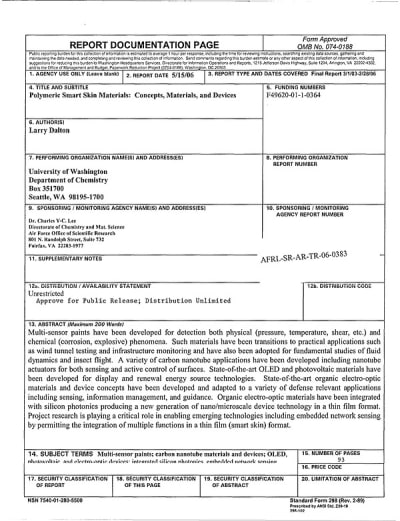
The document titled "Polymeric Smart Skin Materials: Concepts, Materials, and Devices" presents a comprehensive overview of advancements in smart materials, particularly focusing on multi-sensor paints and their applications. The report, submitted to the Air Force Office of Scientific Research, outlines significant progress made in the development of materials that can detect various physical (pressure, temperature, shear) and chemical (corrosion, explosive) phenomena.
Key achievements highlighted in the report include the successful transition of state-of-the-art pressure and temperature sensing paints for practical use in wind tunnel testing. These paints have been enhanced to incorporate additional functionalities for diagnostic evaluations of aircraft, ground vehicles, and ship surfaces. The document emphasizes the development of light harvesting and frequency conversion coatings, which improve the efficiency of metals by utilizing the unique properties of dendrimers.
The report also discusses advancements in photonic bandgap materials and the evolution of polymeric, dendritic, and dendronized polymer electro-optic materials. These materials have surpassed the performance capabilities of traditional inorganic materials, such as lithium niobate, particularly in terms of bandwidth and drive voltage requirements. This advancement is crucial for the integration of multiple functions in a thin film format, enabling the creation of "smart skin" technologies.
Furthermore, the document details the development of carbon nanotube applications, including nanotube actuators for sensing and active control of surfaces. The report highlights the creation of state-of-the-art organic light-emitting diode (OLED) and photovoltaic materials, which are essential for display technologies and renewable energy sources.
The research outlined in the report plays a critical role in enabling emerging technologies, particularly in the realm of embedded network sensing. By integrating multiple functionalities into a single thin film, these smart materials are poised to revolutionize various fields, including defense, information management, and guidance systems.
Overall, the document serves as a technical report summarizing the significant work accomplished in the field of polymeric smart skin materials, showcasing their potential applications and the advancements that have been made in material science and engineering. The findings underscore the importance of continued research and development in this area to further enhance the capabilities and applications of smart materials.
Top Stories
NewsRF & Microwave Electronics
 Microvision Aquires Luminar, Plans Relationship Restoration, Multi-industry Push
INSIDERAerospace
 A Next Generation Helmet System for Navy Pilots
INSIDERDesign
 New Raytheon and Lockheed Martin Agreements Expand Missile Defense Production
INSIDERMaterials
 How Airbus is Using w-DED to 3D Print Larger Titanium Airplane Parts
NewsPower
 Ford Announces 48-Volt Architecture for Future Electric Truck
ArticlesAR/AI

Webcasts
Aerospace
 Cooling a New Generation of Aerospace and Defense Embedded...
Automotive
 Battery Abuse Testing: Pushing to Failure
Transportation
 A FREE Two-Day Event Dedicated to Connected Mobility
Unmanned Systems
 Quiet, Please: NVH Improvement Opportunities in the Early Design Cycle
Transportation
 Advantages of Smart Power Distribution Unit Design for Automotive &...
Energy
 Sesame Solar's Nanogrid Tech Promises Major Gains in Drone Endurance