




A Study of Two Ferrocene-Based Molecular Electronic Devices
Transport properties were determined to have metallic characteristics.
Acomputational-simulation study of two ferrocene-based molecular electronic devices was performed as part of a continuing effort to develop a capability for ab initio design of metallocene-based electronic devices in general. In addition to the obvious technological advantage for realization of the potential of molecular electronic devices, such a capability would afford an economic advantage by enabling avoidance of the cost of synthesis of many organic molecules that subsequent testing would show to be unpromising for electronic-device applications.
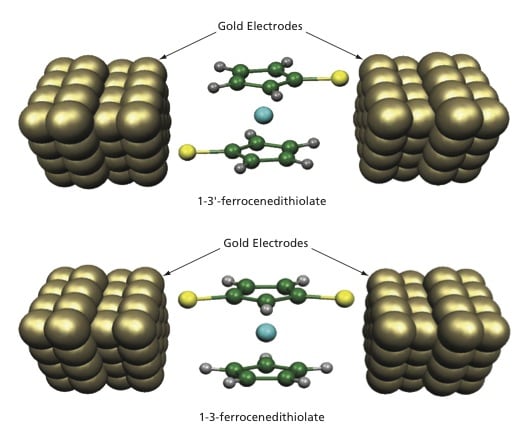
Each of the two devices studied consisted of a single sulfur-terminated ferrocene molecule between two infinitely long gold electrodes (see figure). In one device, the molecule was 1,3'-ferrocenedithiolate and contact with the electrodes was made via the sulfur atoms on different cyclopentadienyl rings. In the other device, the molecule was 1,3-ferrocenedithiolate and contact with the electrodes was made via the two sulfur atoms on the same cyclopentadienyl ring. The structures and the electronic and electronic-transport properties of the molecules, both in isolation and as incorporated into the devices, were simulated numerically by use of a computer program that implemented a combination of density-functional theory and a nonequilibrium-Green’s-function formalism of quantum transport.
This work was done by Kanichi Nakagawara of Nihon Gene Research Laboratories Inc. for the Air Force Research Laboratory. For more information, download the Technical Support Package (free white paper) at www.defensetechbriefs.com/tsp under the Electronics/Computers category. AFRL-0006
This Brief includes a Technical Support Package (TSP).
A Study of Two Ferrocene-Based Molecular Electronic
(reference AFRL-0006) is currently available for download from the TSP library.
Don't have an account?
More From SAE Media Group
Tech Briefs
Superlattice for Sustainable Quantum Electronics
Tech Briefs
Smart Molecules Act as Computer Transistors
Tech Briefs
Enhanced Material Stable Enough for Solar Cells
Tech Briefs
Turning Diamond into Metal
Tech Briefs
Electronics Withstand Extreme Heat
Tech Briefs
Products of Tomorrow
Tech Briefs
Ruthenium-Doped Thermoelectric Materials
Tech Briefs
Rolled 2D Heterostructures
Tech Briefs
Stable Polymeric Ink with High Conductivity

Tech Briefs
New Class of Two-Dimensional Materials
Tech Briefs
Organic Material for Printed Electronics

Tech Briefs
Hybrid Thermoelectric Compound
Medical Design Briefs
Improved Polymer Electrode for Electronic Skin
Medical Design Briefs
Licking a Tootsie Roll® Sensor to Monitor Health
Battery Technology
Nanostructured Alloy for Battery Anodes
Battery Technology
Sustainable Aluminum-Anode Batteries
Aerospace & Defense Tech Briefs
Machine Learning Unlocks Secrets to Advanced Alloys


Aerospace & Defense Tech Briefs
Dense Functionalized-Nanowire Biosensor Arrays
Electronics & Sensors INSIDER
World's First Petahertz-Speed Phototransistor in Ambient Conditions
Electronics & Sensors INSIDER
Advanced Microelectronics: Why A Next-Gen Semiconductor Doesn’t Fall to Pieces

Tech Briefs
Better Microelectronics from Coal
Electronics & Sensors INSIDER
Scientists Create Superconducting Semiconductor Material
Overview
The document titled "Ab initio design of metallocene-based molecular electronic devices" presents research conducted by Hiroshi Mizuseki and colleagues at the Institute for Materials Research, Tohoku University, Japan. The study focuses on the potential of molecular devices, particularly those based on metallocenes like ferrocene, to revolutionize electronic applications. The authors emphasize the importance of predicting the properties and behaviors of organic molecules before their synthesis, which can significantly enhance the efficiency of device development.
The research employs advanced computational techniques, specifically the nonequilibrium Green's function formalism of quantum transport and density functional theory, to estimate the transport properties of two ferrocenedithiolate systems. These systems feature different five-member ring connections, and the findings reveal that the conductance of the ferrocene molecule is influenced by the positioning of sulfur atoms. Notably, the molecule exhibits higher electrical conductivity at low bias when the cyclopentadienyl ring is connected to a gold (Au) electrode via sulfur atoms.
The study also discusses how the transmission coefficients of the ferrocenedithiolate molecules vary with applied bias, attributing these changes to shifts in energy levels and alterations in molecular orbital shapes due to the electric field. The current-voltage (I-V) characteristics indicate that the 1,3-ferrocenedithiolate system displays metallic transport properties, suggesting its potential for use in electronic devices.
The document highlights the significance of understanding the electronic properties of molecular systems to facilitate the design of efficient molecular electronic devices. By leveraging computational methods, the research aims to provide insights that can guide the synthesis of new organic molecules with desirable electronic characteristics.
Overall, this study contributes to the growing field of molecular electronics by exploring the unique properties of metallocenes and their potential applications in next-generation electronic devices. The findings underscore the importance of theoretical predictions in the development of molecular systems, paving the way for innovative solutions in the realm of nanotechnology and electronic engineering.
Top Stories
NewsRF & Microwave Electronics
 Microvision Aquires Luminar, Plans Relationship Restoration, Multi-industry Push
INSIDERAerospace
 A Next Generation Helmet System for Navy Pilots
INSIDERDesign
 New Raytheon and Lockheed Martin Agreements Expand Missile Defense Production
INSIDERMaterials
 How Airbus is Using w-DED to 3D Print Larger Titanium Airplane Parts
NewsPower
 Ford Announces 48-Volt Architecture for Future Electric Truck
ArticlesAR/AI

Webcasts
Aerospace
 Cooling a New Generation of Aerospace and Defense Embedded...
Automotive
 Battery Abuse Testing: Pushing to Failure
Transportation
 A FREE Two-Day Event Dedicated to Connected Mobility
Unmanned Systems
 Quiet, Please: NVH Improvement Opportunities in the Early Design Cycle
Transportation
 Advantages of Smart Power Distribution Unit Design for Automotive &...
Energy
 Sesame Solar's Nanogrid Tech Promises Major Gains in Drone Endurance