




Noise-Immune Stethoscope Benefits Wounded Soldiers
For injured soldiers requiring evacuation from a battlefield via helicopter, body sounds become valuable in managing the patient's condition. Since helicopters and fixedwing aircraft used for evacuation can be extremely noisy, use of a standard stethoscope to assess chest sounds can be difficult.
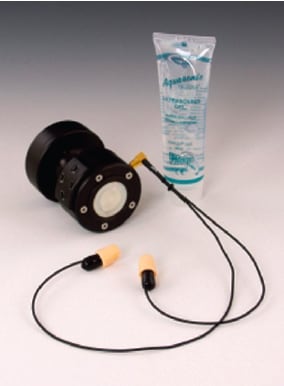
Conventional stethoscopes are sensitive to noise from the environment, since noise invades the stethoscope through the earpieces, the acoustic tubing, and the acoustic sensor. They are difficult to use in environments with noise levels of 80 decibels. Electronic stethoscopes have been developed to address this problem, but they still are only effective in areas with noise levels at 90 to 95 decibels. Noise levels in helicopters like the Black Hawk can rise as high as 120 decibels.
To address this problem, Active Signal Technologies (Linthicum Heights, MD) was awarded $900,000 in Small Business Innovation Research (SBIR) grants from the Army to develop a stethoscope that could be used in high-noise environments. Researchers John M. Sewell and William N. Bernhard of Active Signal Technologies and Adrianus Houtsma and Ian P. Curry of the U.S. Army Aeromedical Research Laboratory (Fort Rucker, AL) jointly developed an ultrasound-based stethoscope.
How it Works
In ultrasound imaging, a high-frequency (megahertz range) sound signal is generated, transmitted from the stethoscope head into the patient's body, and reflections from moving body tissue are picked up by a receiver located in the stethoscope's head. Since the reflections have a different frequency than the transmitted signal caused by the Doppler effect, a difference-frequency can be computed and turned into an audible sound. No matter how intense the environmental noise, it cannot interfere with the heart and lung sounds, since the sound is carried by a 2.3-MHz carrier signal, and a helicopter does not produce interfering noise at that frequency.
In addition, the ultrasound acoustic images contain artifacts of tissue movement that could be valuable for cardiologists who look for specific sound features that correlate with physiological conditions.
The noise-immune stethoscope is a hybrid design in which a conventional operation mode can be selected for quieter environments, and the ultrasound operation can be selected for high-noise conditions. The dual-mode design features a battery compartment on top with two 1.5 V AA batteries. The device is held between the middle and index fingers so the thumb can operate a four-button control panel, which turns the device on, sets the signal volume, and sets the selected operating mode. The doctor or medic can use this setting to switch between conventional and ultrasound modes as noise levels change.
The bottom part of the device contains the stethoscope and the electronics that process the ultrasound signals. For conventional operation, piezoelectric disks are driven by a piston at the bottom of the device that serves as a transformer between the patient's chest and the piezoelectric stack. An O-ring keeps out surface waves that may be excited on the patient's skin by vibration or excessive noise.
For ultrasound operation, two piezoelectric material disks are embedded in the sensor head. One is a transmitter and one is a receiver of the high-frequency sound waves. A contact gel, similar to that used in conventional ultrasound examinations, is applied between the patient's skin and the head of the stethoscope. A single signal output jack enables sealed earphones or headsets to be attached.
Where it Stands
Active Signal Technologies is about to begin the process of Food and Drug Administration (FDA) approval for the noise-immune stethoscope, which is expected to take approximately three months. The company then will begin manufacturing the stethoscopes for sale to the armed forces. The company's chief executive officer, Arthur Cooke, predicted the commercial release of the device initially would be small, with the cost ranging anywhere from $250 to $700. Once the devices are used by the armed forces, commercial interest is expected.
More Information
For more information on the U.S. Army Aeromedical Research Laboratory, visit www.usaarl.army.mil. For more information on Active Signal Technologies, phone 410-636-9350.
Top Stories
INSIDERManufacturing & Prototyping
 How Airbus is Using w-DED to 3D Print Larger Titanium Airplane Parts
NewsAutomotive
 Microvision Aquires Luminar, Plans Relationship Restoration, Multi-industry Push
INSIDERAerospace
 A Next Generation Helmet System for Navy Pilots
INSIDERDesign
 New Raytheon and Lockheed Martin Agreements Expand Missile Defense Production
ArticlesAR/AI
 CES 2026: Bosch is Ready to Bring AI to Your (Likely ICE-powered) Vehicle
Road ReadyDesign

Webcasts
Semiconductors & ICs
 Advantages of Smart Power Distribution Unit Design for Automotive...
Unmanned Systems
 Quiet, Please: NVH Improvement Opportunities in the Early Design...
Electronics & Computers
 Cooling a New Generation of Aerospace and Defense Embedded...
Power
 Battery Abuse Testing: Pushing to Failure
AR/AI
 A FREE Two-Day Event Dedicated to Connected Mobility
