




TI’s Wireless Approach to EV Battery Management
A cell supervisor unit wirelessly communicates with the pack controller, saving space, weight and cost while reducing complexity.
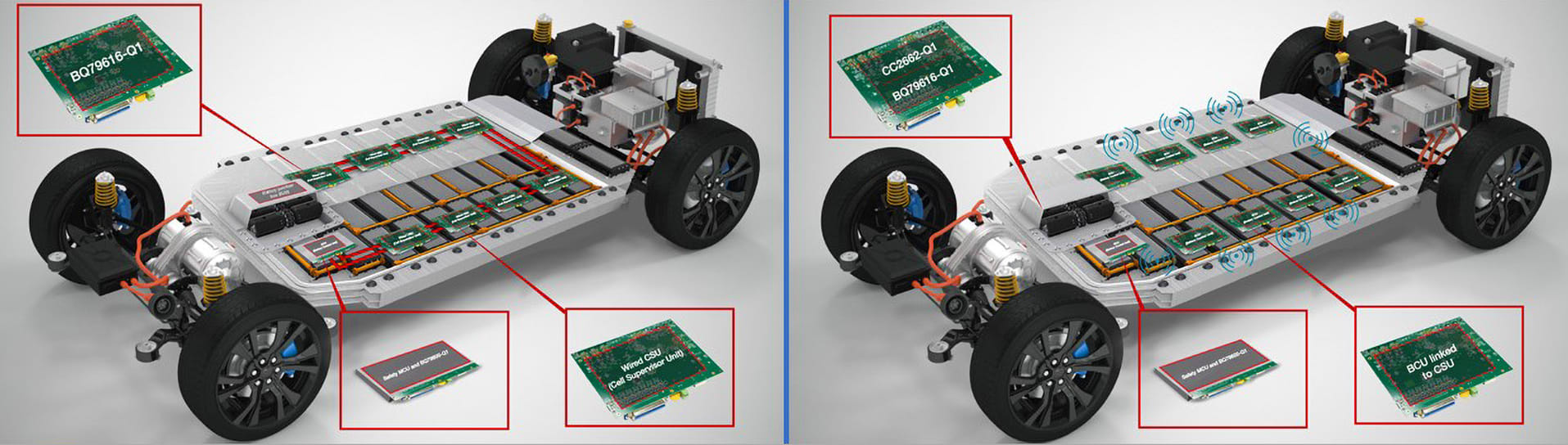
The battery pack of a typical electric vehicle (EV) contains a daisy-chain of wiring. Miles of copper cabling interlinked by hundreds of connectors. Even the battery management systems (BMS) that monitor individual cells are hard wired. The approach is safe; it does the job.
But wiring harnesses and connectors “are a common source of failure,” acknowledged Karl-Heinz Steinmetz, general manager, Powertrain in Automotive Systems, at Texas Instruments (TI). The nature of the assembly is such that if a system fault occurs, it isn’t particularly simple to find the point of failure, which could lead to a costly battery replacement.
There also is the issue of weight – up to 75 to 200 lb (34 to 92 kg) in pack wiring alone, according to Ram Vedantham, TI’s 2.4 GHz business line manager, connectivity. And as larger batteries are used to achieve increased range, there are increased packaging considerations, as well as an increase in the number of connections – and more mass. Steinmetz also notes the manufacturing cost and complexity of connecting modules to modules within the battery pack. It’s largely a manual operation involving wires, isolation components, wiring harnesses and connectors.
With OEMs seeking lighter, less complex and more cost-efficient battery packs, TI has developed a wireless BMS that is based on the company’s CC266C2R-Q1 system-on-a-chip. It’s an AEC-Q 100 compliant, Arm Cortex M4 wireless microcontroller (MCU) that works in conjunction with the BQ79616-Q1 battery monitor and balancer. The combination forms a cell supervisor unit (CSU); the CSU then wirelessly communicates with the overall battery control unit. Each CSU is capable of managing up to 24 cells.
Because this technology approach – using microchips to replace copper cables – is new and unconventional, TI contracted with TÜV SÜD to test the system to assure that it would meet the required error-detection performance. This step, in turn, will assure automakers using the system can obtain Automotive Safety Integrity Level (ASIL) D. According to TI, the BMS setup has a network availability of more than 99.999% and a network restart of 300-ms maximum availability. TI has a suite of countermeasures that can be deployed to provide security for the BMS.
More From SAE Media Group
Off-Highway Engineering
Lightning EMotors Adapts to Changing Electrification Market
Automotive Engineering
For Aptiv, More EVs Mean More Profit with SVA
Off-Highway Engineering
Narrower Focus, Bigger Payoff for Commercial EVs
Automotive Engineering
China’s NIO Making EV Battery Swapping Work
Automotive Engineering
Suppliers Prepare for a Drop in EV Market Share
Off-Highway Engineering
Yanmar, ELEO Announce Electrification Strategy for Off-Highway Sector
Off-Highway Engineering
Battery Innovation Key for Commercial and Off-Highway EVs
Automotive Engineering
Eaton Debuts All-In-One Power Distribution for EVs
Automotive Engineering
BEV Heat Pumps Recovering Cost Investments
Off-Highway Engineering
Kalmar Launches 3rd-Gen Electric Terminal Tractor
Automotive Engineering
Establishing Closed-Loop EV Battery Recycling
Automotive Engineering
GM Picks LMR as Its Future Affordable Battery Technology
Automotive Engineering
Kymco’s New Ionex BMU, BaaS Will Boost Electric Scooter Adoption
Automotive Engineering
Tariff Challenges, EV Advances at Mobility 360
Automotive Engineering
Architecting GM’s New EV Batteries
Automotive Engineering
The Battle over EV Value-Add Has Begun
Automotive Engineering
Clarios Sees Low-Voltage Electricals as Vital in EV, AV Future
Automotive Engineering
A Connected Approach to Auxiliary Battery Control
Automotive Engineering
Engineering Flexibility into EV Powertrains
Automotive Engineering
Ford Unveils 2021 Mustang Mach-E Electric Vehicle
Automotive Engineering
Reducing the Battery Materials Supply Risk
Automotive Engineering
Wireless Road Charging for EVs to Debut in 2023
Off-Highway Engineering
Komatsu Employs “Slick” Battery Swapping for Underground LHD
Automotive Engineering
BMW Plans Move to Structural Battery Packs and ‘46120’ Cells
Automotive Engineering
Toward an Electric Two-Wheeled Triumph
Automotive Engineering
All (Robot) Hands on Deck
Off-Highway Engineering
FPT’s Battery Pack Dives into Marine Market
Automotive Engineering
Battery Show 2022: Wireless EV Charging, Scaling Gigafactories
Automotive Engineering
WCX 2025: Vicor’s New Power Modules Arrive with 48V
Top Stories
NewsSensors/Data Acquisition
 Microvision Aquires Luminar, Plans Relationship Restoration, Multi-industry Push
INSIDERRF & Microwave Electronics
 A Next Generation Helmet System for Navy Pilots
INSIDERWeapons Systems
 New Raytheon and Lockheed Martin Agreements Expand Missile Defense Production
NewsAutomotive
 Ford Announces 48-Volt Architecture for Future Electric Truck
INSIDERAerospace
 Active Strake System Cuts Cruise Drag, Boosts Flight Efficiency
ArticlesTransportation

Webcasts
Aerospace
 Cooling a New Generation of Aerospace and Defense Embedded...
Energy
 Battery Abuse Testing: Pushing to Failure
Power
 A FREE Two-Day Event Dedicated to Connected Mobility
Automotive
 Quiet, Please: NVH Improvement Opportunities in the Early Design Cycle
Electronics & Computers
 Advantages of Smart Power Distribution Unit Design for Automotive &...
Unmanned Systems
 Sesame Solar's Nanogrid Tech Promises Major Gains in Drone Endurance