




Link Digital Suspension Uses Sensors, ECU to Keep Cabs Stable
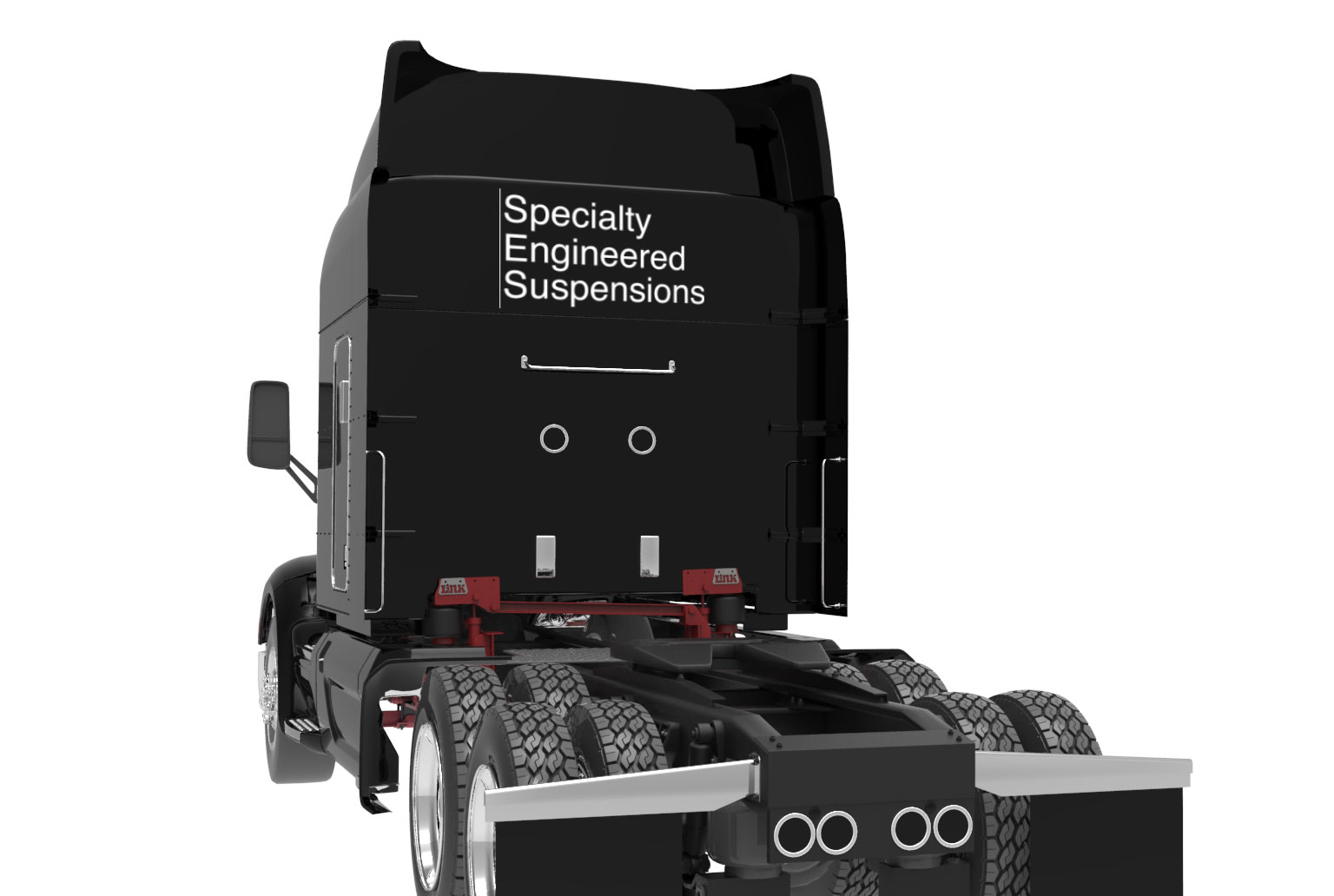
Link Manufacturing is beefing up its usage of digital technologies with an upgraded Cabmate, unveiling a cab suspension system that smooths the ride for both drivers and those in sleepers. Link’s Road Optimized Innovations (ROI) system uses sensors and an electronic control unit (ECU) to stabilize the entire cab for roughly the cost of two advanced comfort seats.

The suspension system levels the entire cab, providing more stabilization than advanced seating solutions. That can help those in sleepers while also smoothing out some of the jerkiness that plagues most stop-start systems. Link plans to keep ROI’s cost premium relatively low compared to conventional Cabmate systems, which recently surpassed 2 million shipments.
“Cab equipment and a person in the sleeper aren’t protected by an improved seat,” said Michael Hof, Link’s VP of new business development. “We hope to have this stay below $2,000. Standard upgrade seats are around $1,000, so this is a wash.”
Drivers present at an unveiling in Sioux Center, Iowa, said their tests showed significant benefits. Cabmate’s enhancements are most noticeable on bumpy roads and events like railroad tracks, while its key benefit on highways may be to stabilize cabs on windy days.


“For in-city deliveries where the roads are not always the best, this will have a big impact in comfort,” said Joel Morrow, a fleet driver who’s head of R&D at Ploger Transportation. “Long-haul drivers won’t see as much benefit until you start talking about wind shear. If the cab stays more stable, it will be very helpful. The benefits for someone in the sleeper are really nice; drivers often wake up in an adrenaline state when there’s a sharp jolt to the cab.”
The system’s ECU runs proprietary algorithms that interpret sensor information in real time. It responds to road events by continuously adjusting the stiffness of shock absorbers and filling or exhausting air from the air springs. The ROI system consumes less than 10 watts of power.
“We have one accelerometer and one position sensor. They monitor what the cab is doing and what the suspension is doing,” said Tye Davis, senior engineer at Link. “From those two inputs, the system can determine the optimal response for the shock. The ECU controls the shock’s solenoid valve, which provides air for the spring. We make adjustments about 200 times per second.”
That technology marks a major turning point for Link, a 40-year-old company which to date has used electronics for basic controls. President Jim Huls said sensor and microcontroller pricing and capabilities make it practical to implement active controls. It’s likely that future systems will make additional use of active control systems.
Link is testing ROI in a new lab that can be customized for a range of systems. Engineering VP Bill Ott noted that “we have the same test systems used by major OEMs, we just have fewer of them.”
It will take OEMs a while to analyze Cabmate and design it in, so Link plans to roll out an aftermarket system to help spark interest in the technology. One fleet owner noted that improved comfort in cabs could help his company retain drivers and attract new hires.
“For us, the biggest value is the safety issue,” said Fausto Velazquez, President of TC Logistics of Mexico City. “This adds value to our fleet, drivers reported less pain in their back, and it reduces noise in the cockpit, so drivers are less stressed and can focus more on the road.”
More From SAE Media Group
Off-Highway Engineering
Link Readies Semi-Active Cab Suspension for Intro on Select 2020 Models
Off-Highway Engineering
Freightliner’s Medium-Duty Makeover
Automotive Engineering
Ford Gives 2019 Raptor Smarter Shocks, New Trail Control Electronics
Automotive Engineering
Chassis Brakes International Debuts First NA-Produced Products
Automotive Engineering
Raptor Tops Fully Redesigned 2024 Ford Ranger Lineup
Automotive Engineering
Subaru Uses ANSYS Tools to Accelerate Hybrid Vehicle Design
Automotive Engineering
CES 2025 Preview: All the Tech That’s Fit to Print
Off-Highway Engineering
Bosch Electrohydraulic Steering Advances Driver Assistance
Autonomous Vehicle Engineering
Platform-Agnostic Interface Aims to Accelerate Truck Autonomy
Automotive Engineering
High-Performance Hybrid Headlines Lexus’s Re-Engineered RX Lineup
Automotive Engineering
Multimatic ‘Legs’ for Ferrari’s New Thoroughbred
Motion Design
Self-Contained Wheel Unit
Automotive Engineering
Automotive Cybersecurity Needs Serious Work
Off-Highway Engineering
Engine Developers Increase Efforts to Decrease Fuel Usage
Autonomous Vehicle Engineering
Predicting the Road to Efficiency
Off-Highway Engineering
EV Startup Prepares to Enter Commercial Market with Novel EAxle
Automotive Engineering
Tenneco Opens Engineering, Simulation Center in Poland
Automotive Engineering
WCX 2024: The Technologies That Will Define Future Mobility
Automotive Engineering
Brembo’s New Octyma Brakes Provide 8 Reasons for Better Deceleration
Automotive Engineering
Williams Debuts New Flexible Platform for BEVs and FCVs
Off-Highway Engineering
Removing Complexity for Autonomous Trucks
Off-Highway Engineering
No Fear of Loading: Driving the 2025 Ram Heavy Duty
Automotive Engineering
Raptor 4-Door-Only for 2021; R Version Coming Next Year

Automotive Engineering
Riding on Air: Activated Carbon Aims at Autos
Off-Highway Engineering
Volvo Trucks, FedEx Demonstrate 3-Truck Platoon on North Carolina Highway
Sensor Technology
Machine Condition Monitoring Keeps a Factory Running
Automotive Engineering
Sensor Fusion Expanding in Step with Advancing Vehicle Sophistication
Automotive Engineering
A Consumer’s View: Perry Parts 3D-Printed Bump Stops
Automotive Engineering
Citroen C4 Cactus
Top Stories
INSIDERManufacturing & Prototyping
 How Airbus is Using w-DED to 3D Print Larger Titanium Airplane Parts
INSIDERManned Systems
 FAA to Replace Aging Network of Ground-Based Radars
NewsTransportation
 CES 2026: Bosch is Ready to Bring AI to Your (Likely ICE-powered) Vehicle
NewsSoftware
 Accelerating Down the Road to Autonomy
EditorialDesign
 DarkSky One Wants to Make the World a Darker Place
INSIDERMaterials
 Can This Self-Healing Composite Make Airplane and Spacecraft Components Last...
Webcasts
Defense
 How Sift's Unified Observability Platform Accelerates Drone Innovation
Automotive
 E/E Architecture Redefined: Building Smarter, Safer, and Scalable...
Power
 Hydrogen Engines Are Heating Up for Heavy Duty
Electronics & Computers
 Advantages of Smart Power Distribution Unit Design for Automotive...
Unmanned Systems
 Quiet, Please: NVH Improvement Opportunities in the Early Design...
