




WCX17: Tech Leaders Talk AI, Cyber and Next-Gen HMI
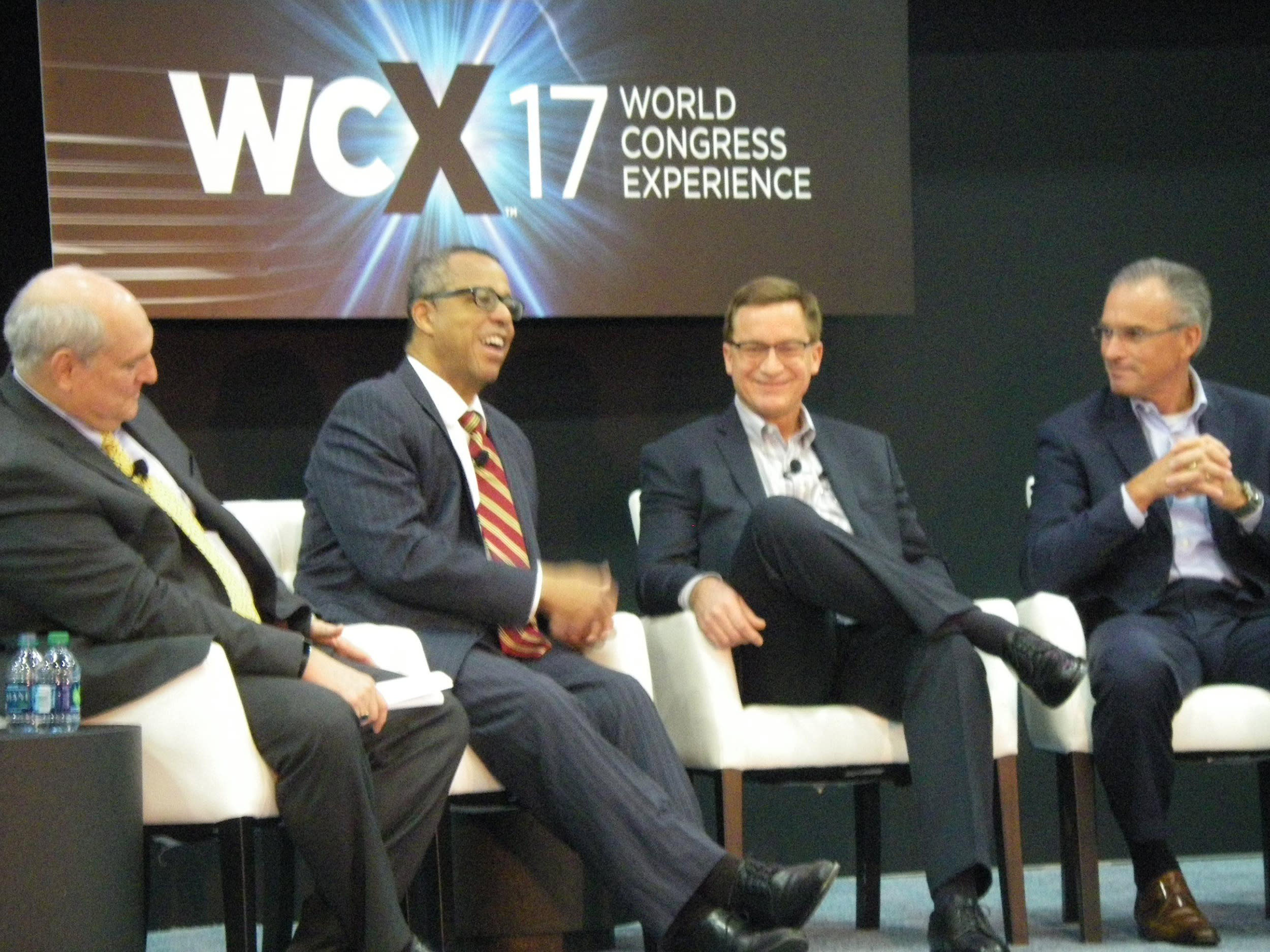
The role of artificial intelligence, the search for cyber security solutions, and the next level of human-machine interface in vehicles were discussed in a Leadership Roundtable of top technologists from Ford, GM, FCA, Continental and Denso, on the final day of SAE's WCX17 conference in Detroit.
Artificial intelligence (AI) has the industry’s attention as engineers look over the horizon for more capability in autonomous vehicle systems. Jon Lauckner, General Motors CTO and President of GM Ventures, explained that AI is a good option for certain tasks, like getting an autonomous vehicle to do object detection and classification. “But to have the power of a human brain—even a teenager, for example—it’s very far away from that capability.”
He added, “We need to go well beyond neural networks if we’re going to deploy AI as the ‘central brain’ in any sort of an autonomous vehicle system.”
Tier 1 supplier Continental employs about 100 engineers and scientists currently working on AI, noted Jeffrey Klei, the company's North America president. “There’s room for AI in all areas of business, not just for the development of automated driving,” he said.
Cyber security was a sizzling topic throughout WCX17, and the technology leaders had their say. "Make no mistake, cyber security is going to continue to escalate as an issue that the automotive industry must address,” said Ken Washington, Ph.D, Ford's Vice President of Research and Advanced Engineering. He noted that there are cyber security lessons to be learned from the computing and aerospace industries.
According to GM's Lauckner, the auto industry’s cyber security challenges are different than those of enterprise IT, which is primarily focused on protecting data elements. But he explained that it’s not data elements sending commands to various vehicle systems. “It’s a message. And we don’t have time to authenticate each and every message that’s on a CAN bus system; authentication takes clock time,” Lauckner noted.
In an automated driving scenario, those messages are spinning around in milliseconds. “Again, you don’t have a lot of time to be doing very sophisticated message authentications,” Lauckner said, adding, “I think there are opportunities for innovations with regard to the particular systems we have on board vehicles.”
The experts also discussed next-generation human-machine interface. “It’s about the consumer,” said Washington. “You don’t know what the customer wants unless you observe them.” He noted that the Internet and Apple iPhone happened because of a technology-push, and that refinements to products and technologies happen by watching the experiences of users.
“It’s really about how you stitch it together to create an experience that customers will love. I think we need to get much better at that as an industry,” he explained. Klei of Continental asserted that HMI should be viewed by the user as an intuitive feature.
“We’ve all learned as an industry that we can’t have all touch-pad surfaces; there must be some haptic feedback in certain circumstances,” he said. “I think as an industry we have to do a better job of getting the HMI right so that the customer’s first experience is a good one.”
Attracting the world's best talent to solve these and other engineering challenges, "the automotive sector is calling," noted Phil Jansen, FCA's Vice President Product Development for NAFTA. “We’re in the business of providing personal transportation for six billion people on this planet. Walk away excited. Don’t walk away fearful because this is a very interesting time,” he told the audience.
The discussion was moderated by Doug Patton, Executive Vice President and CTO for Denso, and the 2017 SAE International President and Chair of the Board.
More From SAE Media Group
Automotive Engineering
SAE Convergence 2016: Automakers, Suppliers Firm That Autonomous Driving Not Decades Away
Automotive Engineering
Part Two of the SAE International AutoDrive Challenge Kicks off Today
Automotive Engineering
America’s Latest AV Testing Site Adds Cloud Provider
Automotive Engineering
Securing the Software-Defined Vehicle
Off-Highway Engineering
SAE International, GM, and Students Gear up for AutoDrive Challenge Year 2 at Mcity
Automotive Engineering
HMI’s Simple Challenge: Control Everything Possible Without Any Difficulty
Automotive Engineering
Deep Learning Could Help Safely Automate Cars
Automotive Engineering
IBM's AutoLAB Leverages Watson for Predictive, Personalized Vehicle Experience
Automotive Engineering
Personalization, Autonomy Create Many Challenges for Engineers
Automotive Engineering
SAE Level 3 "Hand Off" Is Challenging AI Researchers
Off-Highway Engineering
Connected Commercial Vehicles Bring Cybersecurity to the Fore
Automotive Engineering
U.S. Dept. of Transportation Issues New Autonomous-Vehicle Guidelines
Automotive Engineering
Connected Cars Unleash Supply Chain Change
Automotive Engineering
Need for Cybersecurity Awareness for Managers Grows
Automotive Engineering
Cybersecurity Gets Input from Students, Others
Automotive Engineering
SAE Publishes Terminology Standard for Automated Driving Systems
Off-Highway Engineering
Deep Learning How to Drive
Aerospace & Defense Tech Briefs
AIA Predicts Flying Air Taxis, Supersonic Air Travel, and Space Industry for 2050
Automotive Engineering
Artificial Intelligence Becomes a Reality
Off-Highway Engineering
How Can Engineers Help Ensure the Safety, Reliability of Automated Vehicles?
Automotive Engineering
The Future of Autonomous Vehicle Engineering Now Starts in Middle School
Automotive Engineering
Denso Joins Driver Distraction Consortium
Automotive Engineering
Bridging the Automotive/consumer Electronics Product Cycle Gap
Automotive Engineering
Next-Gen Electronic Controls: Open Source, Scalable and Integrated
Automotive Engineering
A How-To for Car Hackers
Automotive Engineering
SAE 2014 Convergence Preview
Automotive Engineering
Cyber Security Requires Preparedness
Automotive Engineering
Connected Vehicles Will Be Hackers' Trophy
Automotive Engineering
Intel Inside the Cloud-Based Data Future
Automotive Engineering
Futurist Kurzweil Discusses Acceleration of Intelligent Technology
Top Stories
INSIDERManufacturing & Prototyping
 How Airbus is Using w-DED to 3D Print Larger Titanium Airplane Parts
INSIDERManned Systems
 FAA to Replace Aging Network of Ground-Based Radars
NewsTransportation
 CES 2026: Bosch is Ready to Bring AI to Your (Likely ICE-powered) Vehicle
NewsSoftware
 Accelerating Down the Road to Autonomy
EditorialDesign
 DarkSky One Wants to Make the World a Darker Place
INSIDERMaterials
 Can This Self-Healing Composite Make Airplane and Spacecraft Components Last...
Webcasts
Defense
 How Sift's Unified Observability Platform Accelerates Drone Innovation
Automotive
 E/E Architecture Redefined: Building Smarter, Safer, and Scalable...
Power
 Hydrogen Engines Are Heating Up for Heavy Duty
Electronics & Computers
 Advantages of Smart Power Distribution Unit Design for Automotive...
Unmanned Systems
 Quiet, Please: NVH Improvement Opportunities in the Early Design...
