




WCX17: FCA Reveals ‘Hole-Istic” New Lightweighting Approach
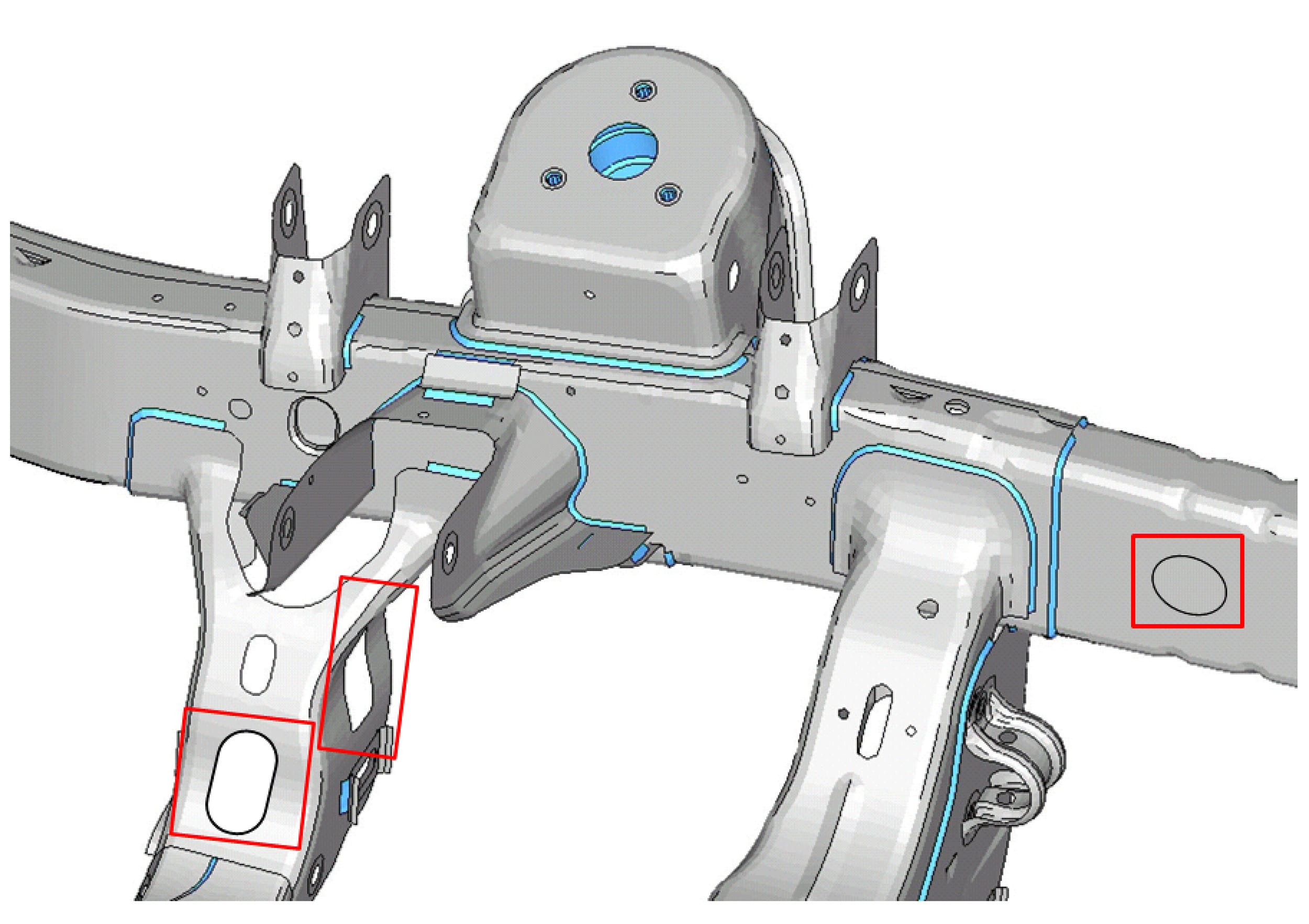
Engineers at FCA revealed at the SAE WCX17 conference in Detroit a new simulation and analysis design tool that can earmark nearly any suitable component for a strategic hole-punching process that can significantly reduce the part’s weight.

Using a pickup-truck frame as an example, engineers reduced its weight by 15 lb (7 kg) but cutting optimally-placed-and-sized holes and slots. The cutouts are located at places that the analysis shows have no impact on the frame’s fatigue or durability properties. By using two specific new simulation algorithms that discretely focus on fatigue performance as the design target, the simulation reveals non-critical areas that are over-engineered and thus are potential candidates for drilling holes or slots to remove material.
The new design simulation enables mass reductions of 3-5% in a large component such as a truck frame.
Engineers presenting the results of the prototype process said that by first focusing on fatigue performance as the design target, the need for intermediate design goals is eliminated, so the new process itself is highly efficient and can help reduce development time. And they said the algorithms used in the process can be applied to the design of nearly any component.
The engineers who authored the SAE technical paper (2017-01-1348) describing the new simulation approach, Barry Lin, Ramachandra Bhat, Shawn Zhang, Taylor Sykes-Green, Nitin Sharma and Kevin Thomson, explain: “Comparing to other optimization processes which typically convert fatigue targets to other design targets such as stress targets, this lightening-hole approach directly uses fatigue targets in the process. It eliminates the need to create intermediate targets and simplifies the whole process.”
The strategy can be easily integrated into conventional design and analysis processes, the authors added.
An FCA engineering source said that although the company has in the past drilled holes in components to lighten them, this new process has yet to be deployed in the design of a production component. However, it seems likely it will soon be used—perhaps to reduce mass in the next all-new Ram pickup, for example, which is scheduled for 2019 launch and will continue to use a steel ladder chassis and predominantly steel cab.
More From SAE Media Group

Automotive Engineering
Lightweight Design Beyond CAD
Sensor Technology
Digital Twins for Industry
Aerospace & Defense Tech Briefs
Physics-Guided Neural Network for Regularization and Learning Unbalanced Data Sets



Tech Briefs
Simulation for Everyone
Off-Highway Engineering
Engineering Simulation Tool
Tech Briefs
Product of the Month




Off-Highway Engineering
Generative Design Software Exploits AI to Change How New Vehicles, Equipment Are Designed
Automotive Engineering
Dimensional Metrology Beyond the CMM
Automotive Engineering
BMW, Classiq Find Better Architectures Through Quantum Computing
Photonics & Imaging Technology
Leveraging CAD for Precision in Wide Field Star Imaging and Spectroscopy

Aerospace & Defense Tech Briefs
Additive Manufacturing
Aerospace & Defense Tech Briefs
Peridynamic Modeling: An Alternative Approach to Analyzing Material Failure

Off-Highway Engineering
Bulk Material Simulation
Aerospace Manufacturing and Fabrication
Quality Control for Additive Manufacturing Parts Using Non-Destructive Testing
Aerospace & Defense Tech Briefs
CAD-CAM-CNC System
Aerospace & Defense Tech Briefs
Using Advanced Computational Engineering Software to Meet Aerospace & Defense Industry Challenges
Photonics & Imaging Technology
Virtually Optimizing Metasurface Topology with a Genetic Algorithm
Off-Highway Engineering
Fatigue Life Analysis Software
Aerospace INSIDER
4D Composite Printing Can Improve Drone Wings
Off-Highway Engineering
Siemens Improves Optimization for Engine Development
Top Stories
INSIDERManufacturing & Prototyping
 How Airbus is Using w-DED to 3D Print Larger Titanium Airplane Parts
INSIDERManned Systems
 FAA to Replace Aging Network of Ground-Based Radars
NewsTransportation
 CES 2026: Bosch is Ready to Bring AI to Your (Likely ICE-powered) Vehicle
NewsSoftware
 Accelerating Down the Road to Autonomy
EditorialDesign
 DarkSky One Wants to Make the World a Darker Place
INSIDERMaterials
 Can This Self-Healing Composite Make Airplane and Spacecraft Components Last...
Webcasts
Defense
 How Sift's Unified Observability Platform Accelerates Drone Innovation
Automotive
 E/E Architecture Redefined: Building Smarter, Safer, and Scalable...
Power
 Hydrogen Engines Are Heating Up for Heavy Duty
Electronics & Computers
 Advantages of Smart Power Distribution Unit Design for Automotive...
Unmanned Systems
 Quiet, Please: NVH Improvement Opportunities in the Early Design...
