




U.S. DoT Chooses SAE J3016 for Vehicle-Autonomy Policy Guidance
The U.S. Dept. of Transportation's policy guidance released Sept. 20 on the testing and deployment of automated vehicles validates SAE International's J3016 standard as the global industry reference for defining the six levels of automated/autonomous driving—a topic which had been contested until now.
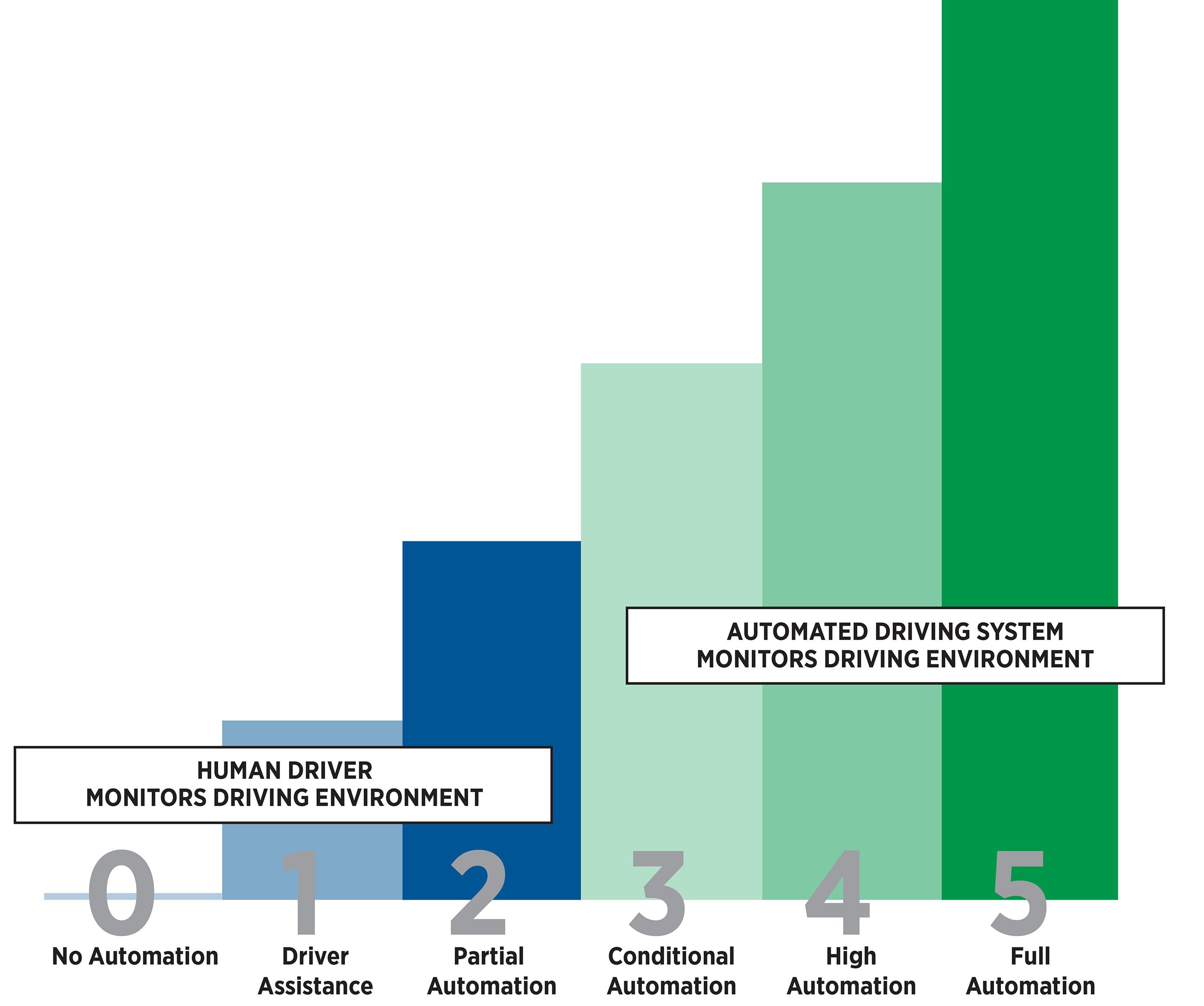
The DoT guidance document, "Federal Automated Vehicles Policy," states that manufacturers are responsible "to determine their system’s AV [automated vehicle] level in conformity with SAE International’s published definitions." This applies to both test and production vehicles. NHTSA will review the manufacturers’ automation level designations and advise them if the agency disagrees with the level assigned by the manufacturer.
The official guidance marks a break from the NHTSA's 2013 language which was sometimes confused as a competing or even joint standard by some in the industry and media. SAE J3016 provides common taxonomy and definitions that underpin the "SAE Levels zero through 6" description that is used increasingly by industry and regulatory experts. The standard was published January 2014.
Formal acknowledgement of SAE J3016 by the DoT "creates a clearer and in some ways simpler framework for an ongoing conversation between industry stakeholders, advocates, and state and local governments that can help direct ongoing regulatory efforts as the industry continues to progress," noted Jeremy Carlson, principal automotive analyst at IHS Markit, in a statement. "This action is therefore a positive step in enabling progress in the development and deployment of autonomous vehicles."
The 116-page guidance document "reflects a shift towards a more proactive regulatory approach," Carlson observes, encompassing vehicle functionality as well as cybersecurity, privacy, human-machine interface, consumer education and other relevant topics in the development process. He said that such a wide approach to regulatory assessment "reflects the rapid pace of innovation and complexity in the fast-moving mobility and transportation industries."
Carlson and the IHS analyst group expect rapid growth in automated vehicles to begin in 2025. His recent report forecasts more than 18 million autonomous vehicles will be sold in the U.S. through 2035, "broadly aligning to SAE Levels 4 and 5" while creating new opportunities for automakers and personal-mobility options for consumers.
DoT will request that vehicle OEMs voluntarily provide reports regarding how the guidance has been followed. This reporting process may be refined and made mandatory through future rulemaking. It is expected that this would require entities to submit a Safety Assessment to NHTSA’s Office of the Chief Counsel for each system, outlining how they are meeting the guidance at the time their product is to be ready for testing or deployment on public roads.
The safety assessment will be used to assist NHTSA and the public in evaluating how safety is being addressed by the industry as it develops and tests automated/autonomous driving systems.
Along with this initial Policy, NHTSA is issuing a Request for Comment (RFC) on the policy ( www.nhtsa.gov/AV ) or in the docket as NHTSA-2016-0090. The RFC will be open for 60 days. NHTSA will analyze the public inputs received during that period and address significant comments in its next policy revision.
More From SAE Media Group
Automotive Engineering
Regulatory Framework Emerging as Autonomy Becomes Reality
Off-Highway Engineering
Realizing Software-Defined Commercial Vehicles
Autonomous Vehicle Engineering
'Level 2+': Making Automated Driving Profitable, Mainstream
Automotive Engineering
New Best Practice Establishes Commonly Defined Terms, Conceptual Framework for ADS ODD
Autonomous Vehicle Engineering
Navigating the Language of Vehicle Autonomy
Autonomous Vehicle Engineering
Underwriters Labs Publishes First AV Safety Standard
Autonomous Vehicle Engineering
Purpose, Perceptions for Driver-Assist Tech Solidify
Automotive Engineering
AVSC Develops Best Practices for Traceable AV Safety Inspection Protocols
Autonomous Vehicle Engineering
Amending the Automated-Driving ‘Constitution’
ADAS & Autonomous Vehicle Engineering
Tesla’s FSD Recall Impacts AV Industry
Automotive Engineering
Seeking a Common Language for Vehicle Automation
Aerospace & Defense Tech Briefs
SAE International Extends Call for Abstracts, Seeks Submissions for AeroTech Conference
ADAS & Autonomous Vehicle Engineering
AV Life After Argo AI
Autonomous Vehicle Engineering
AV and ADAS Testing from out of the Box
Autonomous Vehicle Engineering
Hopeful but Closer Scrutiny for SAE Level 4 Automation
Automotive Engineering
ACM President and Michigan DOT Director Steudle Keynote Kicks off SAE ADAS Event
Automotive Engineering
Preview: SAE 2021 WCX
Automotive Engineering
Department of Transportation Asks for Public Input Regarding Relaxing AV Regulations
Automotive Engineering
Moving Swiftly to Define the Shared-Mobility Future
Autonomous Vehicle Engineering
Autonomy Is Coming to Commercial Vehicles
Automotive Engineering
SAE WCX 2022: OEM Learnings from Level 2 ADAS

Automotive Engineering
Automated Vehicles Not an 'If' but a 'When'
Automotive Engineering
New-Mobility Visionary Burns: Automated Driving ‘Getting Close’
Autonomous Vehicle Engineering
Making the Strategic Move into AV Testing
Off-Highway Engineering
Scalable Hardware-Software Interface Answers Overlooked AV Testing Need
Automotive Engineering
WCX 2019: The AV “Money Race” Is On
Automotive Engineering
Bob Lutz at SAE WCX 2018: ‘It’s All Over’ for Brands, Driving Pleasure
Off-Highway Engineering
Continental, Aurora Finalize Design of Scalable Autonomous Trucking System
Autonomous Vehicle Engineering
The Key to Autonomous Vehicle Safety Is ODD
Top Stories
NewsRF & Microwave Electronics
 Microvision Aquires Luminar, Plans Relationship Restoration, Multi-industry Push
INSIDERAerospace
 A Next Generation Helmet System for Navy Pilots
INSIDERDesign
 New Raytheon and Lockheed Martin Agreements Expand Missile Defense Production
INSIDERMaterials
 How Airbus is Using w-DED to 3D Print Larger Titanium Airplane Parts
NewsPower
 Ford Announces 48-Volt Architecture for Future Electric Truck
ArticlesAR/AI

Webcasts
Electronics & Computers
 Cooling a New Generation of Aerospace and Defense Embedded...
Automotive
 Battery Abuse Testing: Pushing to Failure
Power
 A FREE Two-Day Event Dedicated to Connected Mobility
Unmanned Systems
 Quiet, Please: NVH Improvement Opportunities in the Early Design Cycle
Automotive
 Advantages of Smart Power Distribution Unit Design for Automotive &...
Energy
 Sesame Solar's Nanogrid Tech Promises Major Gains in Drone Endurance