




Integration Can Simplify Motor Development Process
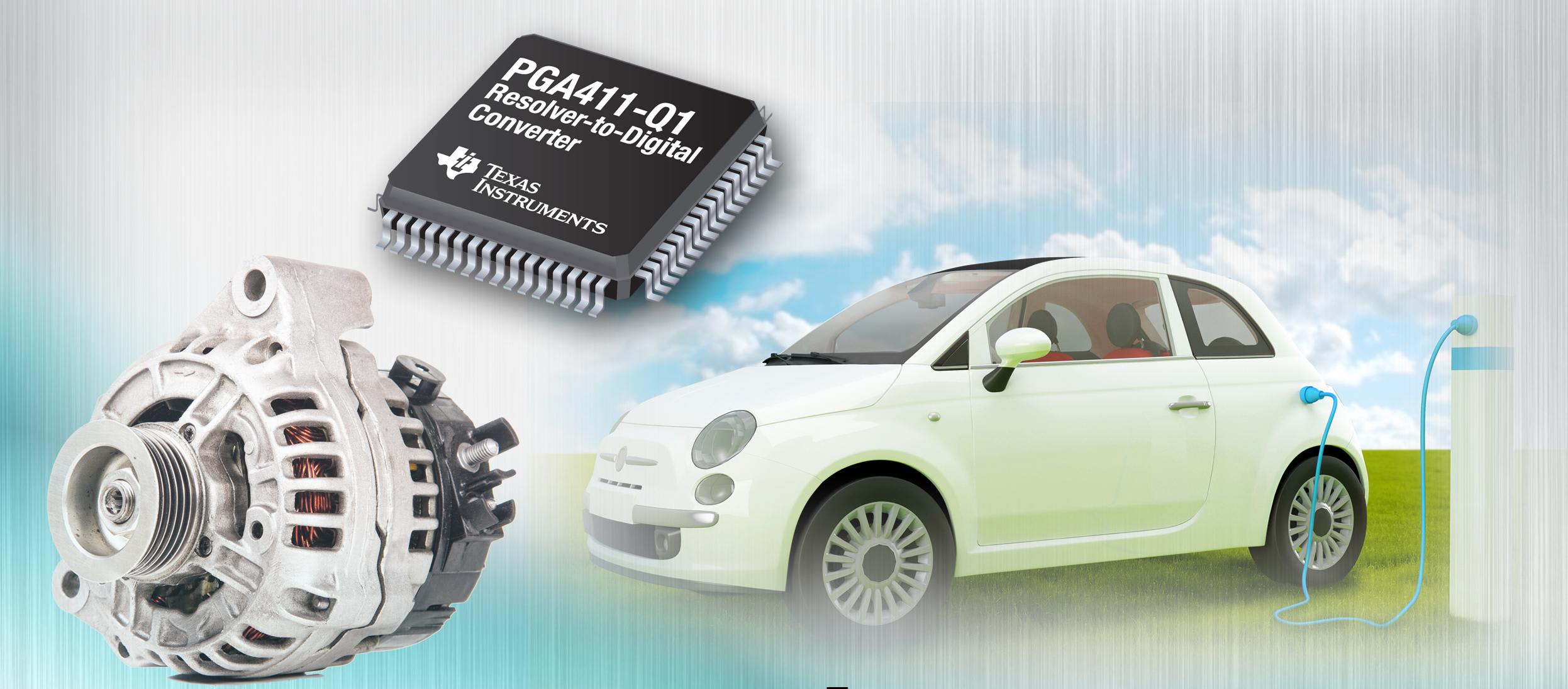
Texas Instruments aims to simplify the design process for the growing number of electric motors used in hybrids and in applications like electric power steering. TI recently unveiled a resolver sensor interface that saves space and provides accuracy that can smooth performance in stop start systems.
The device includes an integrated power supply, exciter amplifier and functional safety features. It simultaneously excites the resolver sensor coil and calculates the angle and velocity of a rotating motor shaft without the external components required by competitive solutions. It’s designed for harsh environments like powertrains.
“This reduces complications in design,” said Amanda Weise, Product Marketing Engineer, Mixed Signal Automotive, at TI. “The resolver sensor interface is not housed in the motor, it sits on a board with the microcontroller and motor driver. Six wires are all that are needed to connect it.”
The PGA411-Q1’s architecture improves system accuracy and stability for systems like hybrid electric vehicle/electric vehicle (HEV/EV) traction inverters, electric power steering and integrated start-stop generators. Integrating components can cut printed circuit board space in half by eliminating at least 10 external and passive components.
“Most solutions us an analog to digital convert, we don’t do a conversion,” Weise said. “We keep analog signals in an analog domain as much as possible. Op amps have adjustable gain; our accuracy is not impacted by the environment.”
The device improves reliability by separating the high-current and high-voltage blocks from sensitive components like the analog front end, which are highly susceptible to damage. Weise said the part’s accuracy could help suppliers reduce the jerkiness that’s plagued many stop start systems.
“For electric power steering and stop-start, you need angle and velocity information,” she said. “For stop-start, the system has to figure out where the motor stopped. To eliminate a jolt when the engine restarts, we provide instantaneous information for exactly where it stopped so the car can pick up where it left off.”
In a related move, TI also unveiled an integrated three-phase brushless DC gate driver, the DRV8305-Q1. It includes a 3.3V or 5V linear regulator, three current-sense amplifiers and a smart gate-drive architecture that allows easy optimization of MOSFET electromagnetic compliance. It eliminates up to 20 external components and operates down to 4.4 V to support start-stop functionality.
More From SAE Media Group
Automotive Engineering
48V Is Coming, and Not Just for EVs
Automotive Engineering
Schaeffler Builds an E-Motor Powerhouse
Automotive Engineering
The Push for E-Powertrain Progress
Automotive Engineering
Real-Time Processors Key to the Zonal E/E Revolution
Off-Highway Engineering
Overcoming EV Drivetrain Testing Challenges
Automotive Engineering
Tula DMD Aims for More-Efficient E-Machines
Aerospace & Defense Tech Briefs
SAE International Extends Call for Abstracts, Seeks Submissions for AeroTech Conference
Off-Highway Engineering
Addressing Electromagnetic Compatibility in the Context of Aircraft Electrification
Automotive Engineering
BorgWarner Integrated Drive Module in Testing Phase
Automotive Engineering
CES 2021: Magna Execs Warn of Impending EV Complexities
Battery & Electrification Technology
The Road to Net-Zero EV Development Labs
Sensor Technology
The Many Uses of Inductive Position Sensors in the IIoT
Automotive Engineering
Mahle Prepares for First Passenger Car E-Motor Application
Automotive Engineering
Inside GM’s Expanded Electric-Vehicle Battery Lab
Sensor Technology
Machine Condition Monitoring Keeps a Factory Running
Automotive Engineering
Magna Shows off Electric Offroad Powertrain, In-Cabin Tech
Automotive Engineering
ZF Introduces Complete E-Drive System for Passenger, Commercial Vehicles
Automotive Engineering
Airing on the Side of Innovation
Aerospace & Defense Tech Briefs
Industry Invited to Participate in AeroTech Aerospace and Defense Technical Program
Automotive Engineering
Toyota Stretches SUV Line-Up with World Debut of Grand Highlander
Automotive Engineering
Millbrook’s New California EV Testing Facility
Automotive Engineering
ACeDrive Consortium Plans More Efficient EV Powertrain
Automotive Engineering
Power over Coaxial in Automotive: A Simplified Path to Advanced Vehicle Systems
Automotive Engineering
All (Robot) Hands on Deck
Automotive Engineering
Bosch Debuts New CV-Specific Electric Motor and Inverter
Aerospace & Defense Tech Briefs
SAE International Issues, Revises Technical Reports for Aerospace Engineering
Automotive Engineering
E-Axles Speed Electrification
Automotive Engineering
Volvo XC90 Line-Up Keeps Hybrid Futures Safe
Automotive Engineering
Intertek Rethinks the EV Test Facility
Automotive Engineering
New 300-Mm Wafer Fab Is Key to Bosch’s Chip Future
Top Stories
NewsSensors/Data Acquisition
 Microvision Aquires Luminar, Plans Relationship Restoration, Multi-industry Push
INSIDERRF & Microwave Electronics
 A Next Generation Helmet System for Navy Pilots
INSIDERWeapons Systems
 New Raytheon and Lockheed Martin Agreements Expand Missile Defense Production
NewsAutomotive
 Ford Announces 48-Volt Architecture for Future Electric Truck
INSIDERAerospace
 Active Strake System Cuts Cruise Drag, Boosts Flight Efficiency
ArticlesTransportation

Webcasts
Aerospace
 Cooling a New Generation of Aerospace and Defense Embedded...
Energy
 Battery Abuse Testing: Pushing to Failure
Power
 A FREE Two-Day Event Dedicated to Connected Mobility
Automotive
 Quiet, Please: NVH Improvement Opportunities in the Early Design Cycle
Electronics & Computers
 Advantages of Smart Power Distribution Unit Design for Automotive &...
Unmanned Systems
 Sesame Solar's Nanogrid Tech Promises Major Gains in Drone Endurance