




Fungus-Inspired Improvements in Battery Performance
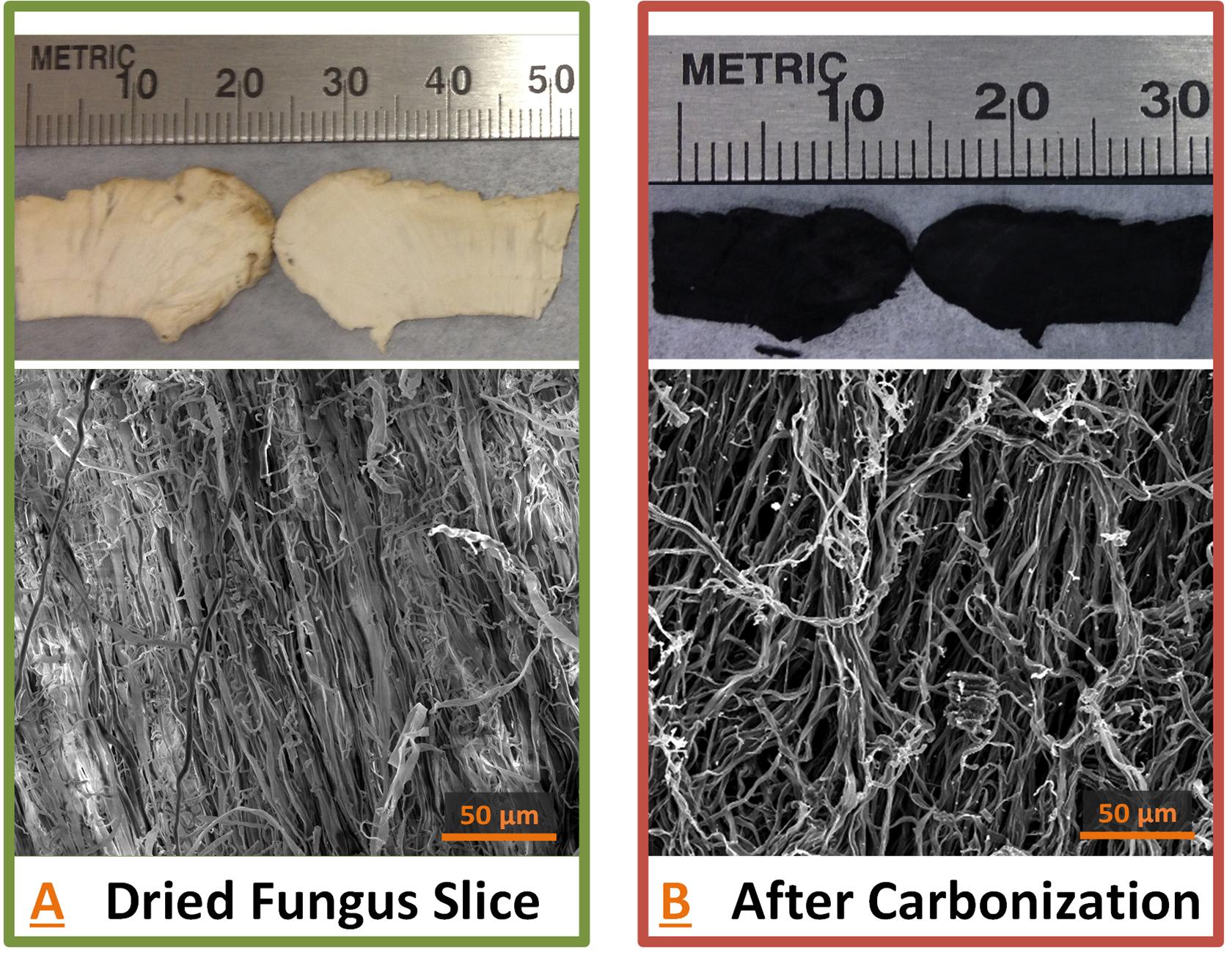
Carbon fibers derived from a sustainable source, a type of wild mushroom, and modified with nanoparticles have been shown to outperform conventional graphite electrodes for lithium-ion batteries.
Researchers at Purdue University have created electrodes from a species of wild fungus called Tyromyces fissilis.
"Current state-of-the-art lithium-ion batteries must be improved in both energy density and power output to meet the future energy storage demand in electric vehicles and grid energy-storage technologies," said Vilas Pol, an Associate Professor in the School of Chemical Engineering and the School of Materials Engineering. "So there is a dire need to develop new anode materials with superior performance."
The anodes in most of today's lithium-ion batteries are made of graphite. Lithium ions are contained in an electrolyte, and those ions are stored in the anode during recharging.
Pol and doctoral student Jialiang Tang have found that carbon fibers derived from Tyromyces fissilis and modified by attaching cobalt oxide nanoparticles outperform conventional graphite in the anodes. The hybrid design has a synergistic result, Pol said.
"Both the carbon fibers and cobalt oxide particles are electrochemically active, so your capacity number goes higher because they both participate," he said.
The hybrid anodes have a stable capacity of 530 mAh/g, which is one and a half times greater than graphite's capacity.
One approach for improving battery performance is to modify carbon fibers by attaching certain metals, alloys or metal oxides that allow for increased storage of lithium during recharging. Tang got the idea of tapping fungi for raw materials while researching alternative sources for carbon fibers.
"The methods now used to produce carbon fibers for batteries are often chemical heavy and expensive," Tang said.
He noticed a mushroom growing on a rotting wood stump in his backyard and decided to study its potential as a source for carbon fibers.
"I was curious about the structure so I cut it open and found that it has very interesting properties," he said. "It's very rubbery and yet very tough at the same time. Most interestingly, when I cut it open it has a very fibrous network structure."
Comparisons with other fungi showed the Tyromyces fissilis was especially abundant in fibers. The fibers are processed under high temperatures in a chamber containing argon gas using a procedure called pyrolysis, yielding pure carbon in the original shape of the fungus fibers.
The fibers have a disordered arrangement and intertwine like spaghetti noodles.
"They form a conductive interconnected network," Pol said.
The interconnected network brings faster electron transport, which could result in faster battery charging.
More From SAE Media Group
Aerospace & Defense Tech Briefs
Nanoparticle Networking Could Lead to Fast-Charging Batteries
Aerospace & Defense Tech Briefs
A Look Inside Lithium-Ion Batteries
Battery & Electrification Technology
Niobium: Magic Metal for Battery Anodes?
Aerospace & Defense Tech Briefs
Glassy Breakthrough for Battery Performance
Aerospace & Defense Tech Briefs
The Next Material Disruption
Battery Technology
Hybrid Membrane Doubles the Lifetime of Rechargeable Batteries

Power Electronics INSIDER
World’s Strongest Battery Paves Way for Light, Energy-Efficient Vehicles
Aerospace & Defense Tech Briefs
OXIS Energy and Bye Aerospace Partner to Develop Advanced Lithium Sulfur Battery Cells for Aviation
Tech Briefs INSIDER
Wild Mushrooms Support New Battery Anodes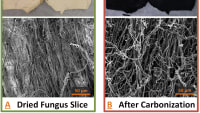
Battery & Electrification Technology
Iron Could Be Key to Less Expensive, Greener Lithium-Ion Batteries
Battery & Electrification Technology
New Priming Method for Improving Battery Lifecycle

Defense INSIDER
Batteries That “Drink” Seawater Could Power Long-Range UUVs
Tech Briefs
A Better-Performing Sodium-Ion Cathode
Power Management INSIDER
Potassium Metal Battery Emerges as a Rival to Lithium-Ion Technology
Tech Briefs
Flexible, Water-Based Lithium-Ion Batteries
Medical Design Briefs
Pomegranate Inspires Battery Design
Battery Technology
Semi-Liquid Metal Anode
Battery & Electrification Technology
Developing Safer Batteries with Solid-State Polymer Electrolytes

Tech Briefs
An EV Battery that Works in Sub-Zero Temperature
Automotive Engineering
3D Graphene Boosts New Batteries Beyond Lithium-Ion
Battery & Electrification Technology
Leading the Charge to Better Batteries
Aerospace & Defense Tech Briefs
Stanford Scientists Create a Smart Lithium-Ion Battery That Warns of Potential Fire Hazards
Aerospace & Defense Tech Briefs
Rolls-Royce and Superdielectrics Explore Supercapacitor Technology
Tech Briefs
A Battery Breakthrough, Made from Rubber

Top Stories
INSIDERManufacturing & Prototyping
 How Airbus is Using w-DED to 3D Print Larger Titanium Airplane Parts
INSIDERManned Systems
 FAA to Replace Aging Network of Ground-Based Radars
NewsTransportation
 CES 2026: Bosch is Ready to Bring AI to Your (Likely ICE-powered) Vehicle
NewsSoftware
 Accelerating Down the Road to Autonomy
EditorialDesign
 DarkSky One Wants to Make the World a Darker Place
INSIDERMaterials
 Can This Self-Healing Composite Make Airplane and Spacecraft Components Last...
Webcasts
Defense
 How Sift's Unified Observability Platform Accelerates Drone Innovation
Automotive
 E/E Architecture Redefined: Building Smarter, Safer, and Scalable...
Power
 Hydrogen Engines Are Heating Up for Heavy Duty
Electronics & Computers
 Advantages of Smart Power Distribution Unit Design for Automotive...
Unmanned Systems
 Quiet, Please: NVH Improvement Opportunities in the Early Design...
