




Racket Busters
With a quiet cab at the top of many tractor buyers’ wish lists, agricultural equipment manufacturers are pursuing every opportunity possible to shed decibels.
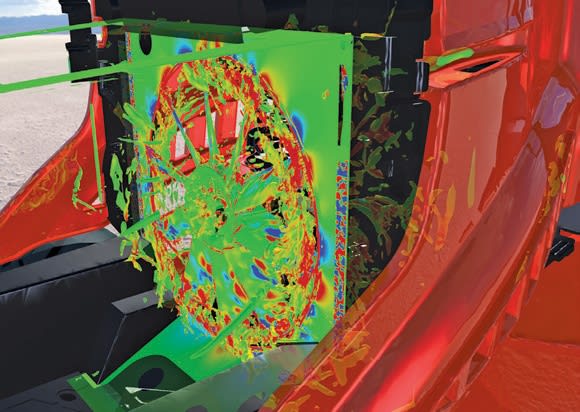
Since the days, several decades ago, when there was no acoustic trim or materials applied to agricultural tractor cabs, manufacturers have become keenly aware of the importance of a quiet cab to equipment buyers and operators and are now investing heavily in software and testing to identify and suppress sources of noise.
According to the European Agency for Safety and Health at Work, prolonged exposure to agricultural noises could result in permanent hearing loss as well as create a greater risk to workers by causing stress that can lead to poor health and leading to accidents as a result of difficult communication.

A quiet cab now ranks among the top three factors that influence buying decisions for New Holland Agriculture customers, along with adequate horsepower and good fuel economy. In its product literature, the company now prominently touts cab quietness, such as the 68-dB(A) cab of the T8 line of tractors, which it claims to be the quietest in its class.
“The primary motivation for noise reduction is customer comfort,” said Sean Dorosz, CCH/4WD Global Tractor Product Marketing Manager, New Holland Agriculture. “All customers we interview tell us they want a quiet, comfortable cab that is easy to be in for 12-16 hours per day every day. They don’t want to be so tired and worn out at the end of a day that they can’t get anything else accomplished but sleeping.”
Exposure to noise in a cab environment can have a similar effect as jetlag on equipment operators, causing fatigue and a lack of awareness.
“The white noise in the background doesn’t affect you during the trip, but at the end, you feel so tired and dragged out,” Dorosz said. “Customers do want to hear certain noises to make sure the engine is working correctly, they can hear alerts, and hear the implement sounds, or be able to hear the ‘wrong’ noises. If the normal operating noises are too loud, they can’t hear what they need or want to listen for.”
Equipment manufacturers are routinely looking to other industries to develop better acoustic quality.
“We are pulling ideas and technology from our alliance with Fiat and Chrysler to gain more ways to analyze and measure noises for Ag equipment,” Dorosz said.
“We leverage the methodology we have built up for passenger cars and other applications in the past to the tractor business,” said Dr. Thomas Hackl, Vice President Off-Road Driveline, AVL. “For example, the acoustic chassis dyno, the engine NVH test bench, the methodology for simulating all the NVH issues have been developed for the passenger car but have been fine-tuned many years ago for the tractor application as well.”

Dual threats
FFT (Free Field Technologies), an MSC Software company, has worked with virtually every car manufacturer in the world as well as Airbus and Boeing to help design products for better acoustic quality. It now has a number of off-highway customers, including New Holland Agriculture and John Deere.
Actran, FFT’s CAE software, helps the engineer understand how noise is being created and what could be the benefit of different types of solutions. While much knowledge can be shared across industries, the off-highway agricultural space has its own unique set of challenges.
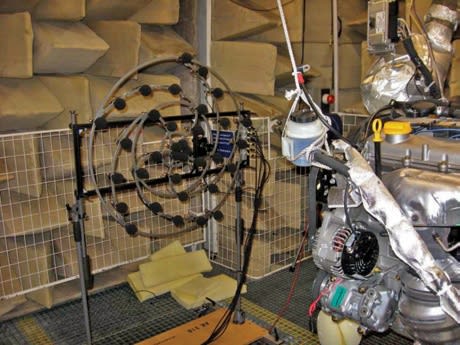
“In that kind of equipment, you have two separate problems,” said Jean-Louis Migeot, CEO, FFT, and an engineering acoustics professor at the University of Brussels. “One is to reduce the amount of noise that is being generated toward the outside, creating noise pollution for people living or working in the neighborhood. You also have to worry about the comfort of the driver or the person working on the equipment.

“On the exterior, we have a set of standards that apply. Many customers are working with us to be sure that their product is going to meet requirements; the main requirement being pass-by noise. If they do not pass the test, if the noise level is too high, their equipment cannot be sold in the country or region where the standard applies. Passenger comfort is also important, but there are no standards. The main motivation for investigating this is that the person who is going to use the equipment is most likely the one that is deciding to buy it and will spend hours in the cab and therefore needs to find the cab comfortable.”
According to AVL’s Hackl, the challenge — at least in Europe — no longer lies in meeting the noise standards as much as meeting expectations for customer comfort.
“There are legal requirements, but these legal requirements are very easy to achieve, and the main driver at the moment is the market requirement,” he said in an interview with Off-Highway Engineering. “People, especially in Europe, tend to buy more quiet tractors. So it’s a selling issue. At the moment, the legal limit is around 85 dB(A), and the tractors are now in the range of 70-74, so the tractor manufacturers are way below the legal requirements due to the fact that people buy more quiet tractors.”
Hackl did acknowledge that the noise standards may be a challenge for tractors coming from India that want to enter the European market. According to researchers from Tractors & Farm Equipment Ltd., the top exporter of tractors from India, the current domestic noise norms in India are around 94 dB(A).
Naming sources
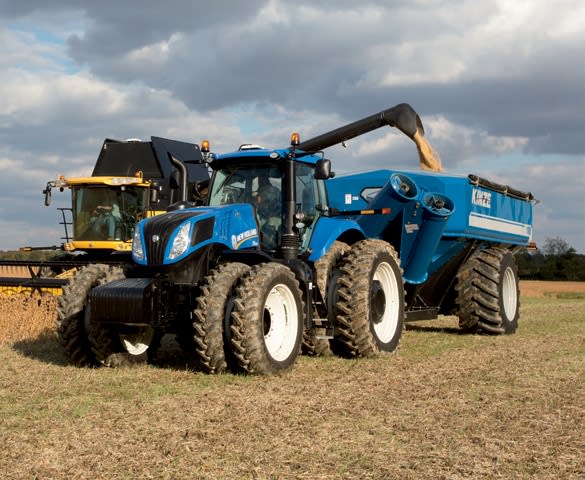
The three greatest sources of noise, according to New Holland’s Dorosz, are the engine, transmission, and hydraulics, with machine size also greatly impacting the noise level.
“When you start putting 600-plus hp through a six-cylinder engine and up to 113 gal/min of hydraulic oil to a rear implement, it causes a lot of noise,” he said.
Operating speed is also a major contributor to noise in agricultural tractors, in fact making an even greater impact on noise than in passenger cars.
“We don’t have the wind-noise issue, but we have the operating noises of a normal tractor condition to deal with,” Dorosz said. “Imagine a 600-plus hp tractor weighing 60,000 lb traveling at 25 mph down the road. This could develop a lot of noise in a transmission that is three-quarters the size of a phone booth. Then that same unit is in the field pulling a 100-ft wide planting unit using 80% of its available horsepower and pushing out 50 gal/ min of hydraulic oil at 2000-plus psi pressure. Those things will generate a lot of noise that is all coming from 2 ft under the operator’s seat cushion. Those are normal operating conditions, and we need to keep the cab quiet so the operator can do the job for 12-plus hours per day.”

As engines have been redesigned to meet new emissions requirements, they must also meet requirements in terms of thermal management and cooling. These two disciplines also have a direct impact on noise levels.
“As the equipment is moving through the various stages of regulatory requirements, what we’re finding is that the companies are having to rotate the cooling fan faster for it to meet increased cooling requirements on the engine. Therefore the fan is becoming a dominant noise source,” said Kevin Horrigan, Senior Technical Director of Heavy Vehicles North America, Exa Corp. “What we’re able to do with our software is to predict the component of fan noise coming from the cooling fan or any other flow-induced noise sources.”
By conducting virtual simulations to quantify the cooling performance prior to design parameters being finalized, key results such as radiator cooling temperature and charge air temperature can be predicted to make sure overall requirements are being met.
“At the same time, we can also set up virtual microphones and predict the noise levels,” Horrigan said. “Often what we see is that those two aspects need to be considered simultaneously because there are trade-offs where it’s easy to increase cooling performance by rotating the fan faster, but that leads to an increase in noise.”
A study commissioned by the Health and Safety Executive (U.K.) found that it is possible to reduce the daily noise exposure for agricultural equipment operators 3 to 16 dB(A) if measures are taken to control noise at the source.
Tools and engineering services such as those provided by Exa, FFT, and AVL can go a long way toward achieving such drastic noise improvement.
“What we offer is NVH improvement by means of measurement of the existing situation and then doing optimization with simulation and testing, and the normal project is finalized with an improved version that we build up, prototype, and then verify the improvement,” Hackl said. “The improvement is typically within 5-7 dB(A), which is quite significant.”
Much progress has been made in the effort to reduce agricultural tractor noise, and much more work lies ahead, according to FFT’s Migeot.
“The noise issue is in itself going to increase and become more of a priority because that will be a key way of differentiating one’s product vs. the competition,” he said. “The focus on sound and vibration will become stronger, as has been the case in aircraft and cars over the past 30 years. It’s no longer acceptable to have very noisy cabs.”
More From SAE Media Group
Aerospace & Defense Tech Briefs
SAE International Extends Call for Abstracts, Seeks Submissions for AeroTech Conference
Sensor Technology
Energy Harvesting Can Enable 1 Trillion Battery-Free Sensors in the IoT
Aerospace & Defense Tech Briefs
Connected Aircraft Technologies Benefit Manufacturers, Airlines, and Travelers
Battery Technology
Mapping Performance Variations to See How Lithium-Metal Batteries Fail
Battery Technology
An Immersive Solution for Thermally Safer EV Batteries
Battery Technology
Modeling & Simulation for Battery Development
Battery Technology
Venting for EV Battery Packs
Automotive Engineering
Engineering a ‘Beast’ of an Electric SUV
Battery Technology
Hybrid Membrane Doubles the Lifetime of Rechargeable Batteries
Aerospace & Defense Tech Briefs
Industry Invited to Participate in AeroTech Aerospace and Defense Technical Program
Automotive Engineering
Wrecking Ball
Tech Briefs
Facility Focus: Georgia Tech Research Institute
Automotive Engineering
Wireless Road Charging for EVs to Debut in 2023
Battery & Electrification Technology
Manufacturing Advances in Solid-State Batteries
Off-Highway Engineering
Addressing Electromagnetic Compatibility in the Context of Aircraft Electrification

Battery Technology
Greater Precision for EV Battery Leak Testing
Battery Technology
Advancing Battery Technology: THE 2021 BATTERY SHOW Preview
Battery Technology
New Materials Move Li-Ion Batteries Toward the Solid-State Endgame

Battery Technology
Cobalt-Free Cathodes for Lithium-Ion Batteries
Battery Technology
Using Multiphysics to Predict and Prevent EV Battery Fire
Automotive Engineering
Virtual and Physical Testing of Third-Generation High Strength Steel

Automotive Engineering
Lightweight Steel on a (Cold) Roll
Battery & Electrification Technology
Mistakes to Avoid When Integrating a Battery Test System
Motion Design
Avoiding Electrical Damage with Conductive Lubrication

Top Stories
INSIDERManufacturing & Prototyping
 How Airbus is Using w-DED to 3D Print Larger Titanium Airplane Parts
INSIDERManned Systems
 FAA to Replace Aging Network of Ground-Based Radars
NewsTransportation
 CES 2026: Bosch is Ready to Bring AI to Your (Likely ICE-powered) Vehicle
NewsSoftware
 Accelerating Down the Road to Autonomy
EditorialDesign
 DarkSky One Wants to Make the World a Darker Place
INSIDERMaterials
 Can This Self-Healing Composite Make Airplane and Spacecraft Components Last...
Webcasts
Defense
 How Sift's Unified Observability Platform Accelerates Drone Innovation
Automotive
 E/E Architecture Redefined: Building Smarter, Safer, and Scalable...
Power
 Hydrogen Engines Are Heating Up for Heavy Duty
Electronics & Computers
 Advantages of Smart Power Distribution Unit Design for Automotive...
Unmanned Systems
 Quiet, Please: NVH Improvement Opportunities in the Early Design...
