




Lightweight CV Joint System
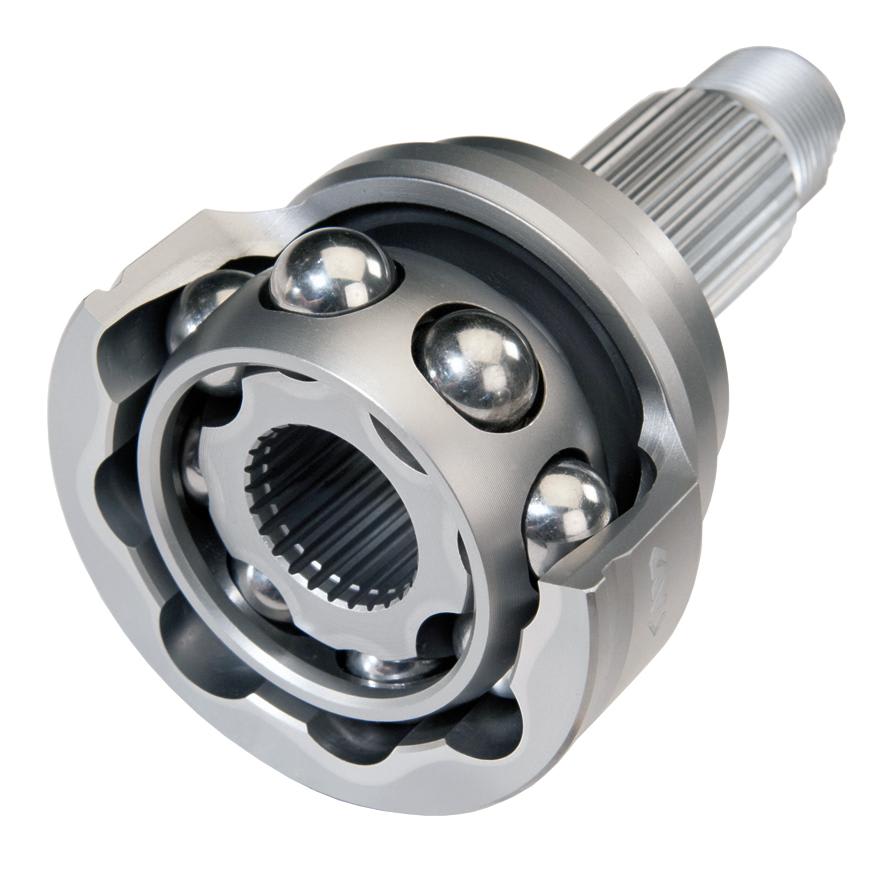
GKN Driveline has developed a family of lightweight constant velocity (CV) joint systems that enables rear-wheel drive platforms to save more than 4 kg. The VL3 CV joint increases torque capacity by up to 27% with no increase in packaging size. Available in four sizes, the VL3-33ISM variant has a torque capacity of 3300 N∙m in a package previously capable of delivering only 2600 N∙m. The system can also maintain performance while reducing package size by approximately 7%. With a plunging distance of 18 mm, the VL3 is the best choice for a rear constant velocity sideshaft for medium working angles with low axial forces and best in class minimum backlash. It uses a Monobloc tubular shaft and face spline connection to the wheel hub to achieve significant packaging and weight advantages as well as noise, vibration, and harshness (NVH) behavior benefits. The VL3 Monobloc joint uses a track geometry with four pairs of opposed ball tracks instead of three, which enables it to transmit more torque to wheels within the same packaging space. The VL3 joint has been selected by BMW to launch on its 7 Series. For more information, visit here .
More From SAE Media Group
Automotive Engineering
GKN Turns the CV Joint Inside-Out
Automotive Engineering
Hyundai’s Uni Wheel Creates Space for EV Powertrains
Automotive Engineering
Multimatic ‘Legs’ for Ferrari’s New Thoroughbred
Automotive Engineering
Power Transfer Coupling
Off-Highway Engineering
EV Startup Prepares to Enter Commercial Market with Novel EAxle
Automotive Engineering
Brembo’s New Octyma Brakes Provide 8 Reasons for Better Deceleration
Automotive Engineering
Q&A: What It Takes to Add an E-Axle
Automotive Engineering
Raptor 4-Door-Only for 2021; R Version Coming Next Year
Motion Control & Automation Technology
Clutches
Automotive Engineering
Hyundai Puts the N in Performance
Automotive Engineering
Hub-Motoring in Lordstown’s Novel Endurance
Automotive Engineering
M XDrive: BMW’s Power + Grip Solution
Automotive Engineering
Schaeffler Heads Back to CES with New Acquisition, Capabilities
Automotive Engineering
GKN Spreads Premium Propshaft Tech to Quiet Pickup Cabins
Automotive Engineering
Porsche Wet Mode Integrates Tech Under One Umbrella
Automotive Engineering
What We’re Driving: Mercedes-AMG E 53 4Matic+
Off-Highway Engineering
New Generation Orbital X Motors
Off-Highway Engineering
No Fear of Loading: Driving the 2025 Ram Heavy Duty
Automotive Engineering
A Consumer’s View: Perry Parts 3D-Printed Bump Stops

Automotive Engineering
Bollinger Motors Reveals Second-Gen Class-3 EV Prototypes
Motion Design INSIDER
Self-Contained Wheel Units Cut Vehicle Costs
Automotive Engineering
Lithium-Free Corvette Z06: More Sting for the 2023 Stingray
Automotive Engineering
Gearing EVs for Greater Efficiency
Automotive Engineering
2020 Toyota Supra Launch Edition

Automotive Engineering
NVH-Fighting Plastic EV Motor Mount Wins Lightweighting Award
Medical Design Briefs
Product Focus: Mechanical Components
Motion Design
Making Automotive Assembly Lines Safer
Tech Briefs
Offset Compound Gear Inline Two-Speed Drive
Top Stories
INSIDERManufacturing & Prototyping
 How Airbus is Using w-DED to 3D Print Larger Titanium Airplane Parts
INSIDERManned Systems
 FAA to Replace Aging Network of Ground-Based Radars
NewsTransportation
 CES 2026: Bosch is Ready to Bring AI to Your (Likely ICE-powered) Vehicle
NewsSoftware
 Accelerating Down the Road to Autonomy
EditorialDesign
 DarkSky One Wants to Make the World a Darker Place
INSIDERMaterials
 Can This Self-Healing Composite Make Airplane and Spacecraft Components Last...
Webcasts
Defense
 How Sift's Unified Observability Platform Accelerates Drone Innovation
Automotive
 E/E Architecture Redefined: Building Smarter, Safer, and Scalable...
Power
 Hydrogen Engines Are Heating Up for Heavy Duty
Electronics & Computers
 Advantages of Smart Power Distribution Unit Design for Automotive...
Unmanned Systems
 Quiet, Please: NVH Improvement Opportunities in the Early Design...
