




Understanding the Importance of Electrostatic Discharge Standards

Within the past decade, the safety and reliability standards for automotive electronics have changed significantly as new technologies have evolved. Technologies that used to be sold as options, including stability control and antilock brakes, are now offered as standard features in most vehicles. Today’s innovative automotive electronics enable lane-departure warning, vehicle communications, and night vision.
This shift in design and manufacturing mandates that designers understand the demands of the automotive certification standard that extends beyond the protection requirements for consumer electronics. However, designing for the automotive standard involves several technology challenges.

As automotive integrated circuits continue getting smaller and faster, they become more susceptible to damage from electrostatic discharge (ESD). In addition, the automotive environment is marked by harsh electrical transients, which are simulated during automotive certification testing.
This article makes practical application of automotive standards, circuits, and solutions to help circuit designers create robust, reliable designs. First, it highlights the testing requirements of two test standards and discusses the most common types of automotive circuits requiring protection. Then, it identifies advanced circuit protection technologies for several automotive applications that should be implemented early in the design phase to ensure safety and reliability.
Measuring up to automotive test standards
Circuit designers must consider the requirements of the ISO 10605 and AEC-Q101 test standards for their advanced vehicle electronics to be qualified for the automotive market.
ISO 10605: This international standard specifies ESD test methods for evaluating electronic modules developed for use in road vehicles. The modules must be able to manage electrical disturbances caused by assembly, maintenance/repair, and operation. For ISO 10605 compliance, every circuit and module must be pretested before being added to the vehicle. Once the assembled car is ready, it must also be tested to ensure safety and reliability.
AEC-Q101: While ISO 10605 focuses on electrical hazards, AEC-Q101 is an environmental specification. It describes a series of qualification tests that ensure the long-term reliability of semiconductor-based components in the automobile. ESD protection devices such as transient voltage suppression (TVS) diodes and TVS diode arrays must increasingly conform to the AEC-Q101 standard for a vehicle manufacturer to add them to a vehicle. AEC-Q101-compliant components must be able to handle thermal shock and cycling, extreme temperatures, and high humidity.
Identifying automotive circuits requiring protection
All circuits and components are susceptible to damage from electrical transients—regardless of their location within the vehicle. The following list identifies the four most common circuits requiring protection:
Legacy two-wire communication buses:
- Controller Area Network (CAN): This standard allows microcontrollers and devices to communicate within a vehicle without the use of a host computer. CAN systems handle a variety of functions—from power steering to the critical drive-train communications between the engine computer and the transmission.
- Local Interconnect Network (LIN): This serial network protocol is used for communication between components in the vehicle. LIN buses manage simple electromechanical functions such as moving the power seats and toggling the cruise control.
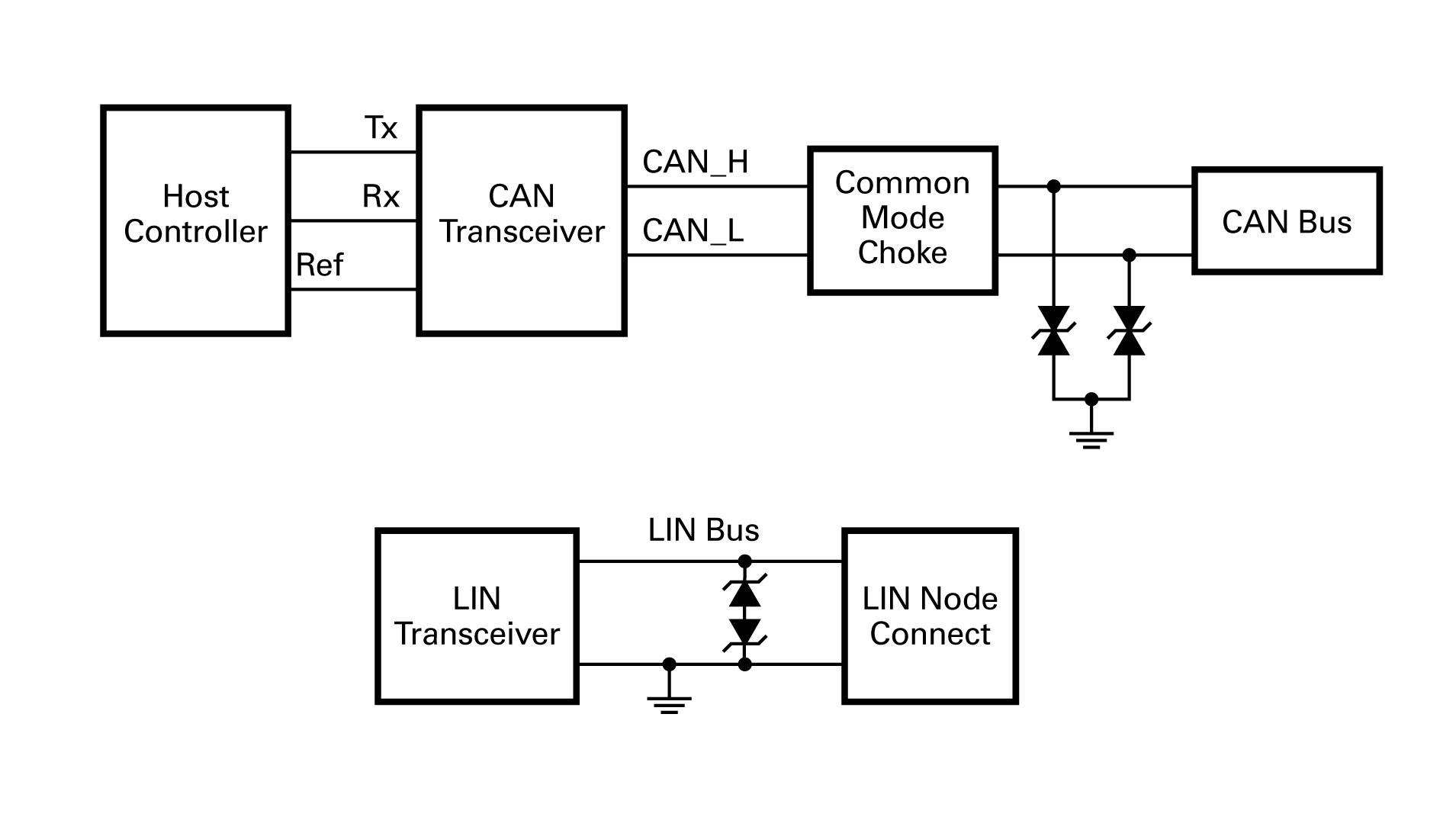
CAN/LIN buses have a high chance of transient surge exposure, which can cause unprotected CAN/LIN transceivers to fail. Figure 2 illustrates practical strategies for CAN and LIN bus protection.
- High-speed digital buses: USB/HDMI ports support consumer applications within the vehicle. For instance, the dashboard may contain a USB port for passengers to charge their phone/tablet or play music. HDMI ports are also being used for backup and forward-looking cameras in vehicles. With faster throughput and greater chip sensitivity, these ports require outstanding signal integrity and system reliability. USB/HDMI ports could be damaged by relatively small ESD events and short circuits within the automobile.
- Wi-Fi communication/SIM socket: This technology allows the vehicle to offer cellular 3G or LTE communication to the passengers. The SIM module is the intermediary part of the circuit that will convert LTE to Wi-Fi, allowing users to connect to phones, tablets, and laptops. The SIM socket requires ESD protection because it will be subjected to human interactions when the module is installed or replaced in the vehicle.
- High-frequency communication/RF (radio frequency): This technology is supported by short-range RF circuits that enable vehicle-to-vehicle or vehicle-to-road communications. The network allows cars to see each other and communicate from vehicle to vehicle, which may help prevent collisions and enable smart traffic systems. The front ends of the RF amplifiers tend to be very sensitive to ESD. Unbiased RF signals will generate positive and negative polarity voltages on the antenna circuit.
Matching circuit protection solutions to automotive applications
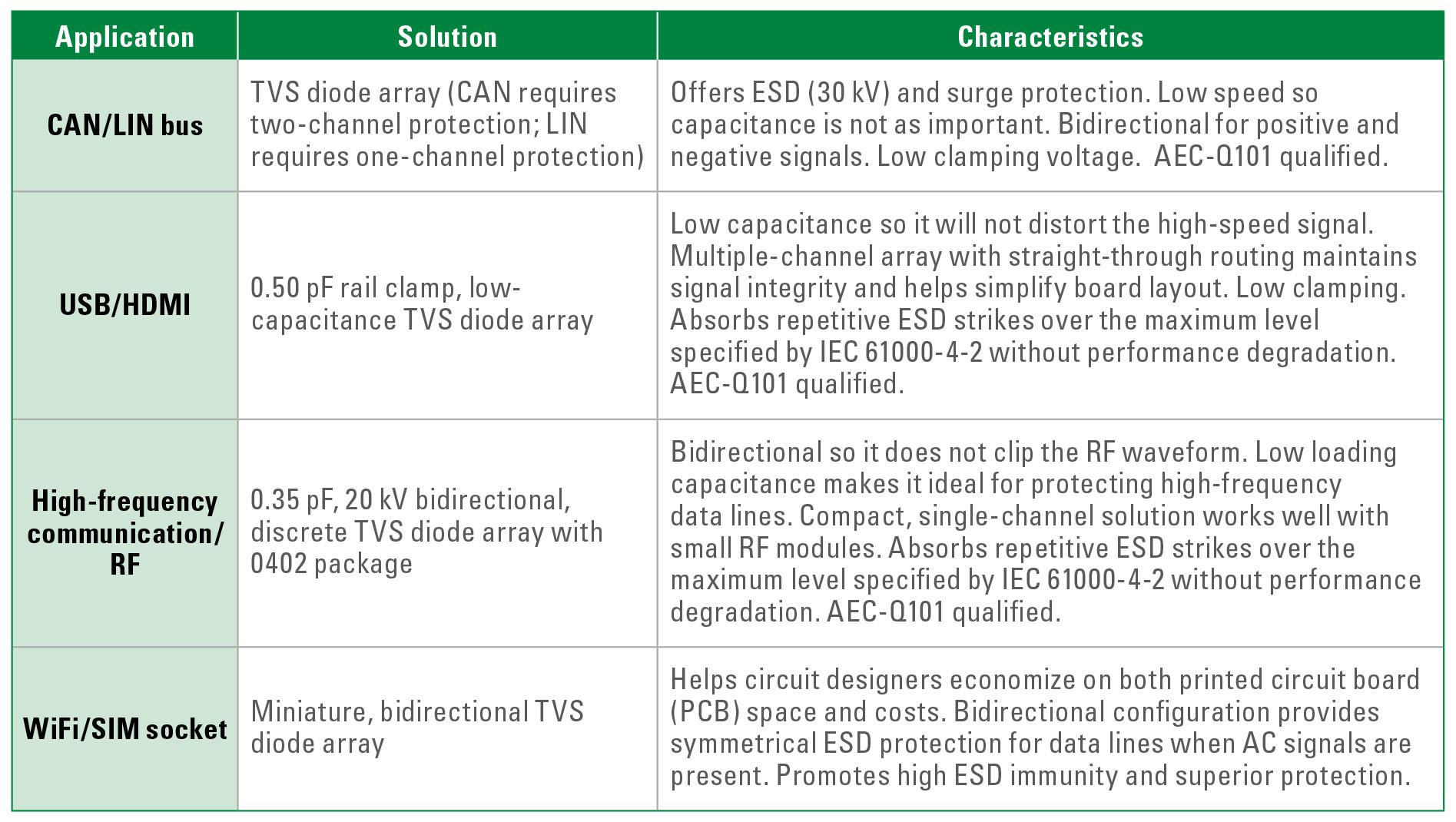
Automotive circuit designers may struggle to find high-quality circuit protection solutions since the number of companies that are capable of developing products that meet the AEC-Q101 standard is limited. When selecting a manufacturer, it is vital to verify the company’s certifications to ensure that its products meet all applicable industry standards. The company should also follow best practices in product design and utilize high-quality manufacturing processes. Table 1 identifies several circuit protection solutions that should be implemented early in the design phase:
Conclusion
Designing robust automotive electronics requires advance planning for the management of environmental and electrical hazards. Successful design starts with understanding the requirements of the ISO 10605 and AEC-Q101 test standards. Adequate protection is required at each layer of electronics since individual modules as well as the completed car will be fully tested for reliability.
The circuit designer should also consider the electrical vulnerabilities of the automotive circuits requiring protection, especially those involving innovative communications and networking. With an understanding of automotive test standards and circuits, the designer can choose the best circuit protection solution for his or her application.
This article was written for Automotive Engineering by James Colby of Littelfuse, Inc.
More From SAE Media Group
Off-Highway Engineering
Filtering out Common Mode Noise with Monolithic EMI Filters
Automotive Engineering
Q&A: Print Your Next Wiring Harness
Automotive Engineering
‘Zonal’ for the Win
Off-Highway Engineering
Addressing Electromagnetic Compatibility in the Context of Aircraft Electrification
Aerospace & Defense Tech Briefs
How SpaceVPX is Influencing the Design of Next Generation Spacecraft Avionics
Aerospace Manufacturing and Machining INSIDER
Army Launches CMOSS Prototyping Competition for Computer Chassis and Cards
Automotive Engineering
Bidirectional ESD Protection Diodes
Aerospace & Defense Tech Briefs
Heterogeneous Integration and SiPs Benefit SWaP-C Reduction
Automotive Engineering
Signal Conditioning, Filter and Instrumentation Amplifier
Off-Highway Engineering
Synchronous Step-Down Controller
Automotive Engineering
LIN Family for In-Vehicle Networking
Automotive Engineering
Dual-Band Front-End Module
Automotive Engineering
Electronic Feature Additions Challenge Carmakers to Control Costs
Aerospace & Defense Tech Briefs
VPT Rad-Hard Point of Load Converters Designed for Digital Processing in Space Environments
Automotive Engineering
Silicon Drives Autonomy Movement
Automotive Engineering
Trimming Wiring Harnesses Becomes Design Focus
Automotive Engineering
Maxim Chips Help Trim Space Requirements in Dashboards
Automotive Engineering
TI Predicts That Low Energy Bluetooth Will Displace Cables
Aerospace & Defense Tech Briefs
Advances in Military Avionics Technologies Create New Challenges for RF Test and Measurement
Aerospace & Defense Tech Briefs
New Products

Automotive Engineering
OTA Reflashing: The Challenges and Solutions
Automotive Engineering
Measuring Module with TEDS Support
Automotive Engineering
Motor Driver IC for Engines
Automotive Engineering
Chipmakers Gearing up for On-Board Wireless Charging
Automotive Engineering
Brushed Motor Pre-Driver IC
Automotive Engineering
Automotive Voltage Detectors
Automotive Engineering
4G LTE-Enabled Information Module
Off-Highway Engineering
Fan Driver

Top Stories
INSIDERManufacturing & Prototyping
 How Airbus is Using w-DED to 3D Print Larger Titanium Airplane Parts
INSIDERManned Systems
 FAA to Replace Aging Network of Ground-Based Radars
NewsTransportation
 CES 2026: Bosch is Ready to Bring AI to Your (Likely ICE-powered) Vehicle
NewsSoftware
 Accelerating Down the Road to Autonomy
EditorialDesign
 DarkSky One Wants to Make the World a Darker Place
INSIDERMaterials
 Can This Self-Healing Composite Make Airplane and Spacecraft Components Last...
Webcasts
Defense
 How Sift's Unified Observability Platform Accelerates Drone Innovation
Automotive
 E/E Architecture Redefined: Building Smarter, Safer, and Scalable...
Power
 Hydrogen Engines Are Heating Up for Heavy Duty
Electronics & Computers
 Advantages of Smart Power Distribution Unit Design for Automotive...
Unmanned Systems
 Quiet, Please: NVH Improvement Opportunities in the Early Design...
