




Rockwell Collins Upgrades Direction Finder with Multi-Channel Scanning
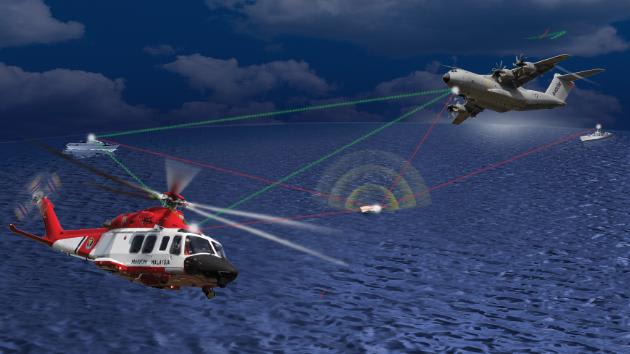
Rockwell Collins's new DF-500 direction finder builds on the search and rescue (SAR) mission of its DF-430 predecessor. The DF-430 had been in production for over 10 years, with more than 2000 units serving government and military SAR organizations globally.
The DF-500 system pinpoints distress signals with what Rockwell describes as "unmatched accuracy and reliability." The unit enables aircraft to receive and immediately locate activated 406 MHz Emergency Position-Indicating Radio Beacon (EPIRB) signals, allowing crews to go directly to people in distress.
“When it comes to airborne SAR missions, saving time is often the difference between a rescue and a recovery,” said Troy Brunk, Vice President and General Manager, Airborne Solutions for Rockwell Collins.
No calibration is required for the DF-500 and it is fully backwards compatible with the DF-430. The system’s all solid-state antenna is designed to easily drop into mounting provisions for the widely used DF-301E direction finding antenna system. It has stand-alone or integrated line replaceable units for universal interface ability, and the flush mounted antenna that doesn't affect the aircraft flight envelope.
Software defined radio technology developed for the DF-500 enables higher sensitivity, immunity to interferences, and stability of bearing indications. New features include multi-channel scanning and real-time monitoring, as well as fast scanning and interoperability with maritime digital selective calling (DSC) and automatic identification system (AIS) distress protocols. Its multi-channel architecture enables key frequencies to be monitored simultaneously allowing rapid detection of emergency beacons and distress or safety calls over V/UHF radios.
The DF-500 provides full compatibility with all existing and all future identified frequencies for the International COSPAS-SARSAT Program, a satellite-based SAR distress alert detection and information distribution system, and can be upgraded to new waveforms.
It can provide the bearing to a COSPAS-SARSAT as well as its beacon’s latitude and longitude, along with its unique identifier, at ranges up to 116 nmi. Once the signal is received, the system provides the operator with a bearing to rally the beacon, and beacon GPS coordinates, if available, to be entered into the flight management system and fly directly to the beacon’s location.
A civil version, DF-500C, is also available and does not require export license.
More From SAE Media Group
Aerospace & Defense Tech Briefs
Persistent Systems Auto-Tracking Antenna Adds Aircraft to Network, Enhances Data Sharing
Aerospace & Defense Tech Briefs
PAE ISR Engineers Boost Resolute Eagle UAS Networking, Endurance, Payload Capacity with Persistent Systems MPU5
Aerospace Manufacturing and Machining INSIDER
Army Launches CMOSS Prototyping Competition for Computer Chassis and Cards
Aerospace & Defense Tech Briefs
Optoelectronic Analog Signal Transmission Takes Center Stage Amidst Aerospace and Defense Innovation


Aerospace & Defense Tech Briefs
Northrop Grumman Chosen to Develop AESA Technology for DARPA
Tech Briefs
Test Strategies to Track Hypersonic Threats
Aerospace & Defense Tech Briefs
Heterogeneous Integration and SiPs Benefit SWaP-C Reduction
Aerospace & Defense Tech Briefs
Spectrum Processing Subsystems
Aerospace & Defense Tech Briefs
Advances in Military Avionics Technologies Create New Challenges for RF Test and Measurement
Aerospace & Defense Tech Briefs
Mettis Aerospace to Serve as Testbed for World’s First Wi-Fi 6-Enabled Smart Factory Technologies
Aerospace INSIDER
Voltage Controlled Oscillator
Aerospace & Defense Tech Briefs
Martin UAV VTOL Unmanned Aircraft Taps Persistent Systems Wave Relay Data Link Technology
Aerospace INSIDER
Low-Loss RF Coax Cable Assemblies
Aerospace & Defense Tech Briefs
Rydberg Technologies Shows Potential of Long-Range RF with Quantum Sensor at NetModX23
Off-Highway Engineering
RFID Electronic Immobilizer
Automotive Engineering
Dual-Band Front-End Module
Aerospace & Defense Tech Briefs
Raytheon to Upgrade B-52 with AESA Radars
Defense INSIDER
MAPS GEN II: Navigation System Upgrades for Army Vehicles
Aerospace & Defense Tech Briefs
Anti-Drone Jammer
Aerospace & Defense Tech Briefs
90° Hybrid Coupled Power Amplifier – Pros and Cons
Aerospace & Defense Tech Briefs
Revolutionizing Electronic Warfare: Unleashing the Power of High-Performance Software-Defined Radios
Aerospace & Defense Tech Briefs
Bringing RF into the Embedded World: It's Time
Aerospace & Defense Tech Briefs
Five-Satellite MUOS Constellation to Deliver Secure, Next-Gen SATCOM on Battlefield
Aerospace & Defense Tech Briefs
AeroVironment Releases New Puma 3

Tech Briefs
Hyper-Distributed RFID Antenna (HYDRA) System

Aerospace & Defense Tech Briefs
Airbus D&S Designs New RF Filter for 3D Printing
Top Stories
INSIDERManufacturing & Prototyping
 How Airbus is Using w-DED to 3D Print Larger Titanium Airplane Parts
INSIDERManned Systems
 FAA to Replace Aging Network of Ground-Based Radars
NewsTransportation
 CES 2026: Bosch is Ready to Bring AI to Your (Likely ICE-powered) Vehicle
NewsSoftware
 Accelerating Down the Road to Autonomy
EditorialDesign
 DarkSky One Wants to Make the World a Darker Place
INSIDERMaterials
 Can This Self-Healing Composite Make Airplane and Spacecraft Components Last...
Webcasts
Defense
 How Sift's Unified Observability Platform Accelerates Drone Innovation
Automotive
 E/E Architecture Redefined: Building Smarter, Safer, and Scalable...
Power
 Hydrogen Engines Are Heating Up for Heavy Duty
Electronics & Computers
 Advantages of Smart Power Distribution Unit Design for Automotive...
Unmanned Systems
 Quiet, Please: NVH Improvement Opportunities in the Early Design...
